Will axolotls eat my fish?
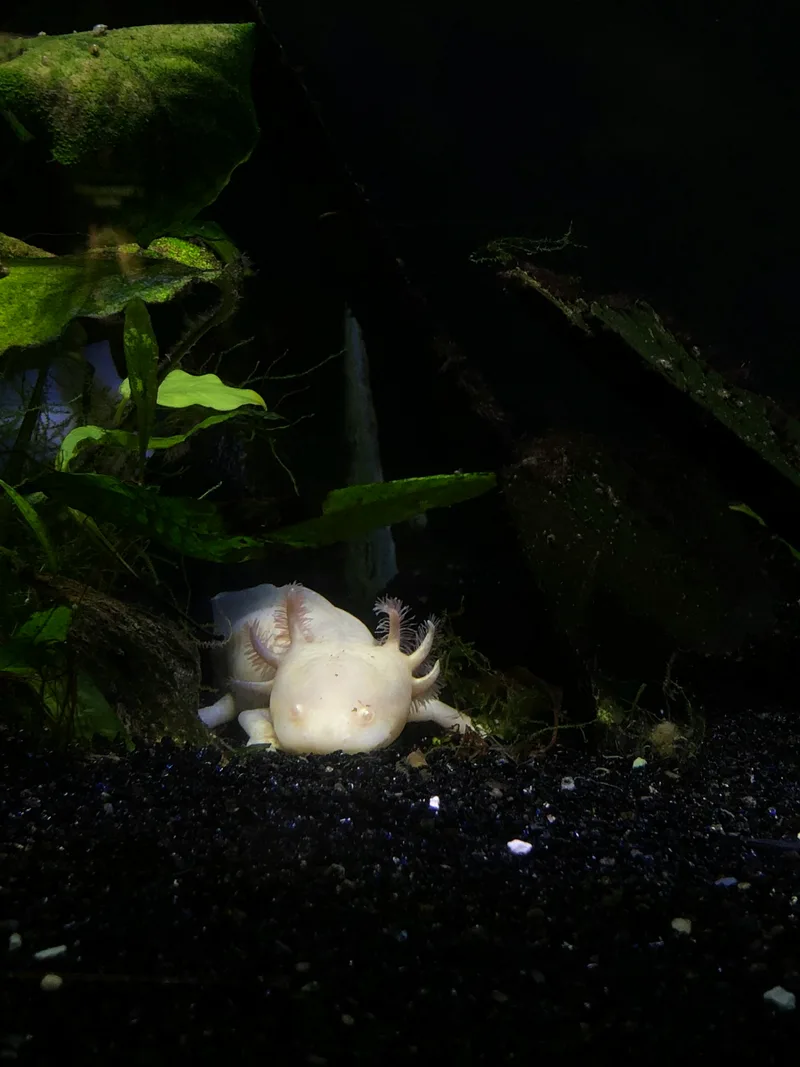
Yes. An axolotl will inhale any fish small enough to fit in its mouth, no hesitation, no decision. But the twist that catches most people off guard is that the fish too big to swallow are the dangerous ones in the other direction: they tear at the axolotl's gills, and the water warm enough to keep them alive is steadily cooking the axolotl. This is a pairing that fails three separate ways at once, which is why the only fish-and-axolotl combination that actually works isn't a tankmate at all.
Will an axolotl actually eat my fish, or just chase them?
It will eat them. Not because it's aggressive, but because of how its mouth works: an axolotl doesn't hunt and decide, it inhales. When something edible drifts past, the axolotl snaps its wide mouth open and a slug of water rushes in, carrying whatever was floating there straight down its throat. The fish doesn't get chased. It gets vacuumed.
So the question isn't really about temperament. It's about size. Any fish small enough to pass through that mouth is food, and the axolotl makes no distinction between a worm, a pellet, and a guppy. They're all just things that fit.
Did you know? An axolotl doesn't bite and chew, it feeds by suction. When it lunges, it snaps its wide mouth open so fast that the sudden drop in pressure pulls a slug of water, and whatever is floating in it, straight inside. It's the same trick that lets it swallow a whole earthworm without ever closing its jaws on it, which is exactly why anything fish-sized in front of that mouth is in trouble.
And the fish that's too big today won't stay too big. A young axolotl grows to nine inches or more, and a fish you added as a "safe" larger tankmate becomes a mouthful once the axolotl catches up to it. The size that protects a fish is a moving target, and it moves in the axolotl's favor.
What about fish too big to swallow, are those safe?
This is where it flips. The fish that can't be eaten are usually the ones that hurt the axolotl.
An axolotl breathes through those feathery external gills, the frilly red stalks behind its head. They're soft, full of blood, and they drift in the current. To a fish, they don't look like gills. They look like worms. And a fish that spots something wormlike waving in the water is going to go after it.
So the "safe" big fish nip. Plecos rasp at the gills with their suckermouths. Corydoras and other catfish, the exact fish people ask about because they seem so peaceful, pick at them too. A torn gill is more than cosmetic: it bleeds, it stresses the animal, and an open wound in tank water is an easy doorway for infection.
Bottom-dwellers are often the worst offenders, which surprises people. A catfish feels like the gentle, mind-your-own-business option, but it lives on the floor of the tank, and so does the axolotl. They share the same few square inches. The fish that spends all its time at the bottom is the fish with the most chances to take a curious nip at gills that are right there at eye level.
Why does water temperature rule out fish anyway?
There's a third reason the pairing fails, and it has nothing to do with who eats whom.
Axolotls are cool-water animals. They want water around 60 to 64°F (16 to 18°C), and they start to suffer above 72°F (22°C). Warm water stresses them, weakens their immune response, and over time it does real damage. Almost every common aquarium fish is tropical and needs the opposite: water kept above 72°F by a heater.
There's no overlap. There's no thermostat setting where the axolotl and a tropical fish are both comfortable. So even a hypothetical fish that was too small to nip and too big to be eaten would still be wrong, because one of the two animals is always living in water that's wearing it down. If you're working out the exact numbers and where the danger zones start, the safe range for an axolotl's water is worth getting exactly right before anything else.
Aren't feeder fish the one safe exception?
Here's the one place fish and axolotls genuinely overlap, and it isn't as tankmates. It's as food. Some keepers feed live fish as an occasional treat, and that can be fine, but it comes with traps worth knowing before you drop anything in the tank.
The species matters. Guppies, endlers, and platys are reasonable as a once-in-a-while snack, ideally fed as small fry. Goldfish and "rosy" minnows are not, and the reason is a chemical one: they carry thiaminase, an enzyme that breaks down vitamin B1. Feed them regularly and the axolotl goes deficient over weeks, even though each individual fish looked harmless going in.
There are other risks beyond the species list. Fish from a store can bring parasites and disease straight into your tank. Fish bones can cause a blockage in the axolotl's gut. And live fish are rich, novelty food, never something to build a diet around. If you want the complete picture of what doesn't belong anywhere near an axolotl's mouth, it helps to know which foods cause the most trouble and why.
- Reasonable as an occasional treat: guppies, endlers, and platys, ideally fed as fry
- Avoid for thiaminase: goldfish and rosy minnows (they break down the axolotl's vitamin B1)
- Avoid for aggression: mollies, which harass rather than get eaten
- Always quarantine store-bought fish before feeding, so you're not importing parasites
- Never a staple: live fish are a treat at most, a few times a month at the absolute outside
None of this is a reason to keep fish living in the tank. A feeder fish is food passing through, not a roommate.
So what can actually share a tank with an axolotl?
If not fish, then what? The honest answer is shorter than most people want: the safest tankmate for an axolotl is another axolotl of a similar size, or nothing at all. Solo is the default for a reason, and a single axolotl in a properly cool, bare-bottomed tank is a happy axolotl.
There are a few small invertebrates that sometimes work and plenty of caveats around the ones that don't. If you've accepted that fish are out and you're wondering what, if anything, can safely move in instead, that's the next thing to sort out. But notice the shape of the original question. "Will it eat my fish" quietly assumes the fish are the ones in danger. The truer picture is the reverse: the axolotl is the fragile one here. It's the animal whose gills get torn, whose water gets too warm, whose health erodes in a setup built for fish. The pairing isn't unfair to the fish so much as it's three quiet ways to harm the axolotl, and that's why the answer to whether they can share a tank is simply no.