What water is too cold for axolotls?
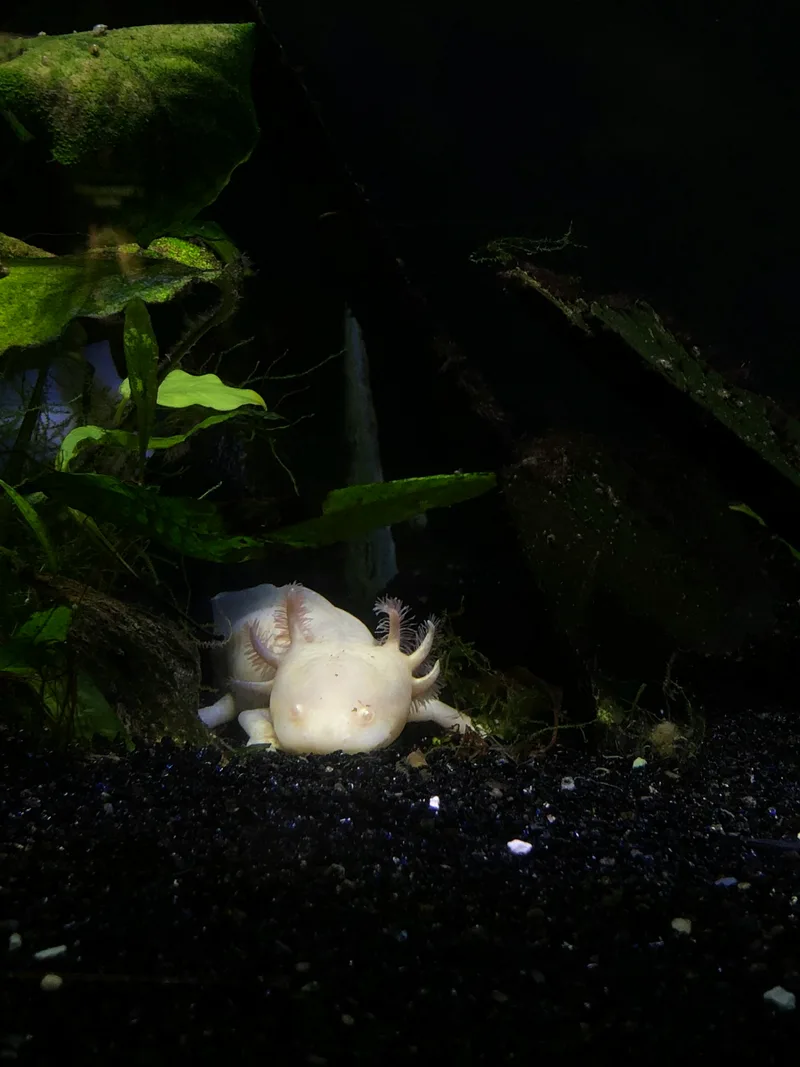
You came in worried about how cold is too cold, but cold almost never hurts an axolotl (Ambystoma mexicanum). They are comfortable from the low 60s°F down into the low 50s, stay safe down to around 40°F (4°C) where they simply slow down and eat less, and only run into real trouble near freezing. The number that actually kills them sits at the opposite end: above about 72°F (22°C), heat is what does the damage. So the question turns out to be aimed at the safe half of the thermometer, which leaves a better one to answer instead.
How Cold Is Actually Too Cold?
For a healthy axolotl, the cold end of the thermometer is mostly comfort, not danger. Here is where the lines fall.
| Temperature | What it means for the axolotl |
|---|---|
| ~60 to 64°F (16 to 18°C) | Ideal. Active, eating normally, good color |
| ~50 to 59°F (10 to 15°C) | Fine. A little less active, still feeding |
| ~40 to 50°F (4 to 10°C) | Safe but sluggish, sits still, eats little |
| Below ~40°F (4°C) | Risky. Prolonged exposure becomes dangerous |
| Near or at freezing | Fatal |
A tank sitting in the high 50s or low 60s is not a problem. It is the cool end of where this animal is meant to live, and a slower, quieter axolotl at those temperatures is behaving exactly as it should. Real cold risk only begins once the water gets down toward 40°F and stays there for a long stretch, and the only truly fatal cold is water at or near freezing.
How the water cooled matters more than the final number. A tank that drifts down a few degrees over a cold week is barely a concern. A fast swing of several degrees in a couple of hours stresses the animal more than the cold itself, because its body can't adjust its metabolism that quickly. If you ever do need to change the temperature, change it slowly.
Should You Worry About Cold, or About Heat?
If you tape one number to the tank lid, make it the ceiling. Heat is what kills axolotls in home tanks, and it does it far more often than cold.
The trouble starts above about 72°F (22°C). Warm water holds less dissolved oxygen at exactly the moment a warmed-up axolotl needs more of it, and a metabolism running hot is a metabolism under strain. Sustained warmth is what leads to refusing food, bacterial and fungal infections, stress, and death. This is the number-one killer, and it tends to arrive in summer or in a heated room where the water quietly follows the air up.
So the worry most owners walk in with has the direction backward. A tank drifting down on a cold night is moving toward safety. A tank creeping up in July is moving toward the thing that actually does the damage. Watch the high end, not the low.
My Axolotl Barely Moves in Cold Water, Is It Sick?
A cold axolotl that is sitting still, swimming slowly, and ignoring its food is almost certainly fine. In cold water the body downshifts, and a slowed-down animal is the expected result, not a sick one. It reverses the moment the water warms back up.
The way to tell normal from a real problem is to look at what else is going on. Lethargy by itself, with the water cold, is just the cold. Lethargy alongside other signs is something else, because those signs don't come from temperature.
Normal in cold water:
- Sitting still on the bottom for long stretches
- Slower, less frequent swimming
- Eating little or showing no interest in food
A real problem, regardless of temperature:
- Gills curled forward against the head
- Frantic gulping at the surface
- Floating it can't control or sink out of
- Gill color fading or patches of fungus appearing
If the only thing that changed is that your axolotl slowed down as the water cooled, that is the cold doing its normal work. If any of the second list shows up, temperature is not the explanation and the cause is worth chasing down separately.
Did you know? Axolotls keep their larval body for life: the feathery external gills and the finned tail never go away, where their salamander relatives lose theirs and crawl onto land. That permanently aquatic, cool-water body is exactly what makes them so at home in the cold and so badly suited to heat.
Why Doesn't Cold Bother Axolotls the Way It Bothers Fish?
Because cold is the water an axolotl was built for. The animal evolved in the cool, high-altitude lake complex around what is now Mexico City, where the temperature stayed low and rarely climbed. Cold isn't an emergency it has to survive but the baseline condition its whole body is tuned to, the same way a tropical fish is tuned to warmth.
There is one neat piece of physics underneath the reassurance. Cold water holds more dissolved oxygen than warm water does, and a cold, slowed-down axolotl needs less oxygen than a warm, active one. So the cold end of the range gives the animal more oxygen at the moment it needs less. The warm end does the reverse, squeezing the oxygen out of the water exactly as the axolotl's demand for it rises. The whole margin of safety leans cold for a reason.
That is also why the practical follow-up questions point away from heating. Once you understand the water can run cool without harm, the real question becomes whether the tank needs a heater at all once the room cools off, and most of the time it doesn't. If you decide to run the tank with no heater, the thing to settle is the temperature range to aim for without one, and it sits comfortably in the cool band this animal already prefers.
The reading you arrived afraid of, a thermometer dipping low on a cold night, is the safe direction. The number worth taping to the lid is the ceiling, not the floor. An animal that walked out of an ice-cold mountain lake was never going to be undone by a cool room.