What can an axolotl not eat?
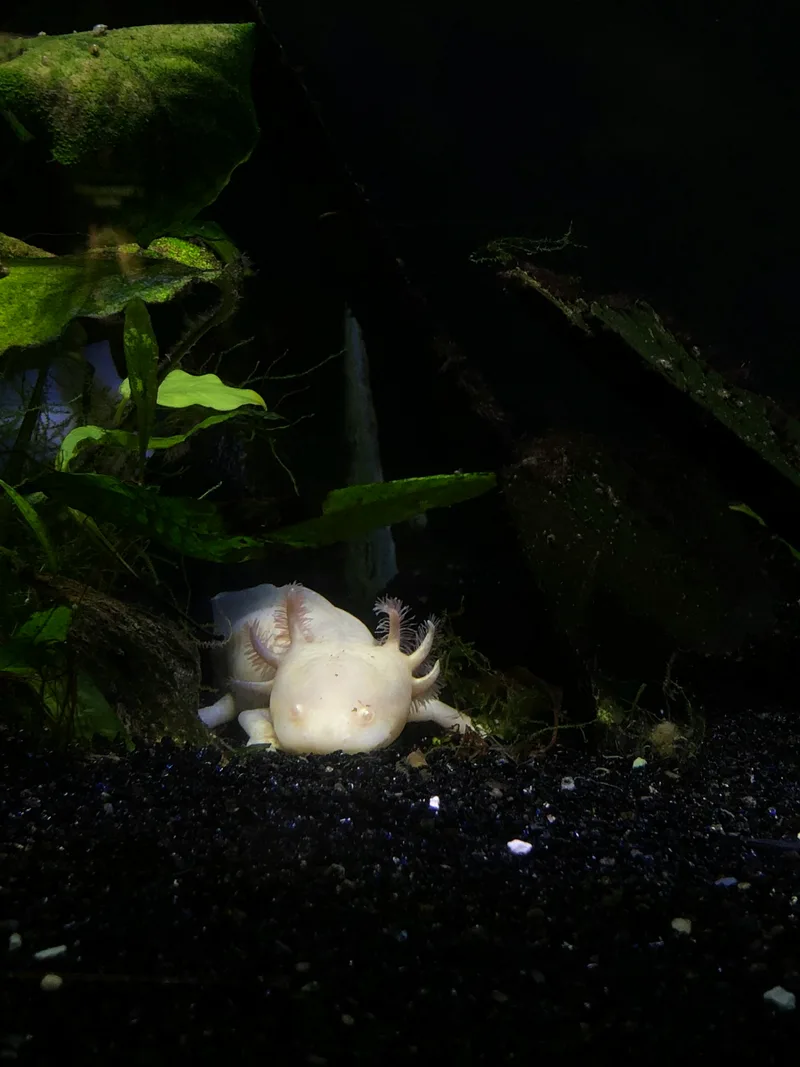
An axolotl should not eat fish (feeder fish, goldfish, minnows), hard-shelled insects like mealworms or crickets, anything salted, seasoned, or cooked, or any prey larger than the space between its eyes. The surprise on that list is fish. An aquatic predator that evolved in a lakebed turns out to be poorly served by the most obvious thing it could swallow, and not for one reason but for three. Feeder fish carry an enzyme that destroys vitamin B1. Goldfish bones are stiff enough to perforate the gut on the way through. Mealworm shells don't break down. One unsafe list, three completely different mechanisms, which is why the cleanest way to learn it is by why, not by what.
Which foods are off the list and why?
The unsafe list groups cleanly by mechanism. Once you see the mechanism, the items stop looking arbitrary.
Thiaminase fish. Goldfish, rosy red minnows, and many shiner species carry thiaminase, an enzyme that breaks down vitamin B1 in whatever ate the fish. Fed regularly, an axolotl (Ambystoma mexicanum) on a thiaminase-fish diet develops a B1 deficiency over weeks to months. This is true for captive-bred, quarantined feeders too. Thiaminase is about the fish's biology, not where it came from.
Bones and hard prey. Feeder goldfish are not just a thiaminase problem. Their bones are stiff enough to puncture the gut on the way through. Adult shrimp with hardened shells fall in the same category for the same reason.
Chitin and hard insect shells. Mealworms, crickets, and other hard-bodied insects have an outer shell of chitin that an axolotl cannot digest. The shells pass intact and can pack together into a blockage. Soft-bodied insect larvae aren't in the same class as their adult forms.
Live feeder fish and the parasite problem. Wild-caught feeders, and live fish from any non-quarantined source, can carry parasites and bacterial diseases that move straight to the axolotl. Tropical feeder species like guppies add a second issue: they're warm-water fish, kept warm at the store, and dropping a stressed tropical fish into 60 to 64°F water means a stressed prey animal in a tank where the axolotl is at its calmest. Even after a full 30-day quarantine, feeders are a last-resort food, not a staple.
Substrate. Not a food, but worth listing because axolotls swallow it. Gravel-sized substrate gets vacuumed up with a worm and lodges in the gut. Fine sand passes; small stones don't. Bare bottom or sand finer than 1 mm is the only safe substrate for an axolotl tank.
Anything salted, seasoned, or cooked. Human food is not an "occasional treat" for an axolotl. Salt is osmotically harmful to a freshwater amphibian. Spices, oils, and cooking byproducts have no place in the diet, and a cooked fish has lost the nutritional point of being a fish anyway.
Oversized prey. A useful rule of thumb is the gap between the eyes. Anything wider than that gap is too big to swallow cleanly and risks lodging on the way down.
| Food | Why it's a problem | Safer alternative |
|---|---|---|
| Goldfish | Thiaminase plus bones stiff enough to perforate the gut | European nightcrawlers, cut to size |
| Rosy red minnows | Thiaminase, even in captive-bred stock | European nightcrawlers |
| Feeder guppies | Parasite risk plus warm-water stress; only after a 30-day quarantine, and only as a last resort | Blackworms |
| Mealworms | Chitin shells don't digest and pack into a blockage | Sinking axolotl pellets |
| Crickets | Same chitin and impaction problem; legs and wings are worse | Sinking axolotl pellets |
| Frozen bloodworms as a staple | Low in nutrients for the volume they take up; fine as a treat, not a base diet | Earthworms as the staple |
| Raw beef or pork | Wrong fat profile for an amphibian; raw mammal meat can carry bacterial loads the axolotl's immune system isn't built for | Earthworms |
| Anything salted, seasoned, or cooked | Salt is osmotically harmful, seasonings have no business in the tank | Cold, fresh earthworm |
| Foods larger than the gap between the eyes | Choking and gut-lodging risk | Cut prey down before feeding |
Why is fish, the obvious food, actually one of the worst?
Thiaminase is an enzyme present in many freshwater fish that breaks down thiamine, vitamin B1, inside whatever ate the fish. The vitamin disappears post-digestion. An axolotl fed thiaminase fish once or twice across a year will be fine. An axolotl fed them regularly accumulates a B1 deficiency that shows up as loss of appetite, neurological signs like balance issues or odd swimming, and, if it runs long enough, death.
The piece most owners miss is that this has nothing to do with where the fish came from. A captive-bred, perfectly clean, quarantined rosy red minnow carries the same thiaminase as a wild one. The enzyme is part of the fish's biology. There is no sourcing fix.
Layered on top of thiaminase is the bone problem. A juvenile feeder goldfish has bones rigid enough to puncture the soft tissue of an axolotl's gut on the way through. So feeder fish are a two-problem food, not a one-problem one: even if you somehow zeroed out the B1 destruction, the physical risk is still there. This is the reason every reliable axolotl source converges on worms as the staple and treats feeders as something between optional and avoid.
Did you know? Thiaminase is the same enzyme that has zookeepers thaw and supplement frozen fish before feeding seals, penguins, and otters. The captive-marine-mammal world has been managing this exact B1 problem for decades.
What if my axolotl already ate something on this list?
Most after-the-fact scares end fine. The right move is to identify what was eaten, watch for specific signs, and not repeat it.
If it was a one-off small piece of fish or a shrimp tail, the odds are good. A single thiaminase exposure won't cause a deficiency, and a small piece is unlikely to do mechanical harm. Watch for regurgitation in the next 24 hours, skip the next scheduled feeding, and don't repeat.
If it was a hard-shelled insect like a mealworm or cricket and you can see it inside the abdomen, the concern is impaction. Move the axolotl to a bare-bottom tub with clean, cold water so you can actually see whether anything passes. Keep the water cool, in the low 60s°F. Hold off on food for 48 to 72 hours and watch the warning signs below.
If gravel went down with a worm during feeding, treat it the same way as a swallowed mealworm. Tub on bare bottom, cold water, watch for passage. Small stones usually move through within a few days.
If what was eaten was salted, seasoned, cooked, or otherwise human food, that's the one case where waiting is the wrong move. Call an exotics vet now. Salt poisoning in a freshwater amphibian can move quickly, and there's no home fix for it.
Warning signs to watch for after a suspect meal:
- Refusing food for more than 3 days
- No poop for 48 hours or longer
- Visibly swollen or hard belly
- Floating that doesn't resolve when you nudge them down
- Gills clamped flat against the head or curled forward
- Lethargy that doesn't lift overnight
Any of those alone is worth a vet call. Two or more is not optional.
What should I feed instead?
The staple is European nightcrawlers, cut to size, fed two or three times a week for an adult. Sinking pellets formulated for axolotls are a fine second option, especially for owners who don't want to keep worms at home. Live blackworms make a good occasional treat. Frozen bloodworms are useful for picky juveniles but too low in nutrition to be a base diet.
The pattern that ties the whole "no" list together is this: an axolotl is built to swallow soft, slow-moving, boneless prey from a cold-water lakebed. Every food on the unsafe list breaks one of those four properties. A fish has bones and thiaminase. A cricket has a hard shell and legs that catch. A piece of cooked, salted shrimp is salty, dry, and the wrong temperature. Hold a candidate food up against soft, slow, boneless, cold, and the answer comes out on its own, even for items that nobody has thought to put on a list. A worm clears all four, which is why most experienced keepers feed European nightcrawlers as the staple, two or three times a week.