Do axolotls need a friend?
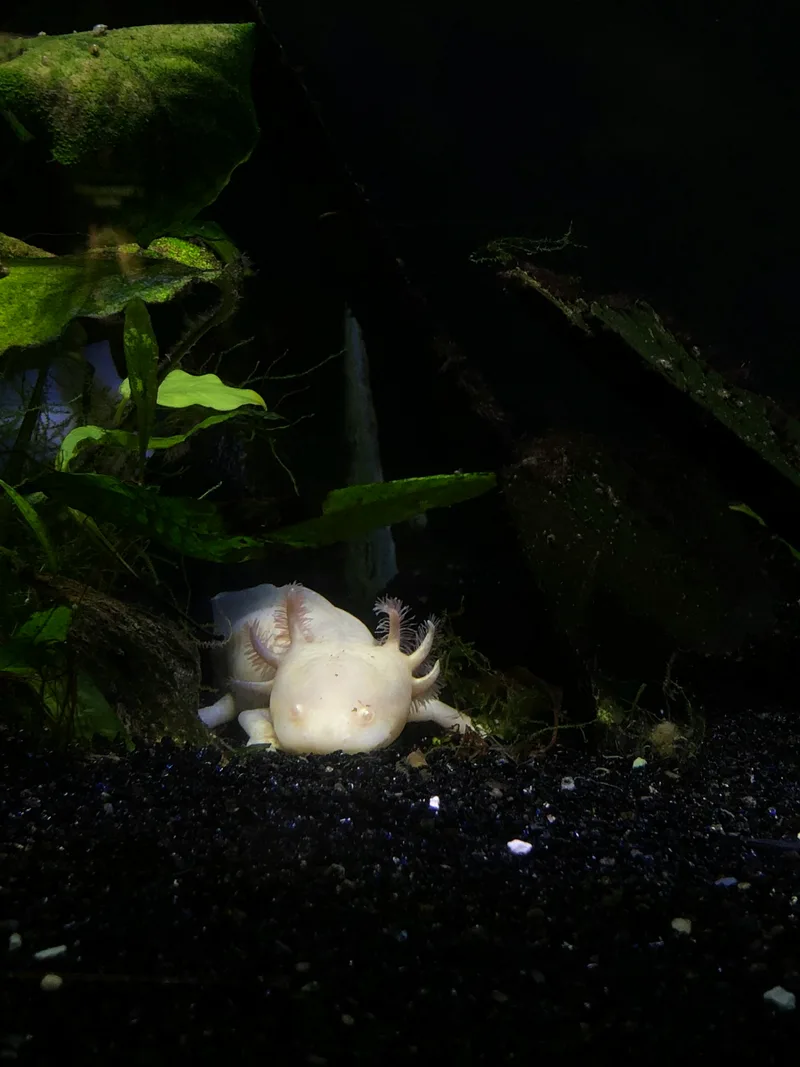
No, your single axolotl (Ambystoma mexicanum) isn't lonely and doesn't need a friend. It's a solitary animal, so keeping one alone is the safe default, not a compromise you're making on its behalf. Here's the part that's easy to miss: the side-by-side resting that owners read as two axolotls keeping each other company is the same behavior that, in a shared tank, ends with one of them missing a gill or a leg. The reason a single axolotl is fine alone is the same reason a second one is a risk, and once you see why, the choice gets a lot simpler.
If They Don't Get Lonely, Is It Safe to Keep Two Together Anyway?
You can keep two axolotls together, but it's a choice you're making for yourself, not something the animal needs. Two can live in one tank if you set it up for it, and plenty of people do. The cost is that you're taking on a standing risk of nipped gills and bitten limbs, and a possible vet bill, in exchange for the enjoyment of watching two instead of one.
The reason it's risky comes down to how an axolotl finds food. It doesn't really hunt by sight. It waits, and when something moves within reach, it lunges and swallows. A passing gill or a wiggling toe registers the same way a worm does, especially around feeding time or when one of them is hungry. The bite isn't aggression in any meaningful sense. It's an ambush predator doing the one thing it's built to do, aimed at the wrong target.
If you do want a pair, here's what has to be true before you try:
- Matched size. Two axolotls of roughly the same length. A bigger one will eat a smaller one, or take chunks out of it. Never put a juvenile in with an adult.
- Enough water. Plan on at least 30 gallons for two. A single axolotl is fine in 20, but a pair needs the extra room to stay out of each other's way.
- Plenty of hides. Multiple caves, pipes, or shaded corners, so each one can tuck away and never has to share a spot it doesn't want to share.
- Feed both fully. A well-fed axolotl is far less likely to snap at its tankmate. Make sure each one actually gets its food, not just the faster of the two.
- Accept the risk anyway. Even with all of the above, gills and toes still get nipped. Axolotls regrow lost parts, but an open wound in a home tank can get infected. This never drops to zero.
Solo keeping skips all of that. One axolotl, a 20-gallon tank, no monitoring of who's eating what, no injury risk from a tankmate. If you're weighing the decision between one axolotl and two, one is plainly the lower-stress, lower-cost setup, and the animal loses nothing by it.
Why Doesn't an Axolotl Get Lonely the Way a Dog Would?
A dog is a pack animal. Its ancestors survived by living in a group, and a lot of dog behavior only makes sense as social behavior, which is why a dog left alone all day genuinely struggles. An axolotl comes from the opposite world. In the wild it lives a solitary life in the cool lakes and canals around Mexico City, not in groups, not in pairs, not raising young together. There's no social wiring to leave unmet, because there was never any social life for evolution to wire in.
That's the real answer to the loneliness question. Loneliness is what happens when a social animal is cut off from the group it's built to need. An axolotl was never built to need one. An empty-looking tank doesn't read as isolation to it the way an empty house reads to a dog, because it has no sense of a group it's missing.
Did you know? An axolotl never grows up. Most salamanders crawl out of the water as adults, but the axolotl stays in its larval form for its whole 10 to 15 year life, keeping its feathery external gills and finned tail and never leaving the water. That same refusal to grow up is part of why it never develops the social habits of a land animal.
There's one observation that makes a lot of owners doubt all this. People with two axolotls often report that the pair seems to do everything together, resting side by side, ending up in the same cave. It looks like friendship. What's actually happening is that both animals want the same things: the coolest spot, the darkest hide, the corner with the least flow. Two solitary animals choosing the same favorite spot end up in the same place, and from the outside that looks like company. It isn't a bond. It's two independent preferences pointing at the same piece of the tank.
What About a Fish, a Snail, or a Shrimp for Company Instead?
There's no good companion species for an axolotl, and that's genuinely fine. Once you've accepted a second axolotl isn't needed, the next instinct is usually to add something else to the tank to liven it up. But every common option fails for the same reasons a second axolotl is risky, just more so.
Fish are bad on both ends. Most fish will peck at an axolotl's exposed gills, which look like little waving treats to a tankmate looking for a bite, and an axolotl with chewed-up gills can develop infections and stops eating. Going the other way, the axolotl will try to eat any fish small enough to fit in its mouth, and fish bones and spines can injure it or get stuck on the way down. Faster fish stress it out; smaller fish become food. Neither outcome is what you wanted.
Snails get swallowed whole. An axolotl will hoover up a snail without a second thought, shell included, and a shell-sized lump is exactly the kind of thing that causes a blockage. Shrimp are often suggested as the "safe" option, and they're safer in the sense that they won't hurt the axolotl, but they're not company. They're a snack with extra steps. The axolotl eats them, and you're back to one animal in the tank.
No tankmate turns a solo axolotl tank into a social one, because the axolotl isn't looking for company in the first place. If you want the full rundown of which animals can and can't share a tank with an axolotl, the short version is that the safest tank for an axolotl is one with nothing else in it. An empty-looking tank with one axolotl isn't a lonely tank. It's the quiet, uncrowded water a solitary ambush predator was shaped to live in, and giving it that isn't depriving it of anything. It's giving it exactly what it's for.