Should I get 1 or 2 axolotls?
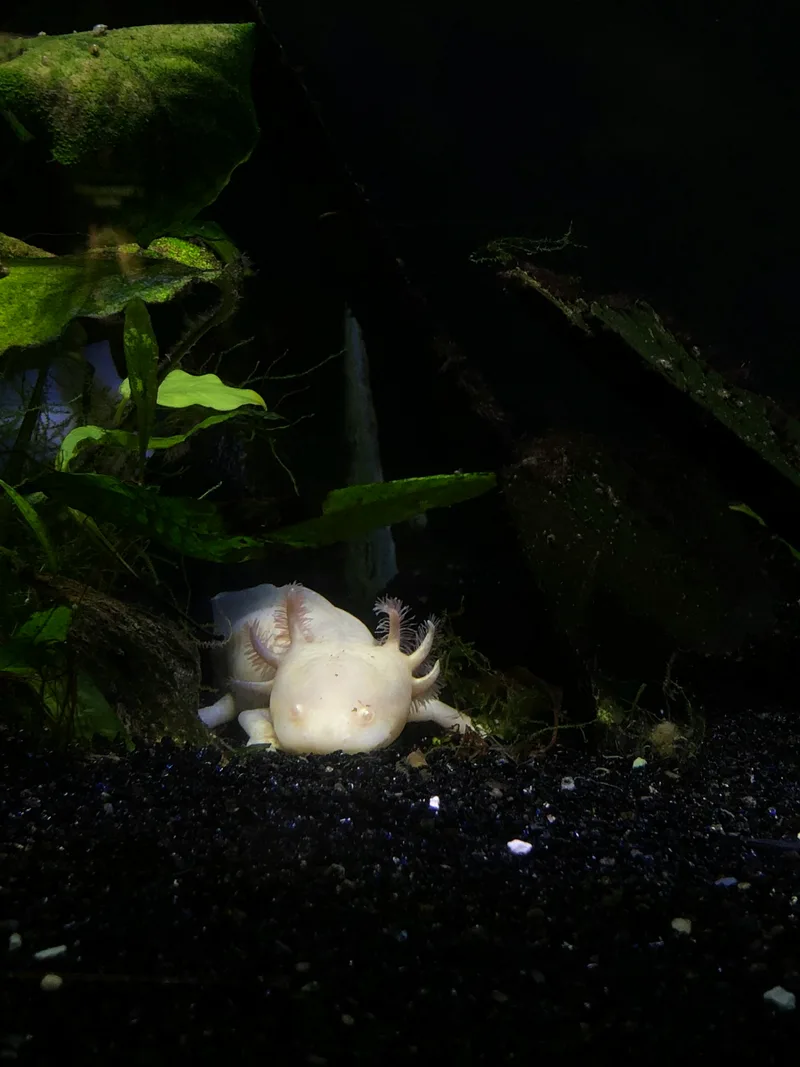
Get one. The worry that sends most people back for a second axolotl (Ambystoma mexicanum), that the first one is lonely, is aimed at a feeling the axolotl doesn't have. What it does have is a near-blind ambush instinct that strikes at anything moving in front of it, which means a second axolotl shows up less as a companion and more as a roommate that can bite. Two can live together, but only as a deliberate setup with matched sizes, a bigger tank, and the breeding question handled first. The reason solo is the safe default, and what a pair actually costs you, is the rest of this.
Will a Single Axolotl Be Lonely?
No. An axolotl alone in a tank shows none of the signs that a social animal shows when it's isolated. It rests on the bottom, patrols the glass, hunts when food appears, and goes back to sitting. That's the whole behavioral range, and none of it changes for the better when you add a second one.
The reason sits in where they come from. Axolotls evolved in the lake system around Mexico City, Lake Xochimilco and the old Lake Chalco, as ambush predators that sit still and wait for something to swim past. They aren't a schooling fish that reads safety from the size of its group. There's no social drive built into them, so there's nothing to leave unsatisfied by keeping one. Loneliness is a thing you're feeling on the axolotl's behalf, not something it's experiencing.
So when you catch yourself thinking the one in your tank needs a buddy, it's worth separating what you're seeing from what you're imagining. A still axolotl isn't a bored or sad one. It's an animal doing exactly what it's built to do, which is mostly nothing, very patiently, until dinner walks by.
Did you know? Axolotls have famously poor eyesight and hunt mostly by feel, picking up movement and water vibration through a lateral line, a row of sensory pits running down each side of the body. That's the same reason a tankmate registers as "something moving nearby to snap at" rather than as company. The axolotl isn't seeing a friend. It's sensing a target.
What Actually Happens When You Keep Two Together?
They bite each other. An axolotl will try to eat anything that fits in its mouth, and that includes another axolotl's gills, feet, and toes, especially around feeding time when everything moving looks like food. The fluffy external gills are the most exposed and the most often nipped, and a stub where a gill stalk used to be is a common sight in tanks where two are kept without enough care.
This is why size-matching is the rule that matters most. Never put a smaller axolotl in with a larger one. If the small one fits in the big one's mouth, it can simply become a meal, not in a fight, just in the ordinary course of the bigger animal eating. Two axolotls of roughly equal size can't swallow each other, which takes the worst outcome off the table and leaves you managing the smaller injuries.
Those injuries aren't usually fatal on their own. Axolotls regenerate lost limbs and gills, often completely, which is one of the genuinely remarkable things about them. But a fresh bite is still an open wound in tank water, which means stress and a real risk of infection while it heals. The animal you weighed against can take a chunk out of it and the chunk will grow back, but the days in between are hard on it.
Two can work. The version that works is two roughly equal-sized animals, each with its own cave or hide to retreat to, in enough space that they aren't constantly in each other's path, fed well and on schedule so neither is hungry enough to start treating the other as food. If you're not set up to give them all of that, you're not keeping a pair. You're keeping one axolotl and its next meal. The same predatory instinct that makes them snap at a tankmate is what drives an axolotl to go after smaller fish and shrimp in the tank, so a second axolotl is one more thing in front of that mouth, not an exception to it.
How Big a Tank Do You Need for Two Axolotls?
One axolotl needs about 20 gallons. A pair needs more than double that floor space in practice, roughly 30 gallons at a minimum and comfortably more, because the constraint isn't just water volume, it's the footprint and the number of separate places each animal can claim. Two axolotls sharing a 20-gallon tank are forced into each other's space, and forced proximity is exactly what turns into bitten gills.
What the second animal really costs you breaks down like this:
- Floor space, not height. Axolotls live on the bottom, so it's the length and width of the tank that matter, not how tall it is. A long tank beats a tall one of the same volume every time.
- At least two hides. Each axolotl needs its own cave, pipe, or shelter it can retreat into and not be followed. One shared hide just relocates the conflict.
- More filtration and more cleaning. Two animals roughly double the waste load, and axolotls are messy, heavy-waste animals to begin with. The water has to stay clean, cool, and gently filtered for both, which is more pump and more water changes than a single one needed.
The decision rule is simple. Only get two if you can give them the footprint, the hides, and the clean, cool, low-flow water that two animals need at once. If you'd be squeezing a pair into the setup you bought for one, the honest move is to keep the one you have. A pair is comfortable in a 30-gallon-plus tank with a long footprint, where each animal can hold its own end of the glass.
Will Two Axolotls Breed if You Keep Them Together?
If one is male and one is female, almost certainly yes, and that's the consequence most people never see coming. A mixed-sex pair kept in good conditions will spawn, and they don't need any encouragement from you to do it. Here's the catch that makes it hard to avoid by accident: you usually can't tell an axolotl's sex until it's over a year old. The juveniles you buy at the store look the same regardless, so "I'll just get two and sort it out" quietly means "I might be buying a breeding pair."
And a spawn is not a small event. A single clutch can run into the hundreds of eggs, and raising axolotl fry is genuinely demanding work. They need live food, frequent water changes, and separation from each other as they grow, because, true to form, the larger fry will eat the smaller ones. Most people who end up with a surprise clutch are not equipped for it, and finding homes for a few hundred baby axolotls is its own project.
The way out is to decide on purpose rather than by accident. If you want two, either keep a same-sex pair once you can actually sex them, or go in genuinely prepared for the possibility of a spawn. What you shouldn't do is assume a male and female will simply coexist as quiet roommates. The question that brought you here, will my axolotl be lonely, turns out to be the wrong question. An axolotl isn't lonely, and a second one isn't a friend. It's a second predator sharing the water. The real decision was never one or two for the axolotl's sake. It's whether you're set up to keep two animals safely apart and well-fed, and for most people, standing in the store with one in the bag already, the honest answer is one.