What animals can live with axolotls in a tank?
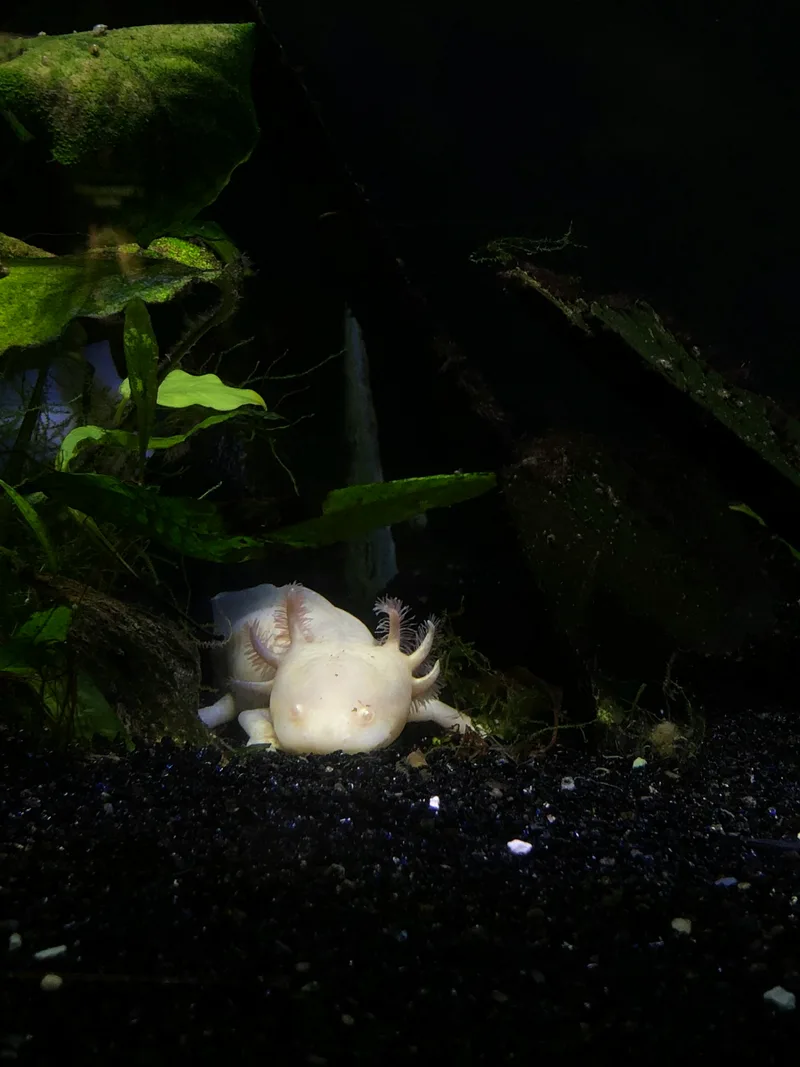
The honest answer is that almost nothing can safely share a tank with an axolotl, and the right setup is one axolotl alone. The closest thing to a safe tankmate is a few cold-water shrimp, and those your axolotl will probably just eat. What makes this stick is that it isn't one rule a careful keeper could work around. It's three separate problems converging on the same answer, the water too cold for nearly any fish, the feathery gills there to be nipped, the mouth that swallows whatever fits. And the company most people are really picturing, something to keep the axolotl from being lonely, turns out to have a completely different answer than fish do.
So What Can Actually Go in the Tank With an Axolotl?
The safe setup is a solo tank. One axolotl, no fish, no cleanup crew. That's it, and it isn't a compromise.
The one low-risk addition is a small group of cold-water shrimp, like ghost shrimp or cherry shrimp. They won't hurt your axolotl. The catch is that your axolotl will likely hunt and eat them over time. They're food, not company, and that's fine if you're treating them as the occasional live snack rather than tankmates you expect to stick around.
Two ideas a lot of people bring to this question are worth clearing up before they cause harm. The first is the "cleanup crew." A pleco or other algae eater is not a safe helper in an axolotl tank. Plecos rasp at the axolotl's slime coat, the protective layer over its skin, and their fins and spines can injure or get swallowed. The second is snails. They look harmless, but their hard shells and the little trapdoor some species have can cut a soft-bodied axolotl, and a swallowed snail can block the gut.
Here's the short version to set the tank up by:
- Safe: A solo axolotl. Cold-water shrimp (ghost or cherry), accepting they'll probably be eaten.
- Risky: Snails of any kind. Other invertebrates.
- No: Any tropical fish. Plecos and algae eaters. Goldfish. Frogs. Crayfish.
If your worry is whether a fish would survive at all, the more direct concern is usually that an axolotl simply treats most fish as prey, which is its own reason to keep them apart.
Why Can't Axolotls Live With Other Fish?
The blanket "keep them alone" rule sounds like overcaution until you see that it's really three independent reasons stacked on top of each other. Any one of them would be enough on its own.
The first is temperature. Axolotls need cool water, around 60 to 64°F (16 to 18°C). Nearly every common aquarium fish is a tropical fish that needs warmth, 75°F (24°C) and up. Those two ranges don't overlap. A tank set warm enough to keep a tropical fish comfortable is actively stressing the axolotl, and a tank kept cool enough for the axolotl leaves the fish too cold to stay healthy. You can't pick a number that works for both.
The second is the gills. An axolotl breathes through those feathery external gills branching off the sides of its head, and they sit right out in the open. Fish nip at them. It's not aggression so much as opportunity, but the result is the same: a torn gill is both a wound and an open door for infection.
The third is the mouth. An axolotl doesn't bite and chew. It feeds by snapping its mouth open to create a sudden suction that pulls prey straight in, and it swallows whatever fits. A small fish becomes a meal. Anything hard, spiny, or too big to pass, like a swallowed snail shell or a catfish spine, can lodge in the gut and cause a blockage called impaction, which is genuinely dangerous.
Did you know? Axolotls have essentially no real teeth, just tiny tooth-like ridges that can't grip or tear. They eat entirely by suction, snapping the mouth open to create a vacuum that pulls food in whole. That's the same mechanism behind both problems above: anything small enough to fit gets swallowed, and anything hard enough to lodge causes trouble.
Should I Get a Second Axolotl to Keep It Company?
This is usually the real question. Most people asking about tankmates aren't shopping for fish, they're worried their axolotl is lonely in an empty tank. So here's the reassuring part: axolotls are solitary animals. A solo tank is not lonely and not cruel. It's the normal, healthy way to keep one.
If you still want two, another axolotl is the only animal that genuinely belongs in the tank with one. It comes with conditions. Keep only adults of similar size together, because a bigger axolotl will bite at a smaller one's limbs and gills. Those parts do regrow, which is remarkable, but the animal shouldn't have to spend its energy regrowing them. A pair also needs more room, around 30 gallons or more, so they aren't forced into constant contact.
One thing that trips people up: a bigger tank does not make fish safe. The three reasons above don't shrink with volume. The water is still the wrong temperature, the gills are still exposed, the mouth still swallows what fits. More space helps two axolotls coexist. It does nothing to make a fish a viable tankmate.
If the companionship question is what's really on your mind, it's worth knowing whether axolotls need a friend at all before you commit to a second one.
What If I Already Have Fish in With My Axolotl?
If you're reading this with a mixed tank already running, don't panic. Look at what your axolotl is actually doing, and let that tell you what to do next.
If the gills look ragged, stubby, or are curling forward, or the axolotl is off its food or pacing the tank restlessly, separate them now. Move the fish out, and check your water temperature while you're at it. Those signs mean the situation has already started causing harm.
If a small fish has gone missing, assume it was eaten. Watch the axolotl's belly over the next few days for swelling, and watch for whether it's passing waste normally. A swollen belly with no waste passing is a sign of a possible blockage, and that's worth acting on. If you think a tankmate has hurt your axolotl, it helps to know the broader signs that an axolotl is sick so you can tell injury from illness.
And if everything looks calm right now, that's good, but it's a matter of time rather than a sign it's safe. The clean next step is the same either way: move the fish to their own tank, and return the axolotl to a cool, solo setup. None of this is a failure on your part. It's just what the animal turns out to need. An axolotl isn't a fish that happens to prefer being alone. It's a cool-water animal whose whole build, the exposed gills, the suction feeding, the temperature it evolved for, makes the bare solo tank the right tank. Setting it up that way isn't denying your axolotl anything. It's giving it exactly what it needs.