What kind of water does an axolotl need?
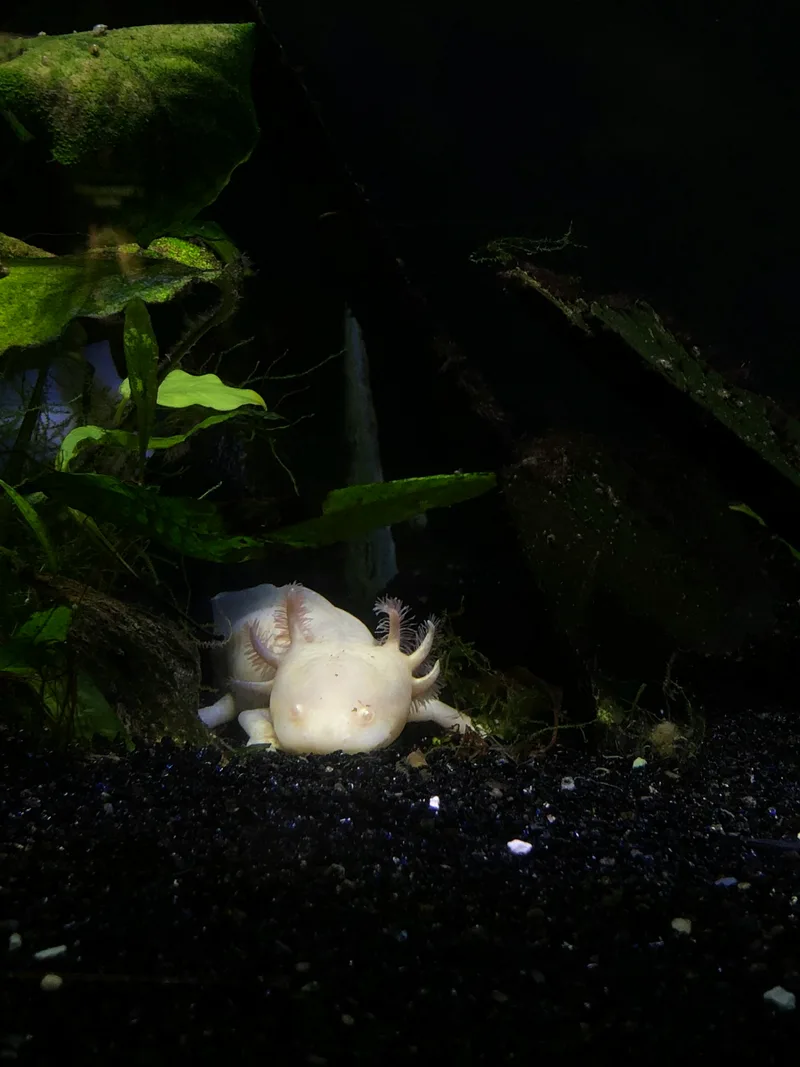
An axolotl (Ambystoma mexicanum) needs plain dechlorinated tap water held between 60 and 68°F (16 to 20°C), with a pH around 7.4 to 7.6 and moderate hardness (7 to 14 dGH). The catch is that the water that looks cleanest will kill it fastest. A gallon of distilled or pure reverse-osmosis water, the stuff sold as "pure," pulls minerals out of an axolotl's skin until its internal chemistry comes apart. Almost every other water rule in the hobby flips here, because an axolotl isn't a fish in cold water. It's an amphibian breathing through its skin, and what's in the water is about to be inside the animal.
How do I actually prepare tap water for an axolotl?
For almost everyone, the right water source is the one already in your kitchen sink. Plain cold tap water, treated with a dechlorinator, is what the vast majority of keepers use, and it's what most rescues recommend. The only job is neutralizing the chlorine or chloramine your water company adds, and doing it before the water touches the tank.
Use Seachem Prime as your default. It handles chlorine and chloramine, binds the small amounts of ammonia left behind when chloramine breaks down, and detoxifies trace heavy metals from old household plumbing. One capful treats 50 gallons, so a 20-gallon tank needs a little under half a cap. Other conditioners work, but Prime is the one almost every axolotl keeper has on the shelf because it covers all three problems in one bottle.
Always dose the water in a clean bucket before you pour it in, not in the tank after. Dosing in-tank stresses the axolotl and leaves chlorinated water sitting on its skin for the minute or two it takes the conditioner to react. Match the new water to tank temperature by letting the bucket sit, and add the water gently so you don't blast the axolotl with a current.
- Fill a clean bucket (one that has never held soap or cleaning product) with cold tap water
- Add dechlorinator at the label dose for the bucket's volume
- Stir for a few seconds and let the water sit until it's within a couple of degrees of the tank
- Pour slowly into the tank during a water change, aiming away from the axolotl
Two edge cases are worth knowing about. If your house is on a whole-home salt softener, the softened line is not safe: it strips out calcium and magnesium and replaces them with sodium, which is the opposite of what an axolotl's skin needs. Run a separate untreated line (most houses have one at the outdoor spigot or in the garage) or switch to bottled spring water. If you're on a private well, test the water for ammonia, nitrite, and hardness before using it. Well water is often fine, but "fine" isn't a guess you want to make with a live animal. For most households, dechlorinated tap water is the right default for an axolotl, and the yes/no comes down to what your specific utility puts in the line.
What parameters should the water actually hit?
Once the water is dechlorinated, the question is whether the numbers on your test kit fall where they need to. Most tap water in the US, the UK, and northern Europe already lands close to the right range for an axolotl. Your job is usually to verify, not to engineer.
Here's the target your liquid test kit should read:
| Parameter | Target | What it means if you're off |
|---|---|---|
| Temperature | 60 to 68°F (16 to 20°C) | Over 72°F (22°C) pushes axolotls into heat stress: refusing food, forward-tipped gills, fungal flare-ups |
| pH | 7.4 to 7.6 | Below 7.0 for extended periods erodes the slime coat; very high pH (above 8) irritates the skin |
| GH | 7 to 14 dGH | Too soft and the axolotl can't hold its mineral balance; too hard is rarely a real problem |
| KH | 3 to 8 dKH | Too low and pH swings during the day as the tank breathes; stable KH keeps pH flat |
| Ammonia | 0 ppm | Anything above zero burns gills and skin. If you read ammonia, the tank isn't cycled yet |
| Nitrite | 0 ppm | Same story as ammonia, different step of the cycle. Zero is the only acceptable number |
| Nitrate | Under 20 ppm | Creeping nitrate is the usual reason for sluggishness and appetite loss in an otherwise clean tank |
A standard liquid test kit (API Freshwater Master Test Kit is the one most keepers own) covers pH, ammonia, nitrite, and nitrate. For GH and KH you want the separate API GH/KH kit, or test strips if that's what's at the store. Test once a week for the first few months of a new tank, then every two or three weeks once the cycle is steady and nothing has changed.
One number deserves its own mention: temperature. Axolotls are cold-water animals, and a tank sitting on a warm windowsill in July can run ten degrees hotter than the room. Keeping an axolotl cool without running a heater is usually a matter of aiming a small clip fan across the water surface, not cranking the house AC down. The full range of ideal water parameters for axolotls sits inside the numbers above, and most tap water in temperate countries already hits them without any engineering on your part.
Why can't an axolotl live in distilled or pure RO water?
This is the part that trips up anyone who's kept fish before. With most tropical freshwater fish, softer water is safer water: you can push a neon tetra (Paracheirodon innesi) into near-distilled conditions and it'll be happy. With an axolotl, the exact same water is dangerous. The reason is the animal's skin.
An axolotl is an amphibian. It has no scales and no waterproof barrier between its body and the water it's sitting in. Salts move across that skin in both directions all the time, and the axolotl uses tiny ion pumps to hold its internal mineral balance steady against whatever the surrounding water is doing. In normal tap water, with calcium, magnesium, sodium, and potassium dissolved in it, the gradient is mild and the pumps barely have to work.
Drop an axolotl into distilled or pure reverse-osmosis water and that gradient flips hard. Minerals leak out of the animal faster than the pumps can replace them, and water floods in trying to equalize the concentration. The axolotl is slowly losing its internal chemistry from the inside out. Keepers call this osmotic stress, and the visible signs (mucus sloughing, lethargy, refusing food) are already a medical emergency by the time they show up.
Did you know? Wild axolotls evolved in Lake Xochimilco, a network of cool, spring-fed channels on the southern edge of Mexico City. The water there runs over volcanic limestone bedrock, so it's naturally alkaline and moderately hard. A tank full of soft, acidic blackwater is perfect for a neon tetra and almost exactly the opposite of what an axolotl's skin is built for.
This is also why hobbyists who run RO systems for other reasons (a planted shrimp tank, a discus setup) have to remineralize their RO water with something like Seachem Equilibrium before it ever touches the axolotl tank. Pure RO goes in; water with the right GH and KH comes out. The same applies to those gallon jugs of distilled water at the grocery store: they are the wrong emergency purchase, even though they look like the clean, safe choice. One more note for anyone who's seen it mentioned on a forum: axolotls are freshwater animals, not brackish. Salt baths are a short, specific treatment for certain fungal infections under a vet's or experienced keeper's direction, not an everyday tank additive. Adding aquarium salt to the water full-time will injure the animal, not protect it.
What if my tap water is bad? Can I use bottled water?
Sometimes tap water genuinely isn't an option. Heavy chloramination that's hard to neutralize, agricultural nitrate above 40 ppm out of the faucet, a rental where the softener can't be bypassed, a temporary outage during a move. For those situations, bottled water is a workable backup, and knowing which kind to grab matters.
Reach for bottled spring water. It comes out of the ground carrying dissolved minerals from the source rock, which is exactly the mineral profile an axolotl needs. Poland Spring, Crystal Geyser, Arrowhead, and most store-brand spring waters all work. Check the label for a mineral analysis if it's printed: you want to see calcium, magnesium, bicarbonate, and sodium listed in real numbers, not blanks.
Be careful with "purified" and "drinking" water. These labels cover a range: some bottlers run municipal water through reverse osmosis and then add a pinch of minerals back "for taste," which gives you something closer to soft tap water, while others ship essentially pure RO. Read the label. If the mineral content is missing or reads near zero, treat it as distilled and don't use it straight.
Distilled water is a no unless you're actively remineralizing it with a product like Seachem Equilibrium, which most casual owners aren't set up to do. Even then, it's more work than the problem is usually worth.
The catch with all of this is cost. A 20-gallon axolotl tank doing a 25 percent weekly water change needs 5 gallons of new water every week, and five gallon-jugs of spring water runs 6 to 10 dollars depending on where you shop. Over a year you're spending more on bottled water than you'd spend on a small aged-water reservoir, a better dechlorinator, or a single-tap RO-remineralization setup. Use bottled water to get through this week, then fix the underlying tap problem. When a bottled purchase is unavoidable, the best bottled water for an axolotl is a spring water with calcium and magnesium listed on the label, not anything marked purified, drinking, or distilled.
And this is the shift that makes every rule in this article stop feeling like a checklist. An axolotl isn't a fish in cold water. It's an amphibian wearing its insides on the outside, trading minerals with whatever liquid it's sitting in, every second of its life. Once you see it that way, you don't have to memorize the parameters. The temperature target is just the metabolism the animal evolved with. The mineral target is whatever keeps the gradient across its skin steady. The dechlorination is because chlorine is a solvent strong enough to eat soft tissue, and that includes gills. Every number stops looking arbitrary, and starts looking like what your animal has already told you it needs.