What is the best bottled water for axolotls?
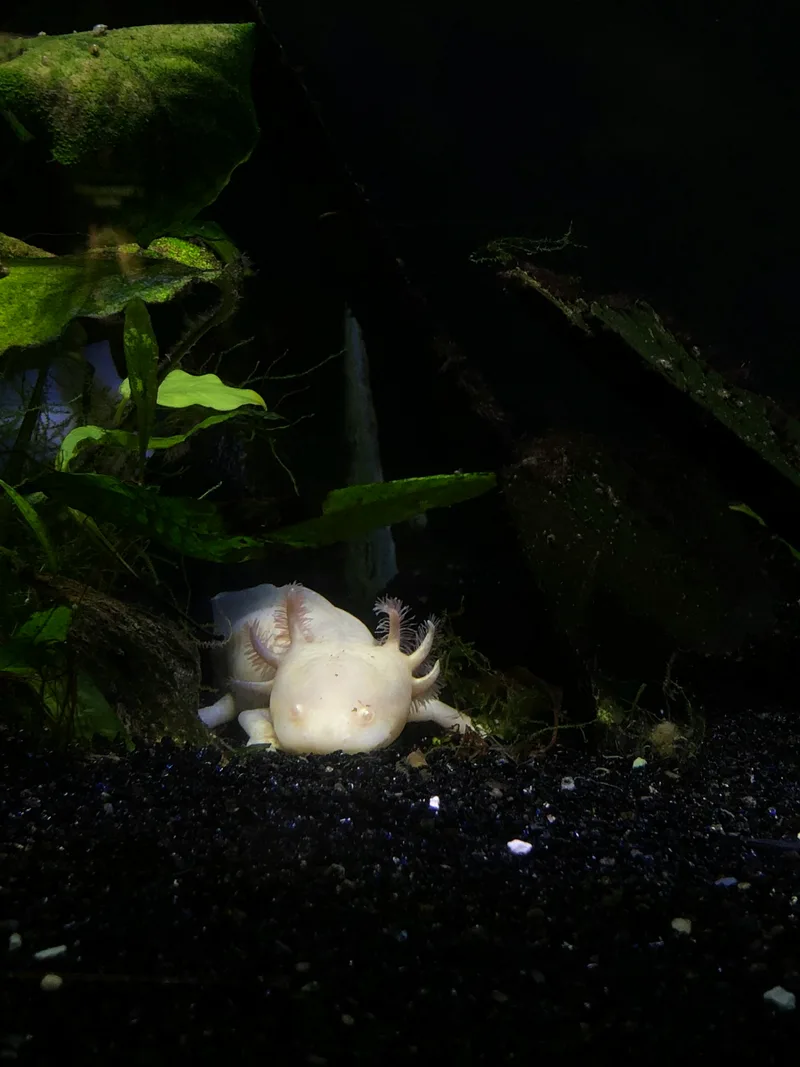
Plain bottled spring water with a named source on the label is the safest bottled choice for an axolotl. The bottled waters most keepers reach for first, "distilled" and "purified by reverse osmosis," are the dangerous ones. Stripped of the minerals an axolotl pulls in through its permeable skin, they leach salts out of the animal instead of feeding them in. And before you build a monthly bottled-water budget around any of this, there's a cheaper answer most keepers walk straight past on the way to the water aisle.
So which bottled water should I actually buy?
Go to the water aisle and look for a bottle that says "spring water" on the front, with the source listed somewhere on the label (a specific spring, town, or state). That's the target. Skip anything labeled "distilled," "purified by reverse osmosis," or plain "drinking water" with no source information, since that last category is usually municipal tap water that has been filtered and may still carry residual chloramine from the treatment plant.
In the US, the brands hobbyists report as consistently clean are Poland Spring, Ice Mountain, Zephyrhills, Crystal Geyser, and most store-brand spring waters from a named source (Kroger, Walmart's "Great Value," Costco's Kirkland Signature, when the label actually points at a spring). If a store brand just says "drinking water," put it back.
Also skip anything flavored, electrolyte-enhanced, or marketed as "alkaline" or "mineral water." Those carry added salts and sometimes sweeteners or citric acid that have no place in a tank.
One habit worth picking up even after you've settled on a brand: the first bottle from a new case gets tested before it goes anywhere near the axolotl. Pour some into a cup, check pH and GH with a strip or a drop kit, and confirm you're landing in the target range. Source water varies by region, season, and which spring was running the day the plant bottled it, and two bottles of the same brand from different distributors can read a few points apart.
- Look for "spring water" on the front label, with a specific source named
- Aim for a pH around 7.4 to 7.6 once you test it, with GH in the moderate range
- Skip anything labeled "distilled," "purified," or "drinking water" without a source
- Skip flavored, alkaline, and mineral-enhanced waters
- Test the first bottle of any new brand with a pH and GH kit before using it
- Once a brand tests clean, stick with it so your parameters stay stable between water changes
Why does spring water work when distilled and RO don't?
Spring water picks up its minerals on the way out of the ground. As it moves through rock and soil, it dissolves a little calcium, a little magnesium, some bicarbonates, and a few other trace salts, and those are exactly what your test kit reads as GH (general hardness) and KH (carbonate hardness). KH is the one that buffers the tank against pH swings. If the KH is near zero, the pH can drop several points overnight between feedings and water changes. GH is the one that gives the animal the calcium and magnesium its body actually uses.
An axolotl needs both, and it needs them more urgently than a typical freshwater fish does, because its skin doesn't work the same way. A goldfish has scales and a tight outer layer that keeps most of the water out. An axolotl (Ambystoma mexicanum) has soft, permeable amphibian skin, and the water it sits in is constantly moving across that boundary in both directions. Put it in mineral-free water and the osmotic gradient runs the wrong way: salts leak out of the animal and into the tank. The visible signs are a stressed axolotl with curled gill tips, poor appetite, and sometimes a slime coat that looks off.
This is why distilled water and plain RO water are dangerous on their own. They have essentially zero GH and zero KH by design, and dropping a soft-skinned amphibian into them is the aquatic version of dehydration. The fix, for keepers who do need to start from pure water (very soft regional tap, or tap with contaminants a standard conditioner can't touch), is to remineralize the RO before it goes in the tank. Products like Seachem Equilibrium or Salty Shrimp GH+/KH+ are made for exactly this: a measured scoop per gallon brings the GH and KH back up to where an axolotl wants them. Done right, remineralized RO is actually the cleanest and most controllable option you can run. Done wrong, or skipped, it's worse than the tap you were trying to replace.
Did you know? An axolotl doesn't drink water the way a land animal does. It takes in water and the minerals dissolved in it directly through its skin and its feathery external gills. That's the same trick that lets it regrow a lost limb cleanly, and it's the same trick that makes mineral-free water dangerous: the exchange runs in both directions, all the time.
If you want the actual numbers your tank should be hitting, the target pH, GH, and KH ranges for an axolotl sit in a narrow band that most good spring water lands in naturally.
Wouldn't dechlorinated tap water be cheaper and easier?
For most keepers on normal municipal tap water, yes, and by a wide margin. A bottle of Seachem Prime or Fritz Complete costs a few dollars and treats hundreds of gallons. You fill a bucket from the kitchen sink, add a few drops of dechlorinator, stir, and that water is safe for the tank in under a minute. You don't haul cases of bottles home. You don't run out on a Sunday. And the parameters stay consistent from one water change to the next, because municipal water plants work hard to deliver the same chemistry every day.
Bottled water earns its place when tap water is genuinely unsuitable, not as a general upgrade. The specific situations where bottled (or remineralized RO) is the right call:
- Your tap carries chloramine at levels a standard dechlorinator can't fully neutralize, or the utility uses unusually high chlorine
- Your tap pH sits outside the 6.5 to 8.0 range the axolotl can tolerate
- Your tap is very soft, meaning the KH is low enough that the pH swings on its own between water changes
- Your tap comes out of a well or a region with high nitrates from agricultural runoff, and you can't get them down far enough with water changes alone
If none of those describe your situation, the honest answer is to test your tap once with a liquid test kit (API Freshwater Master Kit is the standard) and stop there. You'll probably find it's within range, and a few drops of conditioner is all you need.
| Use bottled spring water (or remineralized RO) when... | Use dechlorinated tap when... |
|---|---|
| Your utility uses chloramine at levels a standard dechlorinator struggles with | Your utility uses chlorine or chloramine at normal levels a dechlorinator handles |
| Your tap pH is outside 6.5 to 8.0, or swings week to week | Your tap pH is stable and lands in the target range |
| Your tap is so soft the KH reads near zero and pH won't hold | Your tap has moderate hardness and holds a stable pH between water changes |
| Your tap carries high nitrates from agricultural runoff or old plumbing | Your tap tests clean for ammonia, nitrite, and nitrates |
| Bottled is the cheaper workaround for a real tap-water problem | Dechlorinated tap is the cheaper, more consistent default |
Is regular tap water actually safe for an axolotl?
In most homes with municipal water, yes, once the chlorine and chloramine are neutralized and you've confirmed the parameters with a test kit. The tap itself is not the problem. The chlorine that came with it is, and a few drops of a standard conditioner takes care of that before the water touches the tank. Treating tap water for an axolotl is a two-minute job once you've tested your source, picked a conditioner like Seachem Prime or Fritz Complete, and learned to do it the same way every time.
You came looking for the best bottled water because you wanted to do right by your axolotl, and that instinct is the right one. But an axolotl, with its permeable skin and its constant mineral exchange with whatever water it sits in, is not asking for bottled. It is asking for stable. The same GH this week as last week, the same KH, the same pH, week after week. Whatever water source gets you there consistently is the best one for your tank, and for most homes that turns out to be the tap they were about to walk past.