Is tap water ok for axolotls?
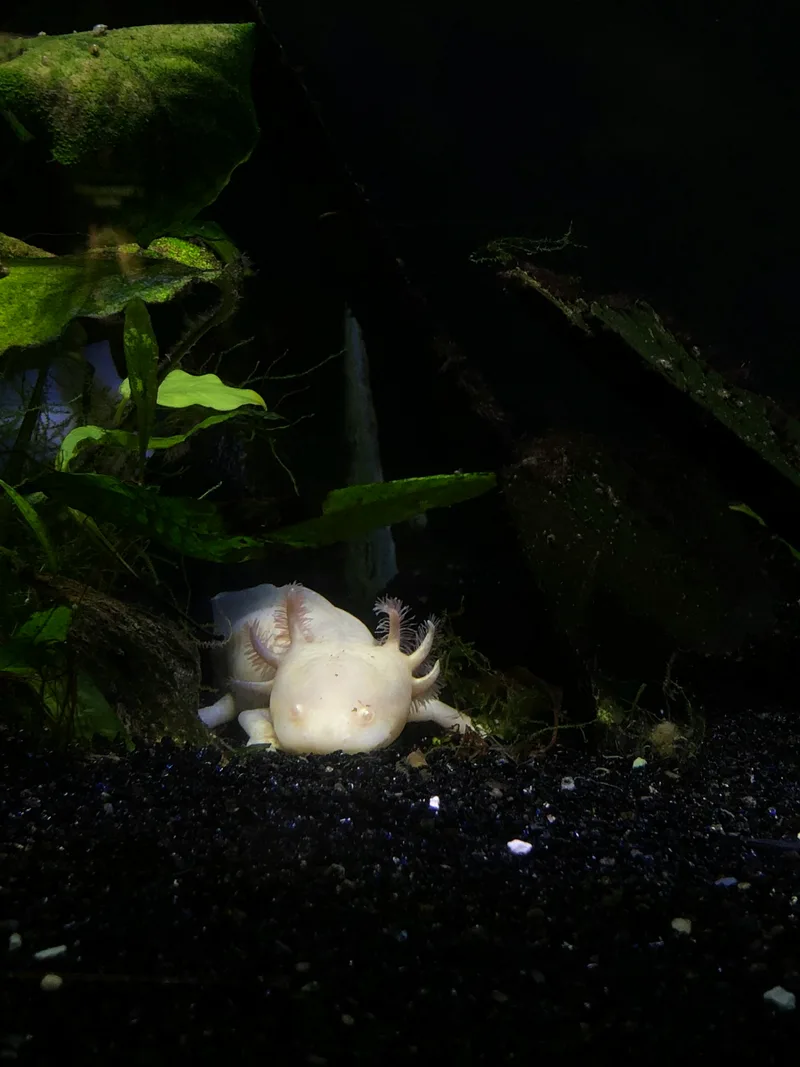
Yes, properly treated tap water is fine for axolotls (Ambystoma mexicanum), and for most keepers it is genuinely the best everyday option. The catch is the opposite of what most pet stores tell you: distilled and straight reverse osmosis water are the dangerous ones, because they have been stripped of the minerals an axolotl needs to hold its own body salts in balance. Tap, dechlorinated and within a fairly narrow parameter window (roughly pH 7.4 to 7.6, 7 to 14 dGH), is the water their gills are built for. And axolotl gills, unlike a fish's, sit out in the open.
How do you prepare tap water for an axolotl?
Before any water goes near the axolotl, you need to know what is in it, get it to the right temperature, knock out the chlorine and chloramine, and put it into a tank that has already finished cycling. None of the steps is hard. They have to be done in order, because skipping one is what hurts the animal.
The full pre-fill checklist:
- Test your tap first. Run a liquid test kit on a fresh sample straight from the faucet. You want pH, GH, KH, and ammonia. This is a one-time baseline per household, not a weekly chore, and it tells you whether your tap is already in the right window or whether you will need to adjust it.
- Match the temperature to the tank. Axolotls want cool water, ideally 60 to 64°F (16 to 18°C). Never higher than 68°F (20°C) for any length of time. If your tap runs warm, fill a bucket the night before and let it sit in the coolest room you have until it equalizes.
- Dose a conditioner that handles chloramine. Seachem Prime is the default. One drop per gallon (one capful per 50 gallons) neutralizes chlorine, breaks the chloramine bond, and detoxifies the ammonia the broken bond leaves behind, all at once. Any conditioner that explicitly says "removes chloramine" on the label will do the same job. One that only says "removes chlorine" will not.
- Only refill into a cycled tank. A cycled tank has a live bacterial colony that eats ammonia and nitrite as fast as the axolotl produces them. An uncycled tank does not, and fresh water going into it will not save the animal from an ammonia spike. If you are starting from zero, cycle the tank fishless first and put the axolotl in only when ammonia and nitrite both read zero with a detectable nitrate reading.
- Check for an ammonia spike 24 hours later. Even a cycled tank can stumble after a large water change. A quick test the next day catches it before it becomes a problem.
The order matters most on the first fill. After that, on weekly water changes, you are only doing steps two and three, plus a test if anything looks off.
Is your tap water actually the right kind for an axolotl?
Axolotls want water that sits in a fairly narrow window: pH 7.4 to 7.6 and 7 to 14 dGH. That is moderately hard, slightly alkaline, and buffered well enough that the pH holds steady between water changes. Most municipal tap water in North America and Europe lands somewhere in that window already, which is why the "just dechlorinate and use it" advice works for most people most of the time.
To find out if yours does, you have two options. The fast one is a freshwater test kit (API's liquid kit is the reference). The slow one is your city's annual water quality report, which is usually a PDF on the utility's website and will list hardness and pH near the top. The report tells you the baseline. The test kit tells you what is coming out of your tap this week.
Once you know your numbers, you can read them against the axolotl target. Three failure modes come up often:
- Too soft. GH under about 5 dGH, with little or no KH buffer. The pH swings between water changes and tends to crash downward. This is common in rainwater-fed systems and some mountain towns. Remineralize with crushed coral in the filter, an aragonite sand layer, or a Wonder Shell in the tank. All three slowly add calcium and carbonate back into the water and stabilize the pH.
- Too hard. GH well over 14 dGH, often with pH pushed up near 8.2. This is common in parts of the American Southwest and in hard-water regions of the UK. Cut the tap with reverse osmosis water at whatever ratio brings the GH back into range. Do not use straight RO on its own.
- Wrong pH. If your tap pH is stuck below 7.0 or above 8.0 with no obvious hardness problem, the simplest fix is bottled spring water with a mineral profile on the label that matches the target. Chasing pH with chemical adjusters is fragile and tends to fail loudly.
A quick reference for matching a tap reading to the right fix:
| Tap reading | Why it matters | What to do |
|---|---|---|
| pH below 7.0 | Too acidic for the axolotl's slime coat and filter bacteria; the tank will struggle to cycle | Remineralize with crushed coral or a Wonder Shell, or cut with bottled spring water |
| pH above 8.0 | Alkaline enough to stress gill function and shift ammonia toward its more toxic form | Cut the tap with RO water until pH settles between 7.4 and 7.6 |
| GH below 7 dGH | Not enough calcium and magnesium for healthy bone and gill tissue; no buffer means pH crashes | Add crushed coral, aragonite substrate, or a Wonder Shell |
| GH above 14 dGH | Mineral load stresses the kidneys over time and usually drags pH up with it | Mix with RO water at a ratio that brings GH back under 14 |
| Chloramine present | Bonded ammonia-chlorine compound that does not off-gas and damages gill tissue on contact | Use a conditioner labeled for chloramine (Seachem Prime or equivalent) at every water change |
| Baseline ammonia above 0 | Rare but real in some municipal systems; will stall a cycle and poison the tank | Dose Prime (it temporarily binds ammonia) and filter through a cycled sponge or polyfilter before use |
The full set of ideal water parameters for axolotls is pH 7.4 to 7.6, GH 7 to 14, KH 3 to 8, temperature 60 to 64°F, ammonia zero, nitrite zero, nitrate under 40 ppm.
Is bottled or distilled water safer than tap?
Tap, bottled spring, and distilled water are not interchangeable. The ranking most pet-store advice gives ("distilled is purest, so distilled is safest") is exactly backwards for axolotls, and the reason matters if you want to avoid spending a hundred dollars a month on the wrong kind of water.
Distilled water and straight reverse osmosis water have been stripped of almost everything. No calcium, no magnesium, no carbonate buffer, nothing. That sounds clean, and for a kettle it is. For an animal, it is not. Axolotls sit in their water with very thin, very wet skin, and they need a mineral gradient on the outside of their body to regulate the salts and water on the inside. Put them in water with no minerals and their body starts leaking the minerals it has. At the same time, the pH of unbuffered RO or distilled water will swing wildly on any input at all, including the animal's own waste. The tank becomes unstable within days.
Bottled spring water is a different story. If the label shows a mineral profile in the axolotl's range (check the pH and the hardness in ppm, multiply ppm by 0.056 to get dGH), it is perfectly usable. The problems with bottled spring water are practical rather than chemical. Brands vary, batches vary, and a 20 or 30 gallon axolotl tank eats through gallon jugs fast enough that the cost adds up in a hurry. It is a reasonable fallback when the tap just will not work. It is a strange default when it does.
Tap water, properly treated, is the only one of the three that is both safe and sustainable for the long haul. Side by side:
| Water type | Safe for axolotls? | Notes |
|---|---|---|
| Tap (dechlorinated) | Yes, if it meets the target | The default for almost everyone. Requires a chloramine-capable conditioner and a baseline that is within the pH and GH window. Cheap, consistent, and readily available. |
| Bottled spring | Sometimes | Safe only if the label shows a pH and hardness in range. Mineral profile varies by brand and batch. Expensive at tank volumes. Good as a fallback if your tap is unfixable. |
| Distilled or straight RO | No | Strips out the minerals the axolotl needs to regulate its body salts, and has no buffer, so pH crashes on any input. Actively harmful as the sole water source. Only useful mixed with tap or remineralized. |
If bottled is the call for your situation, check the label for calcium and magnesium in the right ratio and a pH near 7.5 before buying, since the best bottled water for axolotls varies brand to brand and even batch to batch.
Why does chloramine matter so much for axolotls?
Chlorine and chloramine both kill microorganisms in the water supply, but they behave very differently once they reach your tank. Chlorine is volatile. Leave a bucket of chlorinated tap water sitting open overnight and most of the chlorine will off-gas on its own, which is why older aquarium books often just said "age the water 24 hours and pour it in." That advice is no longer safe, because most municipal water systems in North America and a growing number in Europe have switched from chlorine to chloramine. Chloramine is chlorine bonded to ammonia, and the bond is stable. It does not off-gas. Letting the bucket sit does nothing. A conditioner that says "removes chlorine" but not "removes chloramine" also does nothing. You have to break the bond chemically, which is what Prime and its equivalents do.
Chloramine matters for every fish, but it matters more for axolotls than for almost anything else in the hobby, because of where their gills are. Most fish breathe through gill filaments tucked behind a hard gill cover (the operculum), which gives the delicate tissue a layer of protection from whatever is in the water. Axolotls do not have that. Their gills are external. The pink or red feathery plumes that grow out of the sides of their head, the ones that give them their whole face, are the gills. They sit directly in the water, unprotected, the entire time the animal is alive.
Did you know? Axolotl external gills are richly branched and packed with blood vessels specifically to maximize contact between their blood and the surrounding water. The same adaptation that gives them one of the most expressive faces in the hobby is what makes them unusually sensitive to what is dissolved in the water touching them.
That is why dechlorinating matters more here than in a tropical community tank. A chloramine molecule that drifts past a neon tetra's gill cover is mostly filtered out before it does damage. A chloramine molecule in an axolotl tank is in direct contact with exposed gill tissue from the second it enters the water. The same external, feathery gills that give an axolotl its face are the reason tap water, properly prepared, is not a compromise you are making on their behalf. It is the same water they would thrive in. You are meeting their gills where they live.