How often should I do water changes for an axolotl?
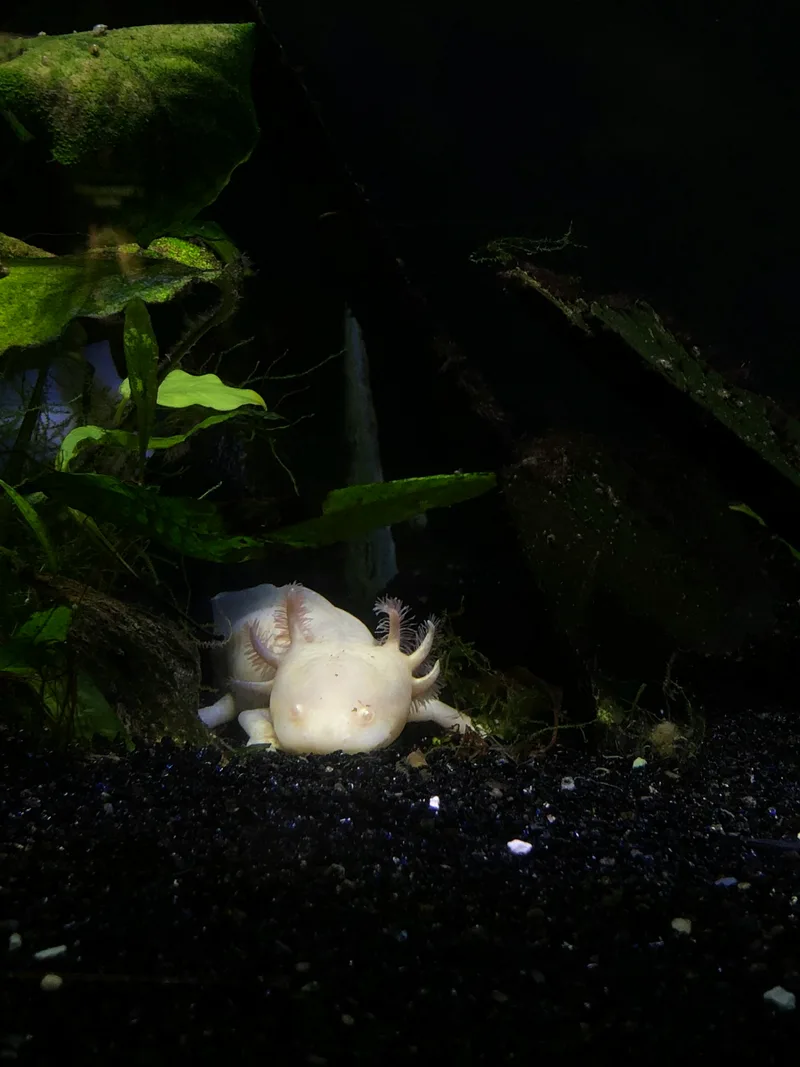
In a fully cycled axolotl tank, change 20 to 25 percent of the water once a week and spot-clean any visible waste daily with a turkey baster. The reason that schedule is tighter than what a goldfish or a tetra would need is that an axolotl (Ambystoma mexicanum) excretes ammonia straight through its gills and skin, not just its kidneys. The water it is sitting in is the water it is offloading waste into, with no scales or mucus layer in between. That biology also flips the rule on a tank that has not finished cycling yet, where the once-a-week schedule will not keep up.
How Much Water Should You Actually Change Each Week?
Once a week, take out 20 to 25 percent of the water and replace it with fresh, dechlorinated water that is close to your tank's temperature. Between changes, keep a turkey baster by the tank and suck out any visible waste you see sitting on the substrate. That is the whole routine, in two habits.
The temperature match matters more for axolotls than for most aquarium animals. Their tanks sit cold, usually between 60 and 64°F (16 to 18°C), and dumping in a bucket of room-temperature tap water can jolt them hard enough to stress the gills. Age the replacement water in a covered container overnight, or chill it in the fridge before it goes in. Dechlorinate it with a standard conditioner before the pour, because chlorine and chloramine will burn gill tissue on contact.
Here is the weekly routine as a checklist:
- Test the tank first so you know where you are starting. Ammonia and nitrite should read zero; nitrate tells you whether 20 percent is enough or whether you should lean toward 30.
- Turkey-baster any visible waste off the substrate and out of hiding spots.
- Siphon 20 to 25 percent of the water volume into a clean bucket.
- Prepare the replacement water at a matching cool temperature, around 60 to 64°F (16 to 18°C), either aged overnight or chilled in the fridge.
- Add dechlorinator to the new water and let it mix.
- Pour the new water back in slowly, against the tank wall or over a plate, so temperature and pH settle without a sudden swing.
Weekly is a floor, not a ceiling. A heavily fed tank, a smaller tank (anything under 20 gallons / 75 liters), or a tank with two axolotls in it will often need a second change midweek. If you test and your nitrate has climbed past 20 ppm since the last change, that is your tank telling you once a week is not quite keeping up. The fix is more frequent changes, not bigger ones, because a single massive change is harder on the animal than two moderate ones.
The ideal water parameters for axolotls sit in a narrower band than most fish will tolerate: pH around 7.4 to 7.6, GH between 7 and 14, and ammonia and nitrite flat at zero. Those are the numbers your test kit should read before and after each change. If the post-change readings are not landing in those ranges, the change was either too small or the replacement water is not matching what the tank needs.
What If Your Tank Isn't Fully Cycled Yet?
A new tank, or one that has recently lost its filter bacteria, cannot keep up with an axolotl on a weekly schedule. Until the filter is processing waste on its own, you are the filter, and the job is daily.
The rule for an uncycled tank: change around 20 percent every day, and test every day. You are watching for ammonia and nitrite. As long as both read at or near zero, you are changing enough. If either one starts to climb, change more water, more often, until they come back down. This is not forever. A fish-in cycle with an axolotl usually takes four to six weeks to finish, and during that window the daily change is what keeps the animal safe while the bacteria colony grows into the load.
The same trigger rule applies once the tank is cycled. If nitrate creeps above 20 to 40 ppm between weekly changes, that is your cue to tighten the schedule. Forty is the outside edge most keepers are willing to accept. Below 20 is where a healthy cycled axolotl tank usually sits when the weekly rhythm is working. The calendar sets the default; the test kit decides when to override it.
Did you know? Axolotls excrete ammonia straight through their gills and skin, not just through their kidneys. There is no lag between the waste leaving the body and the animal sitting in it. It is also why their tolerance for nitrogen compounds runs lower than a typical tropical fish's: the same water they are trying to offload waste into is the water their gills are pulling oxygen from.
Why Do Axolotls Need More Careful Water Changes Than Most Fish?
Axolotls are not scaled fish. They are cool-water salamanders with permeable skin and external gills, and both of those features change what the water is doing to them. A goldfish has a waterproof covering of scales and mucus between its bloodstream and the tank. An axolotl has feathery gill filaments hanging out in the open and skin that lets dissolved compounds move through it more directly. Anything in the water reaches the animal faster, and with less of a buffer in between.
The cold temperature is the second half of the picture. Axolotls are kept around 60 to 64°F (16 to 18°C), which is cold enough that beneficial bacteria in the filter work more slowly than they would in a tropical tank running at 78°F. Cold water also holds more dissolved oxygen, which is good for the axolotl, but it holds that oxygen in a filter environment where the nitrogen cycle is running at about half speed. You have an animal producing waste faster than the bacteria can chew through it, inside a body that is more exposed to whatever the bacteria miss.
That is the whole case for the weekly change. It is not really maintenance in the way a filter swap is maintenance. It is you stepping in to do what a cool, closed system cannot do on its own. Axolotls evolved in the high-altitude lakes around what is now Mexico City, a slow, spring-fed system where cold, clean water moved through constantly and nitrogen compounds never got the chance to build up. Their bodies learned to tolerate cool, clean water, not nitrogen-rich water. A bucket of dechlorinated tap water, poured in once a week, is the cheapest approximation of that flow you can give them at home.