What are the ideal water parameters for axolotls?
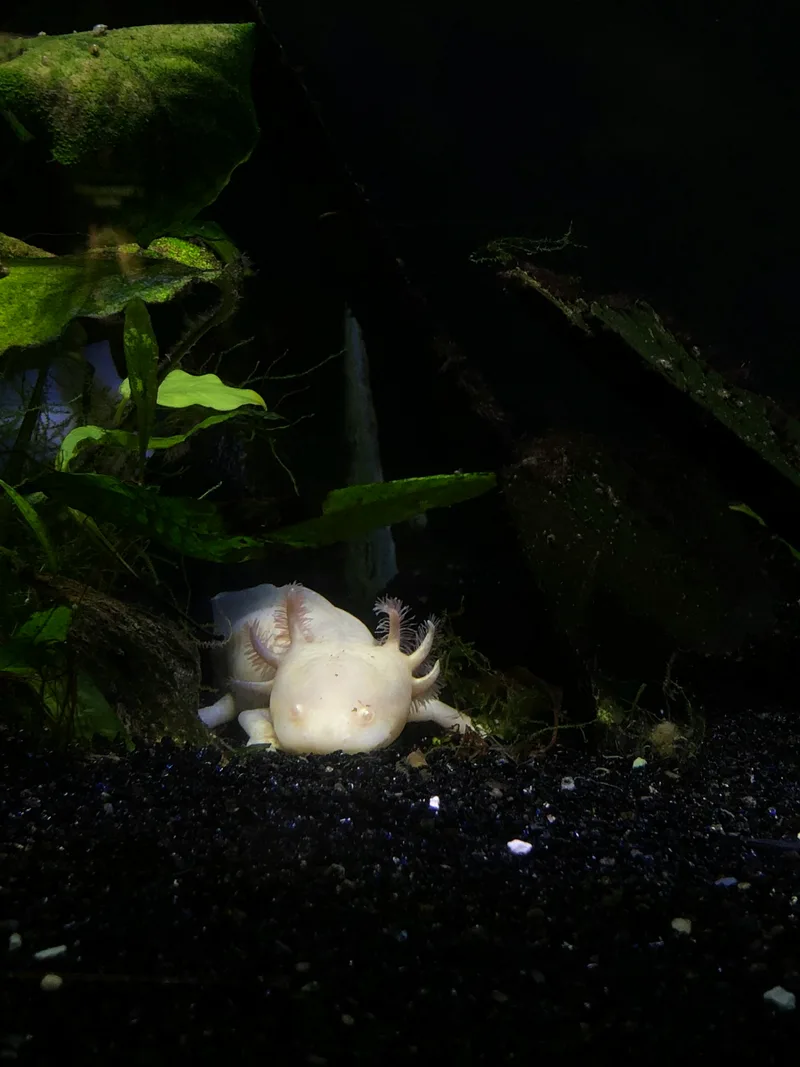
Axolotls want cool water between 60 and 64°F (16 to 18°C), a pH of 7.4 to 7.6, moderately hard water at 7 to 14 dGH and 3 to 8 dKH, and ammonia and nitrite at 0 ppm with nitrate under 20 ppm. Temperature is the one that does the killing. A tank sitting at 75°F because the room got warm in July is a medical emergency on a timer, and a perfect pH cannot cancel that out. Almost everything strange on this list traces back to one fact most owners only learn after something goes wrong: an axolotl is not a fish, and the tropical-tank habits that follow from thinking it is are aimed at a different animal.
What are the exact target numbers?
Here is the full set, laid out so you can put your test kit readings next to it and see where you stand.
| Parameter | Ideal range | Tolerable (short term) | Hard limit |
|---|---|---|---|
| Temperature | 60 to 64°F (16 to 18°C) | up to 68°F (20°C) | never above 72°F (22°C) |
| pH | 7.4 to 7.6 | 6.5 to 8.0 | outside 6.5 to 8.0 |
| GH (general hardness) | 7 to 14 dGH | 4 to 7 dGH | below 4 dGH |
| KH (carbonate hardness) | 3 to 8 dKH | 2 to 3 dKH | below 2 dKH (pH swings) |
| Ammonia | 0 ppm | 0.25 ppm briefly | any sustained reading |
| Nitrite | 0 ppm | 0.25 ppm briefly | any sustained reading |
| Nitrate | 0 to 20 ppm | up to 40 ppm | above 40 ppm |
Temperature is the load-bearing number on this list. A few tenths of a degree off on pH is a rounding error. A tank sitting at 75°F because the room got warm in July is a medical emergency on a timer, and no amount of correct hardness or nitrate will cancel that out. If you only remember one thing from this article, remember that axolotls are cold-water animals and heat is the thing that kills them.
Ammonia and nitrite reading 0 is also non-negotiable, and slightly more serious for axolotls than for the average tropical fish. Ammonia exists in two forms in water, a safer ionized form and a much more toxic unionized form, and the balance between them tips toward the toxic form as pH and temperature rise. Axolotls live in the slightly alkaline water that favors the toxic form, so even a low reading that would be tolerable in an acidic community tank is a bigger problem in an axolotl setup. Treat any reading above 0 as something to fix today, not this week.
How do you actually hit these numbers?
The method here is less about a maintenance schedule and more about avoiding the handful of moves that get axolotls into trouble in the first place. If you set the tank up correctly, the parameters mostly hold themselves.
- Use a liquid test kit, not test strips. The margins you care about, especially on ammonia and nitrite, are tight enough that strips will lie to you in both directions.
- Dechlorinate every drop of tap water before it touches the tank. Chlorine and chloramine damage gill tissue and the slime coat, and axolotls breathe partly through both. A standard aquarium dechlorinator added to a bucket before you pour is enough.
- Fully cycle the tank before the axolotl goes in. A cycled filter is the only thing holding ammonia and nitrite at 0 once there is an animal producing waste, and trying to cycle with the axolotl already in residence is how most beginners end up with chemical burns on their animal.
- Put the tank in the coolest room in the house, off any direct sun, and away from radiators, south-facing windows, and electronics that throw heat. Passive room choice does more for your summer temperatures than any gadget you can buy.
- Keep a small clip-on fan you can aim across the water surface during a warm stretch. Surface evaporation pulls a surprising amount of heat out of the tank, often 3 to 5°F, which is usually the difference between "fine" and "call the vet."
- Keep two or three frozen water bottles in the freezer as an emergency cooldown. A sealed bottle floated in the tank buys you hours on a hot afternoon while you sort out something more permanent.
- If your ambient room temperature stays above 72°F (22°C) for weeks at a time, a chiller stops being optional. It is expensive, it is noisy, and it is the only thing that reliably holds an axolotl tank cool in a warm climate or a top-floor apartment.
Almost every habit a new axolotl keeper brings in from a tropical setup works against the animal. A heater set to 78°F, a bag of sharp gravel substrate, a tank stand by the window where the betta used to live, an aggressive filter flow that looks healthy in a planted tank. Each of those is fine somewhere else in the hobby and dangerous here. Hitting the parameters is mostly a matter of catching those imports before they catch you.
Why does an axolotl need cool, moderately hard water when tropical fish don't?
The numbers on the table are not arbitrary. They are a picture of Lake Xochimilco, the shallow, spring-fed lake complex south of Mexico City where the axolotl (Ambystoma mexicanum) is the only place it still exists in the wild. That lake sits at roughly 7,300 feet of elevation, it is fed by mountain snowmelt and mineral-rich springs, and it stays cool and moderately hard year-round. Everything strange about axolotl care reads as obvious once you picture that water.
Axolotls are neotenic salamanders, which is a fancy way of saying they keep their larval body for life and never climb out onto land. They breathe through a small pair of lungs, through the feathery external gills on the sides of their head, and through their skin. Two of those three routes depend on dissolved oxygen moving directly between water and living tissue, and cool water holds considerably more dissolved oxygen than warm water does. Water at 60°F holds roughly a third more oxygen than water at 80°F, and for an animal that is effectively breathing through its skin, that gap is the difference between a comfortable gas exchange and a constant deficit.
Did you know? Axolotls share a cool, well-oxygenated, moderately hard water requirement with fish like trout, even though pet stores usually shelve them next to tropical community fish. Lake Xochimilco is fed by mountain snowmelt and spring water, and the biology of the animal is tuned to that water all the way down.
Above about 72°F, the math flips on them. Metabolic demand rises with temperature, dissolved oxygen falls with temperature, and the animal starts burning energy faster while having less oxygen to burn it with. What you see from the outside is appetite loss, cloudy patches of excess mucus on the skin, a curled tail tip, more time spent hanging near the filter outflow where the water is most aerated, and eventually fungal and bacterial infections that would never have taken hold on a healthy animal. None of that is an infection caused by warm water. It is stress caused by warm water, and the infection is opportunistic.
The hardness numbers come out of the same lake. Moderately hard water gives the axolotl's skin and slime coat the calcium and magnesium they need to work as a barrier, and soft water below about 4 dGH leaves animals prone to skin problems that look a lot like poor water quality even when ammonia and nitrite are clean. The KH minimum matters for a less obvious reason. KH is what holds pH steady between water changes, and a tank running on KH below 2 dKH is one filter hiccup away from a pH crash that takes the biofilter down with it. A stable 7.5 is much safer for the animal than a "perfect" 7.4 that is drifting by half a point every week.
pH in the 7.4 to 7.6 window matters for the same reason the hardness does. Axolotl physiology evolved against that water, the nitrifying bacteria in a mature filter prefer neutral to slightly alkaline conditions, and the whole system is tuned to sit in that band. You can push a little in either direction without an immediate problem, but you are working against the biology instead of with it, and the cost usually shows up as a tank that feels slightly off in ways that are hard to pin down.
The throughline is simple. An axolotl is not a fish. It is an aquatic amphibian whose body was shaped by a cool, mineral-rich lake at elevation, and every instinct a fishkeeper brings from a tropical community tank is an instinct aimed at a completely different animal. The parameters on this list are not arbitrary targets. They are what happens when you move a piece of Lake Xochimilco into a glass box in your living room.
What's the next thing to check after the parameters?
Once you have a target to aim at, the follow-up questions are almost always about water source, change frequency, and holding temperature through a warm week.
Most tap water in North America and western Europe becomes axolotl-safe with a standard dechlorinator added to the bucket, and the choice between tap, RO, and bottled mostly comes down to what your local water actually measures on a test kit. A mature, cycled tank with one axolotl generally holds steady on a weekly partial water change of around 20 percent of the tank volume, with the exact schedule bending around your stocking and how fast nitrate creeps up between tests. And holding that cool temperature without ever plugging in a heater is mostly a matter of room choice, surface evaporation from a small fan, and knowing when a chiller stops being optional.
None of those follow-ups change the short answer at the top of this page. They just give you the tools to hold those numbers steady once you know what you are aiming for, and once you have stopped treating the tank like a tropical fish setup that happens to contain a salamander.