Can axolotls regenerate anything?
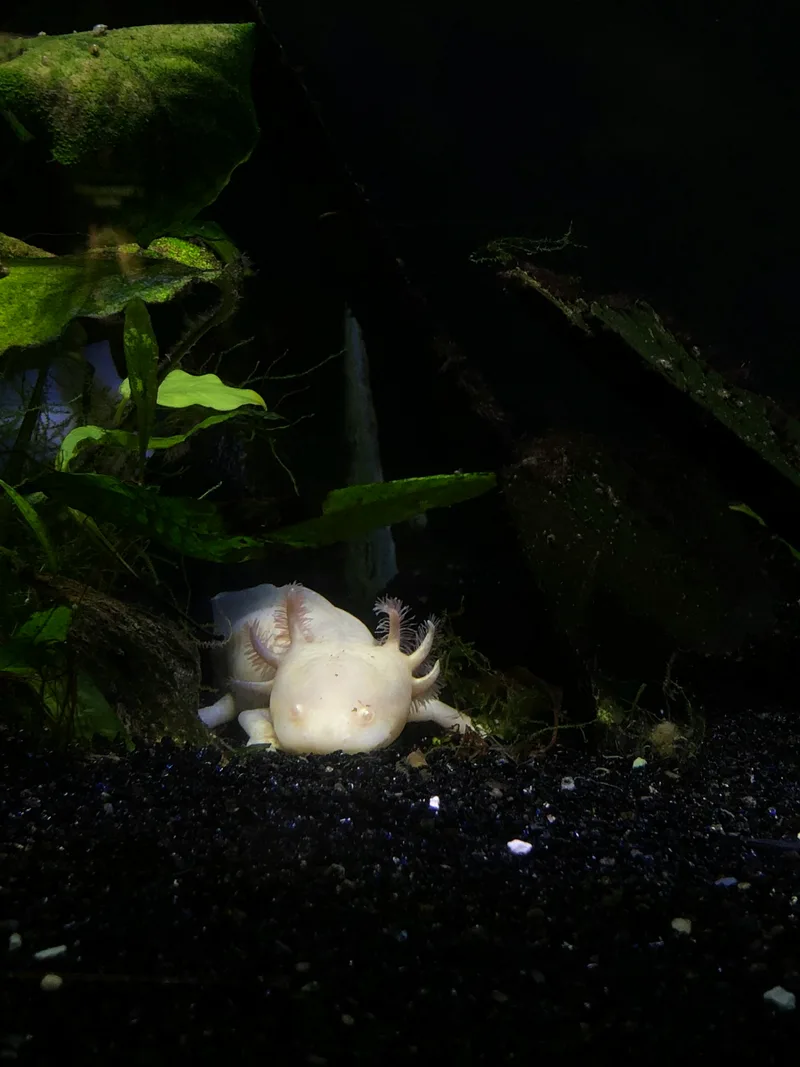
An axolotl (Ambystoma mexicanum) can lose an entire leg and grow it back, toes and all, with no scar, and then do the same thing again next year. The list of what it can rebuild runs almost comically long: tail, feathery gills, jaw, lengths of spinal cord, even patches of heart and brain. So the honest answer to "anything?" is nearly. The catch is that the same animal that can regrow a whole leg can be dead in a few days from water a couple of degrees too warm, and squaring those two facts is the entire job of keeping one alive.
What Can an Axolotl Actually Regenerate?
The honest answer to "anything?" is a long list with a few real gaps at the end. Most animals seal a wound, scar over, and stop. An axolotl treats a missing body part as a problem to be solved, and it solves a remarkable number of them:
- A whole leg, down to the individual toes
- The tail, including the fin and the muscle and bone inside it
- The external gills, those feathery pink stalks behind the head
- The lower jaw, teeth included
- The lens of the eye, and some of the tissue around it
- Long stretches of spinal cord, with the nerve connections wired back up
- Sections of heart muscle
- Areas of the brain
- The ovaries
- The thymus, a small immune-system organ that 2026 research showed it can fully rebuild, something biologists had assumed was beyond reach
That last one matters because it shows the list is still growing. Every few years a structure people thought was off the table turns out to regrow too.
Then the limits, because they're real. An axolotl can't regrow its head, and it can't outrun the loss of a vital organ's function long enough to rebuild it. If something fails fast enough to kill the animal, regeneration never gets its chance. And the ability isn't infinite per body part: amputate the same limb over and over and the regrowth gets slower and sloppier, with the odd extra or missing toe. So "anything" sits closer to the truth for an axolotl than for almost any animal alive. It just isn't quite literal.
How Does an Axolotl Regrow a Whole Leg?
The strange part isn't that the leg grows back. It's that the stump somehow knows what to build. Cut at the wrist and it regrows a hand. Cut at the shoulder and it regrows the entire arm, no more and no less. How does a bare wound know how much limb is missing?
It starts with the cells right at the cut. Instead of scarring, nearby cells rewind to a flexible, almost embryonic state, lose their old job, and gather into a small bud called a blastema, a cluster of cells that will rebuild whatever the body lost. The blastema is the rough draft of the new limb.
What turns that draft into the right limb is a chemical gradient. The wound carries more of a signaling substance called retinoic acid (a molecule related to vitamin A) near the body and less of it farther out toward the toes. The local concentration acts like an address: a high reading tells the cells "you're up near the shoulder, build the whole arm," a low reading tells them "you're out at the wrist, build only a hand." The cells read their position from the chemistry and grow exactly the part that belongs there.
And through all of it the wound never scars. That clean, scar-free healing is the step mammals can't manage; our wounds close with tough scar tissue that shuts the door on regrowth before it can start. The axolotl keeps the door open.
Did you know? The axolotl genome runs to roughly 32 billion base pairs, about ten times the size of the human genome. Scientists are still combing through that enormous instruction set for the genes that make regeneration work.
If They Can Regrow a Leg, Why Do Axolotls Die So Easily?
Because regeneration repairs damage; it doesn't prevent it. Growing back a leg does nothing about water that's too warm, an ammonia spike, a creeping infection, or the slow wear of chronic stress. Those are the things that actually kill axolotls in home tanks, and regrowing tissue is no defense against any of them.
There's also a cost. Rebuilding a limb takes energy and clean biological conditions, and the body will only spend that energy well if it's otherwise healthy, cool, and well fed. An axolotl sitting in warm or dirty water is already struggling to hold itself together. Ask it to rebuild a leg on top of that and it falls behind, deteriorating faster than it can repair. Regeneration is a repair kit, not a suit of armor. It fixes what's already broken; it can't stop the water from breaking the rest.
What Should You Do if Your Axolotl Loses a Limb or Gill?
First, find what caused it and remove that, because regrowth means nothing if the same thing takes another bite. The usual suspects are a tankmate (axolotls nip each other's limbs and gills, which is most of why they're kept alone), sharp or rough decor, or a water-quality problem that's damaging the gills from the inside. Fix the cause before you worry about the wound.
Then give the regrowth the conditions it needs, which is the same short list that keeps any axolotl healthy: pristine, cool water. Keep the temperature in the 60 to 64°F (16 to 18°C) range and the water free of ammonia and nitrite. If you can't trust the tank, for example while a cycle is still settling or a tankmate is being rehomed, move the axolotl to a tub and do a full water change every day. Clean water is the single biggest thing on your side.
Feed well, since the body is rebuilding tissue and needs the material to do it. And leave the wound alone. It's tempting to reach for antiseptics or medications, but an axolotl's skin is delicate and most treatments do more harm than the injury, especially the salt and chemical dips meant for fish. A clean wound in clean water is exactly what regeneration evolved to handle.
Set your expectations for the clock, too. Regrowth takes weeks to months, faster in a younger, smaller axolotl and faster in water at the warm end of the safe range, slower in a big adult or cooler water. If gills are the part you're watching, the good news is that damaged axolotl gills fill back out on their own once the cause is gone, often within a few weeks. And if you're staring at a missing limb wondering when you'll see progress, the pace of axolotl regrowth follows a fairly predictable timeline.
Do Axolotls Keep Their Regeneration Powers for Life?
Yes, through their whole adult life, which is itself unusual; most animals that can regenerate at all lose the knack as they grow up. An axolotl doesn't. It slows with age and gets less reliable in a limb that's been regrown many times, but the basic ability stays switched on for the full 10 to 15 years. If you're curious where the ceiling sits, the number of times an axolotl can regrow the same part is a real and measurable limit.
The sharper catch is what happens if the animal grows up in the other sense. An axolotl normally stays in its larval form for life, gills and finned tail and all. In rare cases it goes through metamorphosis anyway and turns into a land-living salamander, and when it does, it loses most of its regenerative ability. That's a genuine clue: staying "forever young," never finishing the change into an adult salamander, seems to be part of how the ability works in the first place. The same shift that pulls an axolotl onto land switches off the scar-free healing that regrowth depends on, and what an axolotl's body goes through when it morphs reads almost like watching that machinery wind down.
Hold onto the inversion in all of this. Laboratories keep axolotls to learn how to repair human bodies, studying an animal that can do what our medicine can't. In your tank the relationship runs the other way. The regeneration comes free; you don't have to do anything to switch it on. Your entire job is the part regeneration can't do for itself: the cool, clean water that the rebuilding depends on. The trick only ever works on an axolotl that was healthy before it got hurt.