What happens when axolotls morph?
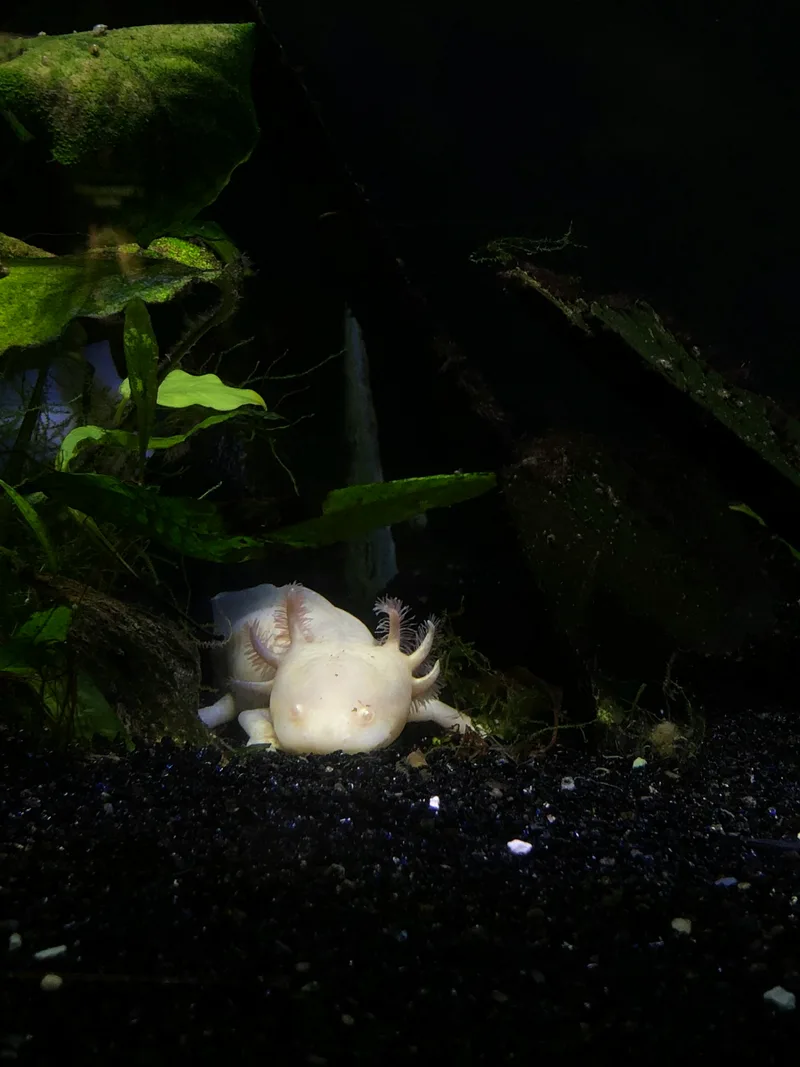
By the time the gills go, most of the change is already over. When an axolotl morphs, it finishes the salamander transformation almost every other amphibian goes through as a matter of course: the external gills reabsorb, the tail fin recedes into a rounded stub, eyelids form, the skin thickens, and the lungs take over for breathing. What looks from the outside like a single dramatic event is a weeks-long internal remodel arriving at its final visible step. The animal that comes out the other side is a fully terrestrial salamander with a sharply reduced regenerative ability and a lifespan that typically drops from ten or fifteen years to two to five.
What Actually Changes on the Outside?
The first sign is usually the tail. The wide caudal fin (tail fin) that lets the axolotl swim starts to thin along its top and bottom edge, and over a couple of weeks it recedes until the tail is a rounded, muscular stub built for pushing the animal along on the ground.
Around the same time, eyelids start to form over eyes that have never had them. Larval axolotls don't need eyelids because there is nothing to blink at underwater. As the animal prepares for air, the lids develop from the rim of the eye inward and the eye starts to look more like a tiger salamander's than the wide, lidless larval eye most owners are used to.
The skin is the next thing to change, and it's the change that's easiest to miss until you notice it. It thickens, the slime coat that protected the animal in water recedes, and new pigmentation often comes through. A leucistic axolotl can develop dark speckling it never had. A wild-type can shift the pattern of its dorsal blotching. The color change is part of the same remodel that thickens the skin for life out of water.
Then the gills. The famous feathery branches behind the head don't fall off, they get pulled back in. The filaments shrink week by week until the branches look like small rosy stubs, and then the gill stalks themselves retract into the head. By the time the gills are gone, the head has visibly reshaped: shorter, blunter, with the gill-stalk sockets sealed over by new skin.
The legs come along with all of this. The webbing between the toes recedes, the toes themselves become more clearly defined, and the legs thicken with new muscle for supporting the animal's weight on land. The front legs put on the most visible muscle because they take the load when the animal lunges to catch prey.
Did you know? If you watched a morphing axolotl from above, week by week, the silhouette change is almost cinematic. Week one: a wide, fringed-headed larva with a finned tail. Week three: the head looks different but you can't say why. Week five: the gills are stubs, the tail is a rod, and the animal looks like a different species sharing the same tank.
The order in which you'd see these changes if you watched the animal week by week:
- The tail fin (caudal fin) thinning along its edges, then receding into a rounded tail
- Eyelids forming over previously lidless eyes
- The skin thickening and the slime coat receding, often with new pigmentation
- The gill filaments shrinking week by week
- The gill stalks pulling back into the head
- The legs and toes thickening, with the webbing between the toes receding
What's Changing on the Inside?
The lungs take over from the gills. This isn't as dramatic as it sounds, because axolotls already have lungs and use them in their larval form, rising to the surface every so often to gulp a breath of air. Watch a healthy axolotl long enough and you'll see it. What changes during the morph is which organ is doing the heavy lifting. The lungs go from a backup system to the primary one, and the gills, no longer needed, are reabsorbed.
The gut shortens. A larval axolotl eats small aquatic prey (worms, brine shrimp, small fish) that come into its mouth on a flood of water. A terrestrial salamander eats earthworms, crickets, and other invertebrates it catches on land. Those two diets need different intestines. The intestine physically remodels and shortens for the carnivore's terrestrial diet, and during the transition the animal often refuses food because the system handling that food is being rebuilt.
The tongue grows in. Larval axolotls don't use a tongue the way a land salamander does. They feed by what's called buccal suction: they snap their mouth open and the inrushing water carries prey straight in. A terrestrial salamander can't do that, because air isn't dense enough to carry anything. The tongue has to lunge out, stick to the prey, and pull it back in. That muscular tongue grows during the morph, and the animal has to learn how to use it.
Did you know? Larval axolotls feed by a kind of underwater vacuum cleaner. They snap their mouth open and the inrushing water carries prey straight in. Morphed axolotls have to give that up entirely and learn to use their tongue to catch food on land, which is one reason newly morphed animals often refuse food for a stretch. The mechanics of eating have completely changed.
The most striking internal change is the one axolotls are world-famous for losing. The regenerative ability that lets a larval axolotl regrow a leg, a gill, a piece of jaw, even sections of heart and spinal cord, drops sharply at metamorphosis. Lab work has shown roughly a twofold reduction in regeneration rate after induced metamorphosis. The limbs that do grow back come with malformations (extra digits, fused bones, asymmetric shapes) that the larval form wouldn't have produced. The genetic program that runs regeneration is still there, but it runs slower and less cleanly in the adult.
All of these changes are driven by the same chemistry. Thyroid hormones, mainly T3 and T4, are the trigger for amphibian metamorphosis everywhere. In axolotls, the thyroid produces very little of these hormones in the larval form, which is why the larval body persists for the animal's whole life. When something pushes thyroid output up, whether that's a temperature swing, an iodine surplus, or a genetic quirk, T3 and T4 flood the body and the remodel begins. The skin thickening, the gill reabsorption, the gut shortening, and the regeneration loss are all the same chemical signal arriving at different tissues.
How Long Does the Whole Transformation Take?
The visible part of the change takes two to four weeks once it starts in earnest. Some animals take longer, especially if conditions slow the process or stop and start it. From the first thinning of the tail fin to the last bit of gill stalk pulling into the head, three weeks is a useful average.
The internal remodeling overlaps with the visible part and continues for a few more weeks after the animal looks done from the outside. The tongue is still learning its job. The gut is still adjusting its length and the bacterial flora that came with the larval diet. The regeneration program is still winding down. An axolotl that "looks morphed" at week four is probably still being remodeled at week eight.
The transition is the most fragile window in the animal's life. The gills are gone or going, and the lungs aren't fully taking over yet, so the animal can drown in water that's too deep. The thickened terrestrial skin isn't quite there yet either, so it can also dry out on a substrate that's too low in humidity. Falling between the two failure modes is the trick.
What this means for the keeper is that the tank conditions need to change as the animal does. Water that was fine at the start of the transition becomes a drowning hazard by the middle. A humid land section that was useless to a larva is the only safe place to be by the end. Through the whole window, a morphing axolotl should be the only animal in its setup. Fish that were fine company for an aquatic axolotl will harass a vulnerable transitioning one, and the morphing animal can't defend itself.
What Does the Animal Become Once It's Done?
A morphed axolotl is, biologically, a Mexican-tiger-salamander-shaped adult. It walks on land, breathes air, and hunts by lunging at moving prey. It can sit in shallow water and absorb moisture through its skin the way other terrestrial salamanders do, but it cannot live submerged anymore. The animal needs to come out of the water to be itself.
The change is one way. There is no known way to reverse it. Once the gills are gone, they are gone, and the body has moved on from the larval program. An animal that has fully morphed will not turn back, even if you put it back in the cool, deep aquarium it came from.
The lifespan typically drops from the ten to fifteen years of an aquatic axolotl to roughly two to five years. The drop is real and consistent across reports, though the reasons are still partly worked out. Some of it is the regenerative loss. Some of it is the stress of the transition itself. Some of it seems to be that the thyroid program that drove the morph keeps the animal running hotter through the rest of its life. The animal that comes out the other side is recognizably the same individual, and it can have a good few years, but it has traded its long larval life for a short adult one.
The husbandry shifts to match. The setup becomes a paludarium with a shallow water section and a larger land area covered in damp moss or coconut fiber, with hides and live plants and humidity high enough that the skin stays moist. The diet shifts to terrestrial invertebrates: earthworms first, then crickets, mealworms, and waxworms. The same individual that ate frozen bloodworms off a feeding dish is now lunging at a cricket on a piece of cork bark.
A morphed axolotl typically lives two to five years after the transition completes, compared with ten to fifteen as a larva. The triggers for axolotl metamorphosis are narrow and almost always not what a careful keeper would do by accident. The early physical signs an axolotl is morphing are quite different from the more common skin and gill changes that mean stress.
The dramatic outside change, the gills disappearing into the head, is the last visible step of a remodel that has been running internally for weeks. The tongue has been learning a new way to catch prey. The gut has been shortening for terrestrial food. The regenerative cells have been losing their larval program. The animal at the end isn't a damaged axolotl. It's something the axolotl was always genetically equipped to become, held back, in the keeper's tank, by a switch the wild Mexican lake spent millions of years selecting against ever flipping.