Will my axolotl's gills grow back?
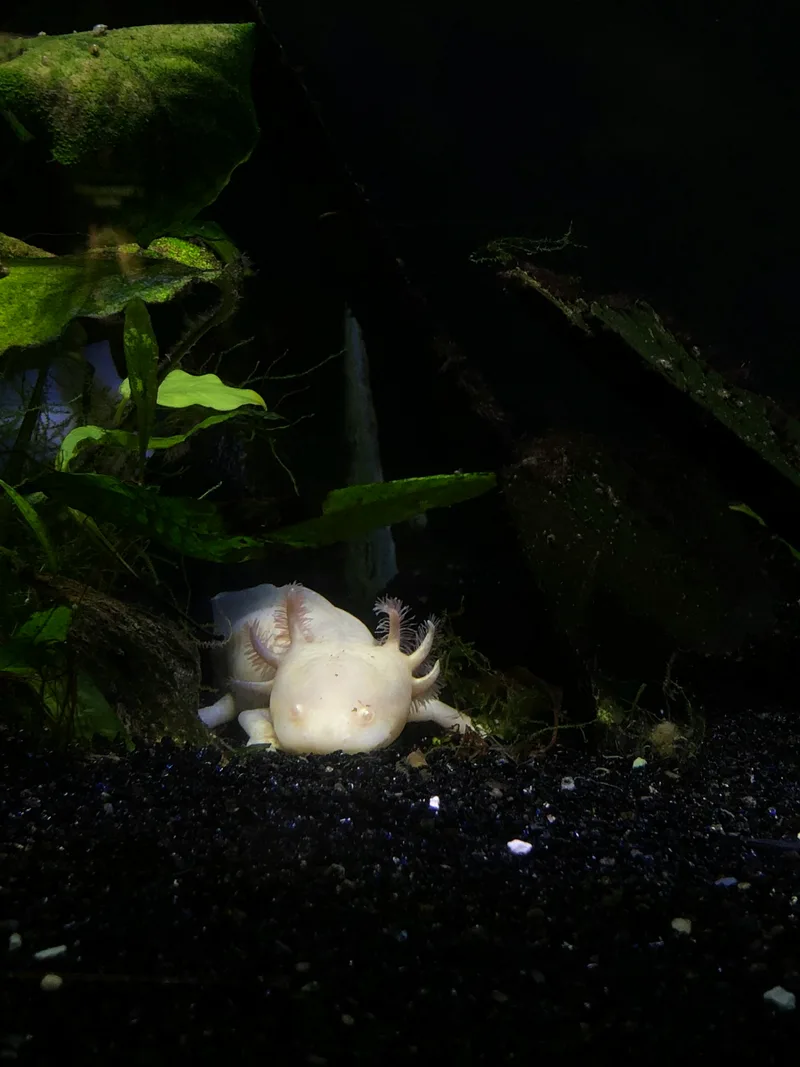
Yes, almost always. An axolotl's gills are covered by the same repair system that can regrow a whole leg, so the tissue already knows how to come back. The catch is that two very different problems look identical from the outside, both showing up as shrinking gills. Gills that got bitten or chemically burned regrow once the damage stops, while gills the axolotl is quietly absorbing, because its water is too warm or too stressful, won't return until you fix the cause. Telling those two apart is the whole answer, so the first thing to sort out is which one is happening in your tank.
Why Did My Axolotl's Gills Shrink in the First Place?
Short gills come from a few different places, and the cause decides everything about what happens next.
If the gill ends look ragged, snapped off, or unevenly chewed, that's physical damage. A tankmate took a bite, or the axolotl snagged a gill on a sharp ornament. This is the most forgiving case, because there's nothing wrong with the water or the animal. Once the source of the injury is gone, the gill rebuilds itself.
If both sets of gills are shrinking evenly and the stalks are curling forward over the head, that points to the water. Ammonia and nitrite burn living tissue, and an axolotl's gill filaments sit in direct chemical contact with the water, so they take the damage first. A single bad spike burns the tissue and it regrows once the water is clean again. Repeated burns over weeks or months are different, because tissue that keeps getting damaged can scar past the point of return.
If the gills are slowly thinning out and the filaments look sparse and wispy, with no sign of a bite or a burn, the axolotl is probably absorbing them. This is the one to understand, because it isn't an injury at all. In warm or poorly oxygenated water an axolotl downsizes gill tissue it can't afford to maintain, much like you'd stop heating rooms you don't use. The plumes shrink on purpose, and they grow back on purpose once the water gets cool and oxygen-rich again.
One look-alike is worth ruling out. White, cotton-like fluff clinging to the gills isn't shrinkage at all, it's a fungus, and it's a separate problem with its own fix.
Whichever case is yours, shrunken gills are not an emergency. An axolotl breathes through its skin and can gulp air at the surface, so it has room to spare while the gills recover.
| What the gills look like | Likely cause | Will they regrow? |
|---|---|---|
| Ragged, torn, or snapped-off ends | A bite or physical snag | Yes, reliably |
| Even shrinkage, stalks curled forward | Ammonia or nitrite in the water | Yes, once the water is fixed |
| Sparse, pale, wispy filaments | Warm or poorly oxygenated water | Yes, once conditions improve |
| White, cotton-like tufts | Fungus | Yes, after the fungus is treated |
How Do I Help the Gills Grow Back?
There's no medicine that regrows gills, and you don't need one. The job is to take away whatever is eating them and let the axolotl's own repair system do the rest. Almost all of that comes down to the water.
Get the water tested and corrected first, because it's both the most common cause and the one you control directly. The targets that matter most for the gills are zero ammonia, zero nitrite, and a cool temperature. Axolotls are cold-water animals, and warm water is one of the main reasons gills get absorbed, so keeping the tank at the right temperature for an axolotl does as much for the gills as anything else you can do.
- Test ammonia, nitrite, and nitrate, then do water changes until ammonia and nitrite both read zero.
- Bring the temperature down to 60 to 64°F (16 to 18°C); a fan over the surface or a small chiller helps in summer.
- Feed protein-rich food like earthworms, which gives the axolotl the raw material to rebuild tissue.
- Remove any fish or other axolotls that nip, and keep in mind that axolotls do best kept alone.
- Keep the water well oxygenated with gentle surface movement, since low oxygen is what drives gill absorption.
- If the tank water can't be cleaned up fast enough, move the axolotl to a tub of clean, dechlorinated water as a stopgap while you sort the tank out.
Once the cause is gone, regrowth happens on its own. You're not treating the gills, you're removing the thing that was shrinking them.
How Long Does Gill Regrowth Take?
The fluffy filaments are the fast part. In good, cool, clean water you can often see them starting to come back within a couple of weeks. A badly damaged gill stalk is slower, taking anywhere from several weeks to a few months to fill back out, and it rarely happens evenly. Keeper reports run the full range, from visible regrowth inside a week to about half a stalk back after a month.
Age matters. Younger axolotls regrow faster and more completely than older ones, so a juvenile's gills usually bounce back quicker than an adult's.
It also helps to loosen your grip on the "before" photo. Regrown gills can look slightly different from the originals, a little less full or a different shape, and that's normal. Gill fluffiness varies naturally with genetics and oxygen levels anyway, so the plumes your axolotl had on its best day aren't a fixed benchmark to measure recovery against. If you're curious how regrowth timelines work across the rest of the body, the pace at which an axolotl rebuilds tissue follows a broadly similar timeline.
When Won't the Gills Grow Back?
A few cases don't end in regrowth, and they're useful to know so you're not waiting on something that isn't coming.
The first is metamorphosis. An axolotl normally stays in its larval form for life, gills and all, but under certain conditions it can morph into a land-dwelling salamander. A morphing axolotl absorbs its gills as part of becoming an air-breather, and those gills are gone for good. This is rare, and it usually comes with other changes at the same time, like a heavier body, changes to the skin, and eyes that look different. If gill loss shows up alone, this almost certainly isn't it. If it comes packaged with those other changes, it's worth checking whether your axolotl is starting to morph before you assume the water is to blame.
The second is scarring. Tissue that gets burned over and over, by water that's been bad for a long time rather than a single spike, can be damaged past the point where it rebuilds. This is why fixing the water early matters more than any treatment.
The third isn't really a problem at all. Some axolotls simply have short, sparse gills by genetics, and no amount of clean water or earthworms will turn them into the big feathery plumes you see in photos. If your axolotl is healthy and the water is right, the gills it has may just be the gills it was born with.
How Do Axolotls Regrow Body Parts at All?
When you get a deep cut, your body seals it with scar tissue. It patches the gap and moves on, and whatever was there before doesn't come back. An axolotl does something stranger and far more useful. Instead of scarring over, the cells around the wound wind themselves back to a flexible, almost embryo-like state, gather into a small bud of raw building material, and rebuild the missing part from scratch.
The part that's genuinely beautiful is how those cells know what to build. They read chemical signals that tell them where on the body they are, so a cell at a gill grows back a gill and a cell at the ankle grows back a foot. The axolotl never has to "decide" anything, and it never grows the wrong part in the wrong place. The position is written into the chemistry. The same toolkit that can rebuild an entire leg is the one quietly on call when a tankmate nips a single gill filament.
Did you know? Axolotls don't stop at gills and limbs. Documented regrowth includes the tail, the skin, parts of the heart, the spinal cord, and even portions of the brain, which is exactly why labs around the world study them for clues to scar-free healing in humans.
This is also why the gills are such a useful thing to watch. They aren't just decoration, they're a live readout of the tank. An axolotl spends tissue on big, full plumes when the water is cool and clean and oxygen-rich, and it cuts back when conditions turn against it. So the regrowth you're hoping to see is really the tank telling you that you've fixed it.