How many times can an axolotl regenerate?
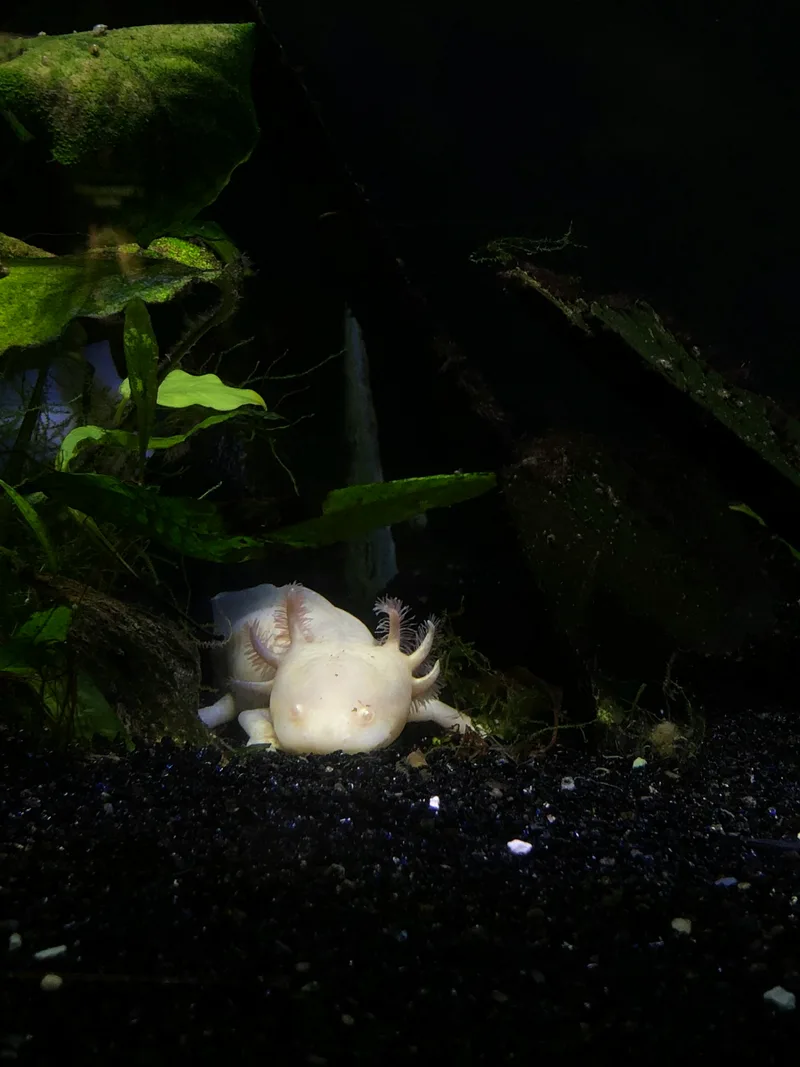
A pet axolotl (Ambystoma mexicanum) can regrow the same lost leg, tail, or feathery gill over and over for its whole 10 to 15 year life, and you will never hit a ceiling. If you have seen the figure "about five times" attached to that question, it is real, but it comes from a lab that amputated the very same leg again and again at one spot and watched the regrowth finally falter after five rounds. That is a limit you would have to manufacture on purpose, not one your axolotl will ever meet on its own. So where does the limit actually live, and how does a body keep rebuilding itself this way in the first place?
So Is There a Limit, or Not?
The honest answer is no, not in any way that matters for a pet.
The "five times" number is real, but it comes from a very specific experiment. Researchers took an axolotl, amputated a limb, let it regrow, then amputated the same limb at the same site, let it regrow again, and repeated that cycle. For the first several rounds the new limb came back faithful: right shape, right number of toes. After roughly five serial amputations at one spot, the regrowth began to degrade. It came back slower, and sometimes with a missing or extra toe.
That is a manufactured condition, not a life span for the animal's healing. Nobody is cutting the same leg off a pet axolotl five times. In a home tank an injury happens once, or rarely, and the ability resets fully between events. So the practical answer is that regeneration is effectively unlimited across the animal's life.
It helps to be precise about what the ceiling even measures. It is about the quality of regrowth under repeated trauma at a single site, not a counter that ticks down with each new limb. The axolotl is not spending a finite budget. It is just rebuilding, the way it always does, and you would have to abuse one spot relentlessly to find the edge.
Did you know? The "five times" figure traces to experiments where researchers amputated and re-amputated the very same axolotl limb over and over, on purpose, to find the limits of its regenerative program. The decline only showed up because the same tissue was being forced to rebuild itself again and again, far past anything an axolotl would meet in a tank.
What Can an Axolotl Actually Regrow?
The word "regenerate" covers far more than a limb. An axolotl can rebuild a whole leg with the correct number of toes, its tail, and the external gills, and that is just the everyday stuff. It can also regrow parts of organs that most animals seal off and abandon for good.
- A whole limb, with the right number of toes in the right positions
- The tail
- The feathery external gills
- Parts of the heart muscle
- Segments of the spinal cord
- Regions of brain tissue
- Eye structures, including parts of the retina
- The jaw
The mechanism behind all of this is what makes it remarkable. When you scrape your skin, cells at the wound rush to seal it with scar tissue and the job is done. An axolotl does something different. Cells near the wound revert to a flexible, stem-cell-like state, gather into a small bud called a blastema, and that bud rebuilds the missing part from scratch, laying down bone, muscle, and nerve in the right order. The wound does not close over. It becomes a construction site.
Did you know? A lizard that drops its tail regrows a rough replacement: a simple cartilage rod with no real bone or proper structure, a stand-in rather than a copy. An axolotl rebuilds the genuine article, with proper bones, muscles, nerves, and the right number of toes, indistinguishable from what it lost.
Does It Slow Down as They Get Older?
Age is the one real-life factor that genuinely shifts the answer. A young or larval axolotl regenerates fastest and most completely. As the animal ages, the same regrowth gets slower and can come back slightly less perfect. What does not happen is the ability switching off. In most animals the capacity to rebuild a limb fades to nothing with age. In an axolotl it never does.
Across a 10 to 15 year life, then, your axolotl keeps the capacity from start to finish. It simply is not quite as quick at twelve as it was at one, the way an older body anywhere takes longer to bounce back.
Age is also not the biggest variable in the room. Warm or dirty water slows regrowth far more than the years do. If you want to know the actual clock on a healing limb or gill, how long the regrowth takes from bud to finished part depends mostly on temperature and the animal's condition rather than its birthday.
How Do You Help an Axolotl Regrow a Lost Limb?
If your axolotl just lost a leg or a gill, the first thing to know is that it is built to handle this. A single lost limb is well within what the animal does on its own. Most of these injuries come from a nippy tankmate, or from a clutchmate during the juvenile stage when axolotls will bite each other. Your job is to give the body clean, calm conditions to do its work.
- Keep the water cool. Aim for 16 to 18°C (60 to 64°F). Warm water stalls regrowth and makes fungus on the open wound much more likely.
- Keep the water clean. A fresh wound is an open door for infection, so stay on top of water changes and parameters while it heals.
- Feed well. Rebuilding a limb takes resources, so a well-fed axolotl has more to work with.
- Separate it from whatever bit it. If a tankmate took the leg, move one of them, so the same spot is not injured again before it heals.
- Watch the wound. A small pale bud should form within days to a week or two, then slowly take shape into the missing part.
What you are hoping to see is that pale bud appearing and gradually growing into a recognizable limb. What should worry you is the opposite: fuzzy fungus building up on the stump, no bud forming at all after a couple of weeks, or the wound looking worse rather than steadily closing. Those are signs to act on, usually by improving water quality first and treating any fungus.
If it was a gill rather than a leg, the same rules apply, and a lost gill grows back the same way a limb does, through the same bud-and-rebuild process, just on a smaller and often faster scale.
The thing to carry away from all of this is not a number. An axolotl does not "use up" its regenerations and it is not counting down toward five. It treats a lost leg the way we treat a healed scrape, as something to mend and move past, and then it does it again the next time without a second thought. The real marvel was never how many times. It is that this animal's body simply never decided to stop.