How long do morphed axolotls live?
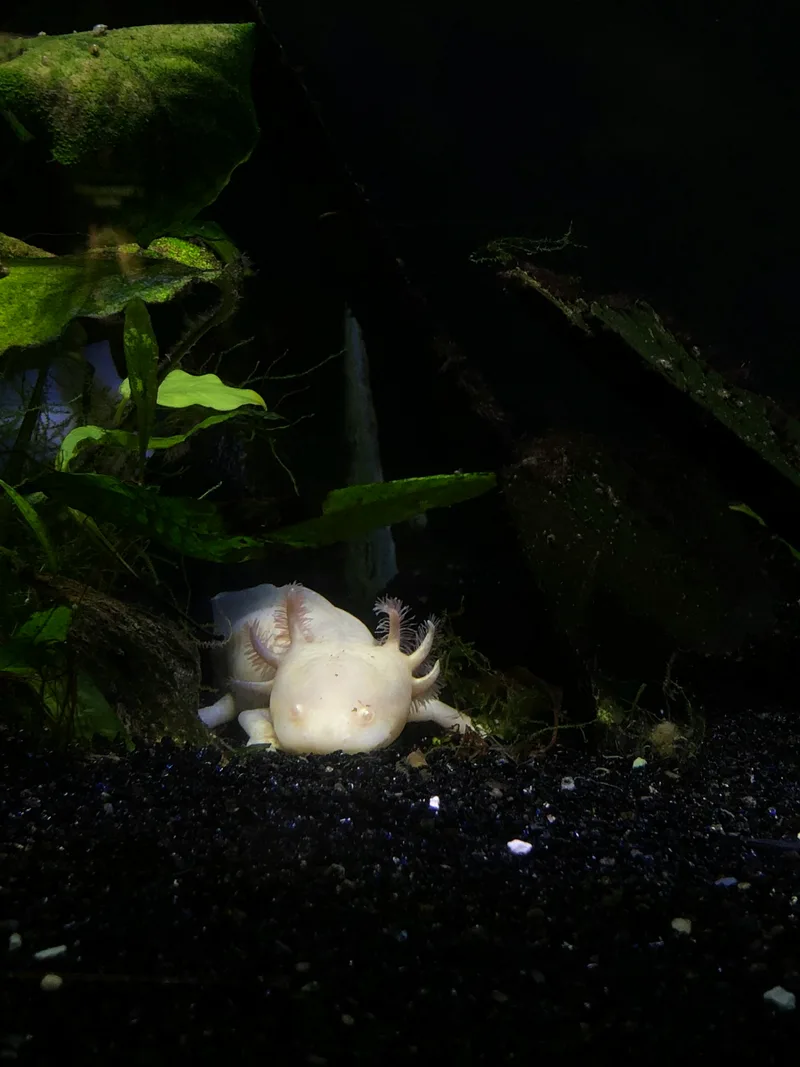
A morphed axolotl typically lives 5 to 10 years, against the 10 to 15 year range of an axolotl that stays aquatic. The animal in the same room with you right now is probably going to live a shorter life than the one you brought home. But the morph itself isn't what shortened it. The number above is mostly a record of what happened to the animal before it morphed: how warm the water got, how long it stayed warm, what was in it. Three things decide where in that 5 to 10 year window you actually land, and only one of them is still in your hands.
How Do I Give a Morphed Axolotl the Best Shot at a Long Life?
The animal in front of you isn't an aquatic axolotl anymore. It's a land salamander in everything but habit, and the care has to match. The transition is fixable with a few concrete changes you can make this week:
- Drop the water level or move to a humid land setup. Once the external gills are reabsorbed, the axolotl breathes through simpler lungs and through its skin. Deep water is now a drowning risk, not a habitat. Either drop the water to a few centimeters with easy land access, or move to a fully terrestrial enclosure with a damp substrate (sphagnum moss or moist paper towel) and a shallow water dish.
- Give it footholds. A morphed axolotl walks more than it swims. Smooth glass with no traction sends the animal sliding, and sliding is stressful. Cork bark, smooth rocks the animal can grip, plastic plants laid flat: anything that gives the feet purchase.
- Hold the temperature ceiling at 22°C (72°F). The temperature rules don't relax just because the animal is on land now. Axolotl physiology is built for cool water, and warm air stresses the morph just like warm water stressed the larva. Cooler is fine; warmer is what got most pet axolotls into this transformation in the first place.
- Switch to soft-bodied foods. Earthworms are the staple. The jaw and gut of a morphed axolotl handle soft, segmented prey well. Crickets and small mealworms work too, dusted with a calcium and vitamin supplement. Skip pellets meant for aquatic axolotls. They're designed to be eaten underwater.
- Feed smaller meals, more often. A morphed axolotl's metabolism shifts with the new body plan. Two or three small earthworms every two to three days for an adult is usually right. Watch the body condition: a healthy morph looks rounded, not gaunt, but not bloated either.
- Keep handling to almost zero. Their skin is permeable and sensitive to oils, soaps, and residues on human hands. If you have to move the animal, use a damp cup or wet hands rinsed with dechlorinated water.
- Keep water quality stable during the transition. If the animal still spends time in shallow water, the same rules apply: dechlorinated water, no ammonia or nitrite, low flow. The morph stage is when the animal can least afford a water-quality spike on top of everything else its body is doing.
- Watch for trouble. Refusing food for more than a week, sunken eyes, gaunt flanks, lethargy, skin that looks dry or cracked, or open wounds that aren't healing. Any of these is a reason to revisit the setup and check the temperature, humidity, and food size.
Doing all of this right pushes a morphed axolotl toward the upper end of the 5 to 10 year range. It won't get the animal back to the 15-year ceiling of an axolotl that never morphed. The body has already taken the hit; the care now is about not adding to it.
Why Does Morphing Usually Shorten an Axolotl's Lifespan?
The axolotl (Ambystoma mexicanum) is a neotenic salamander, which is a careful way of saying it spends its whole life as what looks like a larva. The feathery external gills, the tail fin, the aquatic body plan: these aren't a juvenile stage on the way to something else. They are the adult. When an axolotl morphs, it's being pulled into a body its physiology only half-supports. The lungs and skin take over from gills that were doing the job better. The tail fin reabsorbs. The whole respiratory and circulatory setup has to switch modes in an animal whose biology never expected to make the switch.
Then there's the regeneration cost. Axolotls are famous for regrowing limbs, parts of the heart, even sections of the spinal cord, and they do it more completely than almost any other vertebrate. That ability drops sharply after metamorphosis. A morphed axolotl can still heal, but more slowly and less perfectly. Injuries that a juvenile would shrug off, a morph carries.
The third thread is where the lifespan number actually gets decided. In the wild, axolotls almost never morph. In captivity, when they do morph, it's usually not spontaneous. The trigger is something wrong: thyroid hormone disruption (iodine in the water, chemical contamination), chronically warm water, or sustained stress. By the time the morph completes, the animal has often been through months of low-grade physiological damage. The reduced lifespan is partly the morph itself, but mostly the conditions that caused it. The animal isn't dying young because it morphed. It morphed because something was killing it slowly.
Did you know? Axolotls are not the only neotenic salamander, but they're one of the only ones where staying aquatic is the rule. Their close relative the tiger salamander follows the opposite pattern: it almost always completes metamorphosis, except in cold high-altitude lakes where some populations stay aquatic for life. The axolotl is essentially a tiger salamander that decided staying a kid was working out fine.
Can a Morphed Axolotl Ever Live as Long as One That Didn't Morph?
Yes, sometimes. A morphed axolotl can approach the normal 10 to 15 year range, but only when three things line up.
The first is age at morph. A young axolotl, somewhere in the first year or two of life, transitions into the adult body plan more cleanly than a mature animal. The tissues are still flexible, the organs adapt better, and the recovery from the transformation itself is faster. A four-year-old axolotl that morphs is dealing with a much harder shift than an eight-month-old one.
The second is what caused the morph. A spontaneous morph driven by genetics or a clean hormonal shift is a different event from a morph triggered by months of warm water or iodine exposure. The spontaneous case lands on a healthy animal making a clean transition. The triggered case lands on an animal that's already been damaged by the conditions that caused the morph.
The third is the post-morph care: the shift to a land or shallow-water setup, the temperature ceiling, the food change, the low-stress handling. All of it done correctly from the first week the gills started shrinking, not retroactively six months later.
When all three line up, a morphed axolotl can hit 10 to 12 years, sometimes a little more. This combination is uncommon, though. Most pet axolotls that morph were pushed into it by tank conditions, and most owners only realize what's happening partway through. If you're sitting in front of a young, otherwise-healthy morph and you can't point to anything obviously wrong with the tank that caused it, you have real reason for cautious optimism. It's possible. It's just not typical.
What Else Should I Know If My Axolotl Has Morphed?
A few related questions tend to surface once the immediate care change is in hand.
What pushed your axolotl into morphing in the first place matters for the tank as much as for the animal: if the trigger was tank conditions, those conditions are still present for any other axolotls living in the same setup.
If the animal is still in transition and you're not certain the change is a full metamorphosis, the visible signs of an axolotl actively morphing help separate it from other physical changes that can look similar at a glance.
For a baseline comparison, an axolotl that stays aquatic for its whole life lives in the 10 to 15 year range under good care, with a small number reaching closer to 20. That's the reference point the 5 to 10 year morphed range is measured against.
The lifespan figure for a morphed axolotl is less a verdict on the animal and more a record of what happened to it before and after the transformation. An axolotl that morphed in a clean, cool tank because of its own biology, and got the right care afterward, is a different statistical animal than one that morphed because its water sat at 24°C for a summer. The number isn't fate. It's a downstream signal of conditions.