Do axolotls go through metamorphosis?
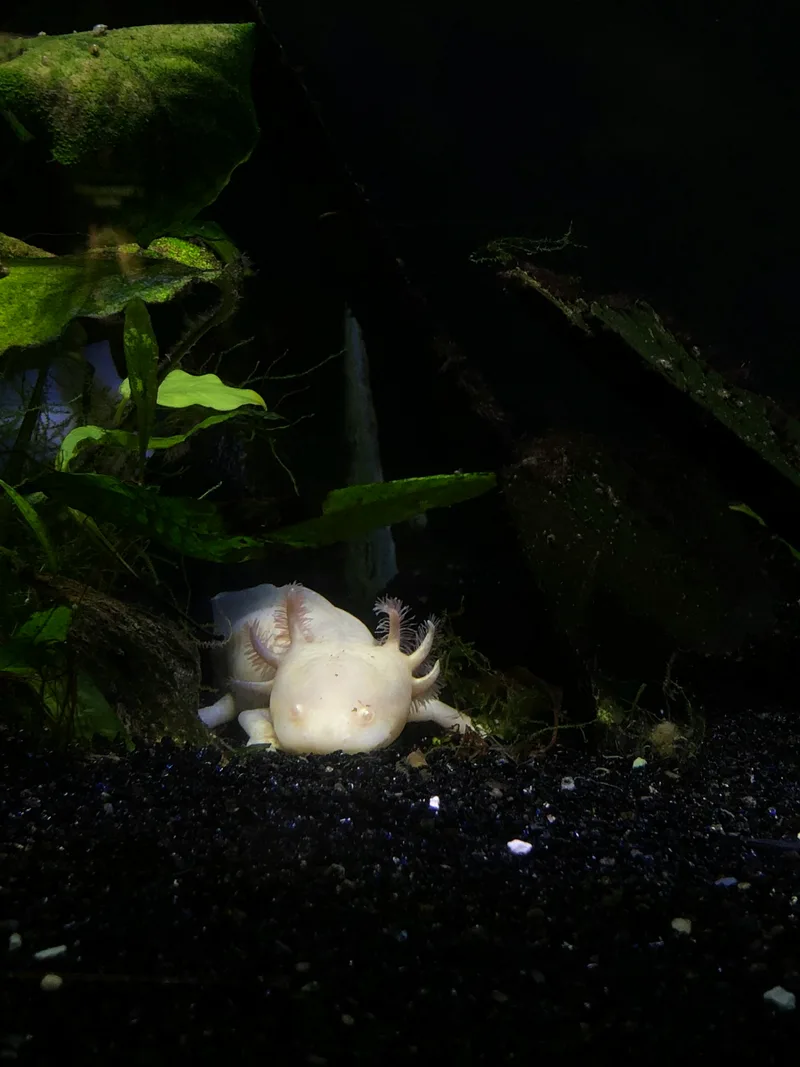
No. An axolotl (Ambystoma mexicanum) stays in its larval form for life: feathery gills, finned tail, fully aquatic. That's the safe topline, and you can trust it for the animal sitting in your tank. The strange part is that the machinery to transform is still inside the axolotl. The signal that fires it is what's missing, and a few specific things can supply that signal by accident or on purpose.
What would actually make an axolotl morph?
Nothing that happens in a normal home tank. Spontaneous metamorphosis is rare even in the wild, and the things that can push an axolotl over the edge in captivity are narrow and usually deliberate.
The triggers, and why they almost never show up by accident:
- Iodine in the water. A direct exposure to iodine (or iodine-rich salts deliberately added) can nudge the thyroid into action. Dechlorinated tap water with a standard conditioner does not contain enough iodine to do this.
- Thyroid hormone exposure. Adding thyroxine (T4) to the water is the lab method for inducing metamorphosis on purpose. It is not present in any normal aquarium supply.
- Long stretches in shallow or partly terrestrial conditions. A wild axolotl in a drying pond is the textbook trigger. A 20-gallon tank with a proper water level does not recreate this.
- Chronic stress in juveniles. Some research suggests sustained stress during the right developmental window can push transformation along, but the effect is small compared to a direct hormonal cue.
- Genetics in some individuals. A handful of axolotls carry a stronger residual thyroid response than the population average. These cases turn up occasionally in breeder reports; they're not a husbandry mistake.
The short version: if your axolotl is in clean, dechlorinated, cool water at a normal level, the conditions that can force a morph are simply not in the tank.
What does a morphing axolotl look like?
The classic signs are physical and slow. They happen over weeks, not overnight, and several show up together. The single most common mistake is reading a stressed axolotl as a morphing one, because the two share the surface symptom of "gills look wrong."
Real metamorphosis affects almost everything about the animal at once. Stress affects the gills first and stops there. Reading the table with that in mind keeps you from chasing a morph when the answer is a water-quality issue.
| Sign | Metamorphosis or something else? |
|---|---|
| Gills shrinking and shortening over weeks | Likely metamorphosis if other signs follow |
| Gills curling forward toward the face | Almost always ammonia or nitrite stress, not metamorphosis |
| Tail fin reducing, the upper ridge flattening | Metamorphosis |
| Gasping at the surface, repeated trips up for air | Oxygen or water-quality problem, not metamorphosis |
| Hiding constantly, gills held flat against the body | Stress or temperature too high |
| Eyelids becoming visible, eyes starting to bulge | Metamorphosis |
| Skin thickening and color shifting, often darker | Metamorphosis |
| The animal trying to climb out of the water | Late-stage metamorphosis, only after the changes above |
If only one row applies and it's a gill change, the much more likely answer is a water-quality issue. Test for ammonia and nitrite, check the temperature, and do a partial water change before worrying about morphing. If three or four rows apply over a span of weeks, the change is probably real and worth a vet call.
Why don't axolotls naturally transform?
The signal is missing. The machinery is not.
In a typical salamander, the thyroid releases a surge of thyroxine at a set point in development, and that hormone is what tells the body to reabsorb the gills, flatten the tail, grow eyelids, and switch to lung breathing. Axolotls have a working thyroid and the receptors that respond to the hormone, but the surge that fires the program never arrives at full strength. The animal stays paused at the larval stage because the cue to leave it never lands.
Evolution favored this in Lake Xochimilco, the cold, oxygen-rich, year-round-stable lake complex outside Mexico City where the axolotl developed. Most amphibians morph because the pond they hatched in might dry out, and a body that breathes air and walks on land is the only way to survive that. Xochimilco didn't dry out. An animal that stayed in the water, kept its gills, and skipped the dangerous in-between phase outbred the ones that morphed. Over time the trigger faded.
Did you know? The axolotl's closest relative, the tiger salamander (Ambystoma tigrinum), goes through full metamorphosis normally. They share the same genus. An axolotl is essentially a tiger salamander that never got the signal to grow up.
What happens to an axolotl that does morph?
It changes from a creature built for the water into one built for the land, and it pays for the conversion. The gills are reabsorbed. The tail fin flattens. Eyelids appear. The skin thickens and the lungs become the primary way the animal breathes. The whole transformation takes a few weeks once it starts.
The cost is real. A morphed axolotl usually lives only one or two years after the change, compared to the ten to fifteen years a larval axolotl can reach. Much of the axolotl's famous regrowth ability goes with the larval form. In controlled experiments where adult axolotls were induced to morph with thyroid hormone, forelimb regrowth took roughly twice as long as in their unmorphed counterparts, and almost every morphed animal developed skeletal defects in the regenerated limb. Only a small share of the control animals did. Husbandry becomes much harder too: the animal needs a humid, partly terrestrial setup with a small water area and a way out, not a standard tank.
It is not a hidden adult stage that the keeper has been holding back. It is a trade that goes the wrong way, and there is no responsible reason to push an axolotl through it.
The axolotl is a tiger salamander that never got the signal to grow up, and that frozen-larval state is what makes the animal you keep. The gills you watch fan in the current, the limbs that grow back, the calm life in cool water: they are all here because the body never moved on. The reason an axolotl doesn't transform is the reason it is what it is.