How to tell if your axolotl is morphing?
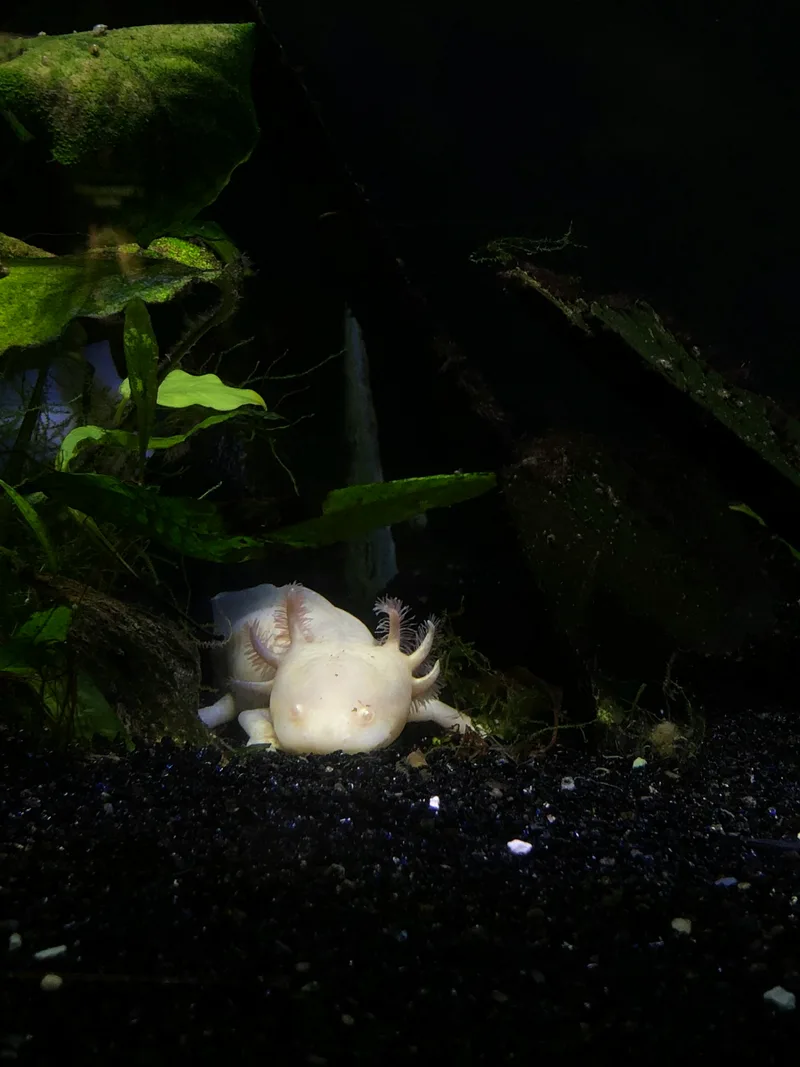
Real morphing is a cluster of changes happening at once: gills curling forward and shrinking, eyelids forming, fins receding, back legs thickening, and the axolotl trying to leave the water. If only one or two of those are showing up, you're almost certainly looking at something else. The captive axolotl (Ambystoma mexicanum) has had its metamorphosis bred out of it for over a century and a half, which makes spontaneous morphing in a healthy pet rare enough that most worried owners are actually seeing stress, illness, or normal gill behavior that mimics the early stages of a morph without being one. The trick is telling the two apart.
Which Signs Mean It's Actually Morphing?
The diagnostic value is in the cluster, not in any single change. A morphing axolotl moves through a coordinated set of changes over roughly two to six weeks, and you'll see most of them, not one or two. Look for:
- Gills curling forward toward the head first, then slowly shrinking down to nubs
- Eyelids forming over eyes that were previously lidless
- Dorsal (back) and caudal (tail) fins receding and losing their soft fringe
- Back legs thickening and becoming more muscular
- Toe webbing disappearing as the toes elongate
- Skin texture roughening and the body darkening
- Behavior shifting toward climbing the tank walls or pushing out of the water
If only one or two of those are present and the rest of the body looks normal, you are almost certainly not watching a morph. The curl-then-retract pattern of the gills is the most morph-specific single sign worth knowing, because ammonia stress also shrinks gills but skips the curl. Most listicles flatten this to "gills shrink" and that is where owners get misled.
Could It Be Illness or Stress Instead?
This is where most worried owners actually land, and the good news is that the lookalikes are usually fixable in an afternoon. Warm water, poor water quality, and ammonia stress can all produce changes that mimic the start of a morph: shrinking gills, gills curled forward, an axolotl surfacing or trying to climb out, blotchy skin. The difference is that those causes hit one or two systems while everything else stays normal. A real morph touches the gills and the eyes and the legs and the fins and the behavior, all within the same short window.
Check water parameters before you check anything else. Test for ammonia and nitrite (both should read zero), check temperature (axolotls want 60 to 64°F / 16 to 18°C, and they get visibly stressed above 72°F / 22°C), and look at the rest of the body. If the gills are curled but the eyelids haven't formed, the toes are still webbed, and the legs look the same as last month, you're seeing stress, not transformation.
| What you're seeing | Looks like morphing | More likely illness or stress |
|---|---|---|
| Gills curled forward, body otherwise normal | Ammonia stress, fixable with a large water change | |
| Gills curl, then slowly shrink while eyelids and legs also change | Real morphing | |
| Trying to leave the water | Almost always warm water or bad water; very rarely a morph | |
| Fins frayed or torn | Injury or fungus, not fin recession | |
| Skin patchy or pale, no other changes | Water quality, ammonia, or temperature stress |
A worried owner whose axolotl is hanging at the surface and curling its gills is, in nine cases out of ten, looking at a tank that needs attention, not a creature in the middle of becoming a salamander. What a stressed axolotl looks like is usually the closer diagnosis when only one or two of these signs show up.
Why Is Real Morphing So Rare in Pet Axolotls?
Axolotls are neotenic, which means they keep their larval body for their whole life. In most salamanders, a surge of thyroid hormone during development triggers metamorphosis, the body absorbs the gills and fins, and the animal walks out of the water. In axolotls, the thyroid signal mostly fails to fire. The cells are listening, but the hormone never arrives in the amount needed, so the animal just keeps growing as a permanent larva. That's why your axolotl has gills in the first place.
Captive axolotls have been bred for this trait for over a century and a half, which makes the genetic odds of a spontaneous morph in a healthy pet very low. When it does happen, there's usually a specific cause behind it: iodine contamination in the food or water (iodine feeds thyroid hormone production), a particular wild-type or hybrid genetic background, or, in research settings, a deliberate injection of thyroid hormone. The ammonia-stress reflex that curls the gills forward is a physiological response in the moment, not the start of a developmental program. The tissue is reacting to a chemical irritant on its surface, and once the water is clean the gills relax back out.
Did you know? The captive axolotl population behind today's global pet trade descends from a small group sent from Mexico to Paris in 1864. Within a few years, French researchers fed some of them thyroid tissue and accidentally morphed them, the first time anyone had induced metamorphosis in a lab. That experiment opened up an entire line of developmental biology research that ran for decades.
In the rare cases when spontaneous morphing does happen in a pet axolotl, iodine in the food or a particular genetic line is almost always the cause. The broken thyroid signal can be overridden, just not easily and not often.
What Should I Do if My Axolotl Really Is Morphing?
If you've checked the cluster, ruled out the lookalikes, and the changes are genuinely happening across the whole body, the tank setup needs to change. A morphed axolotl is now functionally a salamander: it can drown if it can't get out of the water, so you'll need to lower the water level and add a dry land area with a gentle slope. The diet shifts from sinking pellets and worms to live insects, since a morphed animal hunts on land. Expect a shorter life than a neotenic axolotl, usually five to ten years instead of fifteen-plus.
The fact that you searched this question in the first place is itself a small piece of reassuring evidence. Owners of genuinely morphing axolotls usually figure it out from the cluster, not from one sign, because the changes are too coordinated to mistake. For almost every owner with this question, the next move is to check water parameters and temperature, not to start building a land tank. In the small minority of cases that turn out to be real, the body absorbs the gills and fins over roughly two months and the animal emerges as a tiger-salamander-shaped adult that typically lives five to ten years.