What triggers axolotl metamorphosis?
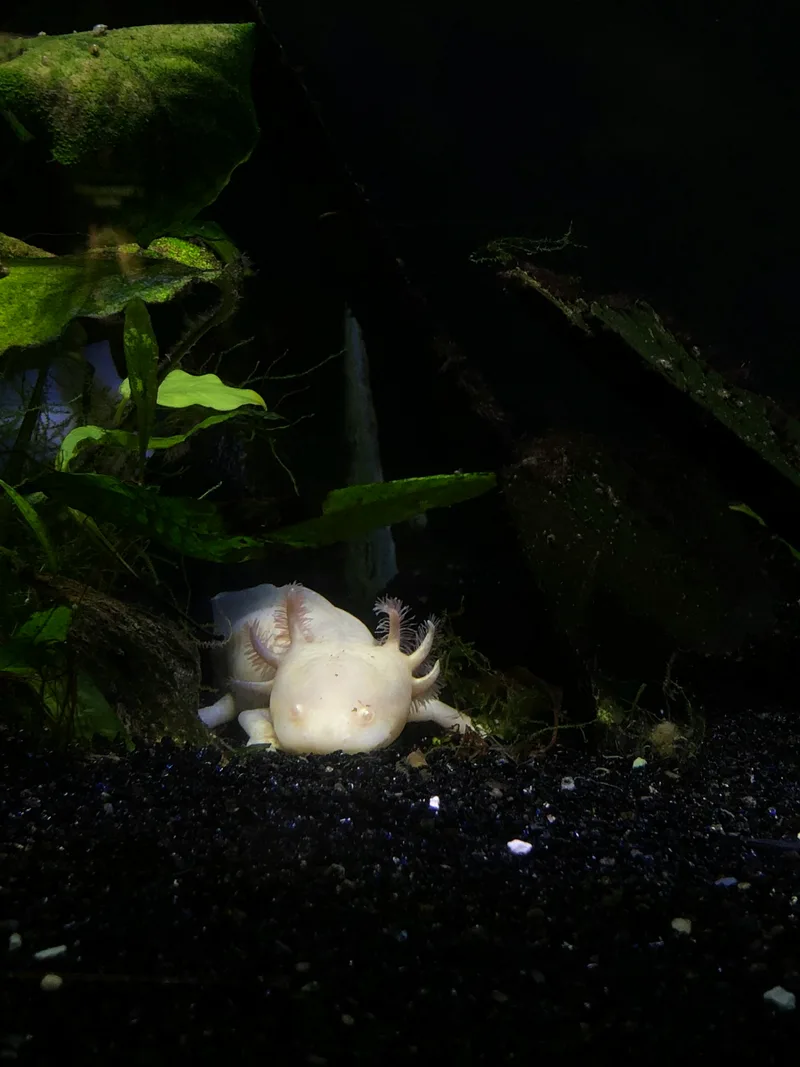
In a normal home tank, almost nothing you do can trigger metamorphosis in an axolotl. The wiring is the reason: the brain barely sends the signal that tells the thyroid gland to make the hormones that drive morphing, so the body never gets the message and stays in its larval, fully aquatic form for its entire life. There is one route that reliably bypasses that wiring, and it's a needle of thyroid hormone going into the animal in a lab. The trace iodine in your tap water and the warm afternoon you're worried about don't come close to that bar, but there is one quiet exception worth knowing about, and it has nothing to do with anything you can change.
Could Anything in My Tank Actually Trigger This?
For metamorphosis to happen, thyroid hormone has to be flooding the axolotl's bloodstream at much higher levels than its own body ever produces. The two real routes for that are an injection or a surgical setup where the gland is replaced and supplemented. Neither of those happens by accident in a living room.
The everyday worries fall apart the moment you put them next to that bar. Trace iodine in tap water isn't absorbed through axolotl skin in anything close to a useful dose, and even the lab studies that dose iodine in the water column use Lugol's solution at concentrations that would devastate a pet animal long before any morphing started. A warm room is dangerous to an axolotl, but the danger is heat stress and bacterial infection, not metamorphosis. The idea that stress alone causes morphing doesn't survive the biology either: stress hammers an axolotl's immune system and its appetite, but it doesn't switch on the thyroid axis.
Here are the five worries that come up most often, and what the biology actually says about each:
- Iodine in tap water. No. The dose and the route are both wrong. Iodine is the raw material the thyroid uses to build hormones, not the signal that releases them, and your axolotl's skin isn't a useful absorption path anyway.
- The room got warm. No. Warm water (above about 22°C / 72°F) harms an axolotl directly through stress, fungal infection, and oxygen loss. It kills the animal long before it morphs it.
- It looks stressed. No. Stress in an axolotl shows up as pale skin, clamped gills, refusing food, sometimes a curled tail tip. It doesn't push the thyroid into action.
- It ate something funny. No. Food doesn't carry thyroid hormone in a form an axolotl's gut can absorb and use. Pellets, earthworms, blackworms, raw fish, none of these are a vector.
- Hybrid genetics from the breeder. Yes, and this is the one case that's actually real. A small percentage of axolotls in the pet trade carry tiger salamander genes from old breeder crosses, and those individuals can occasionally morph spontaneously regardless of what their keeper does. It is rare, it is outside your control, and it is not your fault when it happens.
If you're looking down the list and nothing matches what you're seeing, that's the answer the biology gives you. In a normal home tank, with normal water and normal food, you are vanishingly unlikely to cause this.
How Do I Know if My Axolotl Is Actually Morphing?
Real metamorphosis is slow, visible, and structural. It is not a single bad-looking day. Over weeks the feathery external gills shrink down and then disappear, the tail fin recedes from a wide paddle to a narrower shape, the body thickens through the shoulders and trunk, eyelids start to form over what had been lidless eyes, and the animal becomes restless at the water line and tries to climb out. By the time a real morph is well underway, you cannot mistake it for anything else.
What gets mistaken for morphing is almost always something separate, and almost always more fixable than the keeper fears. Gills that look smaller after a missed water change have lost their fine filaments to ammonia or nitrite, and they regrow once the water is clean. A pale animal hanging near the surface is usually struggling with low oxygen in warm water, or with poor water quality, or with stress from a tankmate, or with all three at once. A slimmer body during a refusal-to-eat stretch is a hunger response, not the trunk-thickening of a morph. None of these track to the staged, weeks-long pattern of an actual transformation.
| Looks like morphing but isn't | Actual morphing |
|---|---|
| Gill filaments smaller after a missed water change or a spike in ammonia | Gills shrinking gradually over weeks and not regrowing after the water is corrected |
| Hanging at the surface from low oxygen or warm water | Animal restless at the waterline and repeatedly trying to climb out |
| Pale, washed-out skin from stress | Body trunk thickening through the shoulders and middle |
| Slimmer body during a hunger strike | Tail fin receding from a broad paddle to a narrower shape |
| Bug-eyed look during fright or low water | Visible eyelids forming over the eyes |
The single most reliable tell is timing: real morphing is a staged change you watch unfold over weeks, not a symptom that appears overnight, so if something looks wrong this morning and looked fine yesterday, it almost certainly is not this.
Why Axolotls Almost Never Morph in the First Place
Metamorphosis in most salamanders is run by the thyroid gland. When the time is right, the thyroid releases thyroxine (T4) and triiodothyronine (T3), and those hormones tell the body to reabsorb the larval gills, thicken the skin into terrestrial form, finish developing the lungs, and head for land. It is one of the cleanest hormone-driven transformations in vertebrate biology.
The axolotl has a break in the chain just upstream of that. The thyroid itself is normal and functional, but the pituitary gland in the brain barely releases the hormone (thyroid-stimulating hormone, or TSH) that tells the thyroid to switch on. With no signal coming in, the thyroid sits mostly idle, the bloodstream stays clear of T4 and T3, and the body never gets the message to morph. The axolotl keeps its gills, keeps its tail fin, stays in the water, and reaches adult size still wearing its larval shape.
This is also why the lab trick of injecting thyroid hormone works while iodine in the tank does nothing. The injection bypasses the broken switch and delivers the message directly. Iodine, by contrast, is just the raw material the thyroid uses to build the hormones, and if the thyroid never gets the signal to build them in the first place, more raw material doesn't help. Putting iodine in the water is like sending lumber to a sawmill that's been told not to open.
Did you know? In 1920 researchers fed axolotls mammalian thyroid tissue and watched them metamorphose within weeks. The experiment helped establish thyroid hormones as the master switch for amphibian metamorphosis, and it's the reason hobbyists still talk about thyroid hormone today. The morphed animals lost much of their famous regenerative ability and lived markedly shorter lives.
There's a why behind the why, too. Axolotls evolved in Lake Xochimilco, a stable, fish-poor freshwater lake system near what is now Mexico City. The water there was permanent and the land around it offered nothing useful to a salamander built for swimming. With no advantage to leaving the water, the lineage held onto its larval form into adulthood and bred there. Holding the juvenile shape (paedomorphosis) became a stable strategy, and the genetic dampening of the thyroid signal is what locked it in.
What If My Axolotl Really Is Morphing?
If after all of this you watch the slow, weeks-long pattern unfold and you're sure it isn't water quality or stress, the practical questions shift. A morphed axolotl is essentially a small salamander. It needs a setup that lets it leave the water: shallow water at one end, a stable land area with humid cover at the other, soft substrate it can't swallow, and a moderate ambient temperature it can choose its way around. The diet shifts toward earthworms, small soft insects, and other prey it can grab from land. The transformation is not reversible.
The physical change from feathery-gilled larva to lunged salamander runs in roughly the order described above: gills first, then tail fin, then trunk, then eyelids. The post-morph lifespan of two to five years is a sharp drop from the ten to fifteen an axolotl gets when it stays larval, and the gap is the strongest single argument against ever inducing the change on purpose. The animals that do morph anyway almost always carry that small stretch of tiger salamander genetics from old breeder crosses, surfacing a trait the rest of the population evolved away from in Lake Xochimilco's stable waters.
Whatever you find, hold onto the part that matters most for an anxious keeper. Axolotl metamorphosis is one of the very few situations in this hobby where the honest answer to "what did I do wrong?" is almost always "nothing." The biology is wired against it, the routes that bypass that wiring are deliberate laboratory procedures, and the rare cases where it happens anyway come from a stretch of genetics you had no way to see when you brought the animal home. Your job here isn't prevention. It's recognition: knowing what real morphing looks like, and trusting that almost everything else you see is something else, something more ordinary, and usually something you can fix.