How do I tell if my axolotl has died?
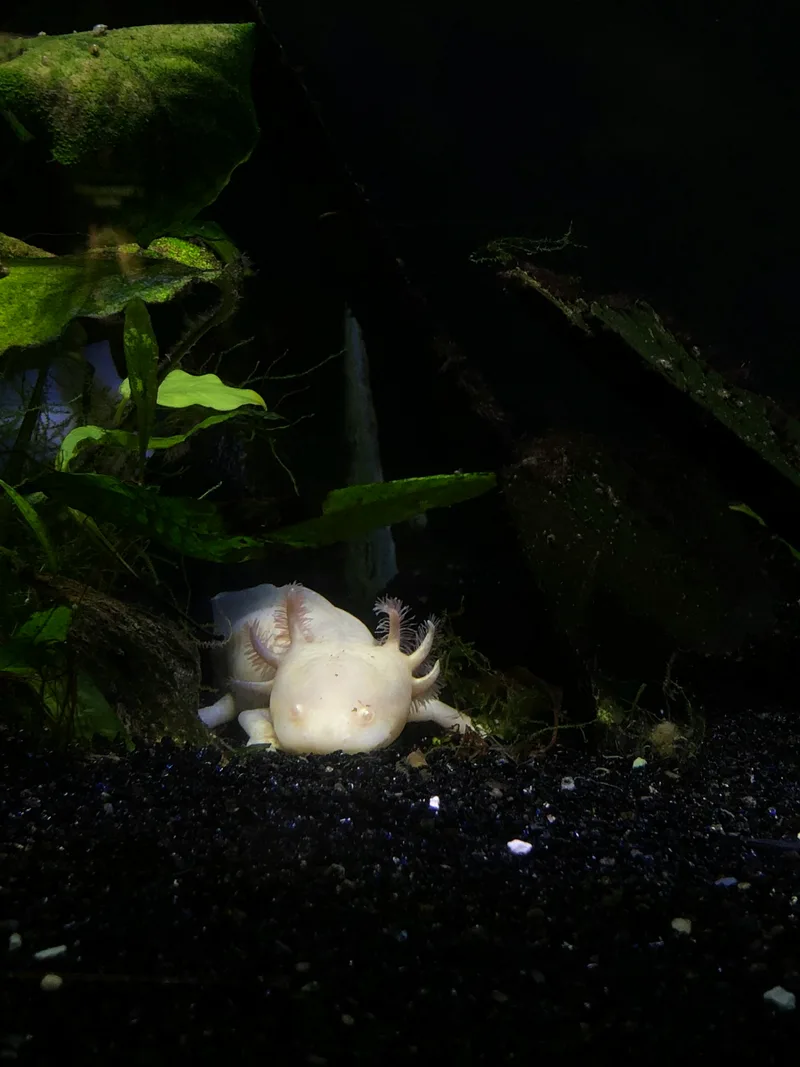
A living axolotl almost always answers back, so the real test is a gentle touch and a close look at the gills, not how still it lies. And the stillness is the trap: a healthy axolotl can rest dead-still on the bottom for hours, and a cold or critically sick one can drop to almost no movement at all, wearing the exact same lifeless face as a dead one. The single thing your panic is fixed on, the not-moving, is the least reliable sign in the tank. So before you conclude anything, run the quick checks below and watch for one clear answer back.
What's the Fastest Way to Check Right Now?
You can settle the live-or-dead question in under a minute. Don't lift the animal out or shake the tank. Just run these checks in order, from the most reliable to the least, and watch closely for any response at all.
- Gently nudge a back foot or its side. Use a clean finger or the blunt end of a turkey baster. A living axolotl almost always flinches, pulls the foot away, or walks off, even if it's slow about it. Any reaction at all means alive.
- Look hard at the gill stalks. The feathery branches on either side of the head are the clearest tell. A single faint flutter, a slow flick, or a twitch means the animal is breathing. Watch for a full thirty seconds, because the movements can be tiny and far apart.
- Drop a small piece of food near its head. A bit of earthworm or a pellet right in front of the snout. A living axolotl, even a stressed one, often turns its head, opens its mouth, or makes a small lunge. No response here doesn't confirm death on its own, but a response confirms life.
- If it's belly-up, watch whether it slowly rights itself. A floating or upside-down axolotl that's alive will usually work its way back over, even if it takes a while. One that stays limp and inverted through everything above is a worse sign, though still not proof by itself.
The rule is simple. One clear response, a flinch, a gill twitch, a snap at food, means your axolotl is alive and you should treat it as a sick animal that needs help, not a lost one.
Could It Just Be Sleeping or Critically Sick Rather Than Dead?
Two states look almost exactly like death, and both are far more common than the real thing. The reason this question is so hard is that a living axolotl in either state can give you almost nothing to go on.
The first is rest. Axolotls don't sleep the way we do, but they do go still for long stretches, settling on the bottom and barely moving for hours at a time. They have no eyelids, so the eyes stay open the whole time, which makes a resting one look unsettlingly lifeless. A resting axolotl still shows the occasional faint gill movement, and it will eventually answer a gentle nudge.
The second is a genuine emergency. A critically ill axolotl, one knocked down by ammonia in the water, a heat spike, or severe stress, can sink to almost no visible movement and still be alive. Its gills may go pale and its body may go slack. This animal is not resting. It's shutting down, and it can sometimes be saved if you act fast.
To tell these apart from death without guessing, watch the tank quietly for several minutes and look for any single gill or limb movement. Then run the gentle nudge again. Then walk away and come back in fifteen or twenty minutes and check one more time. A resting axolotl will give you a sign across those checks. A truly dead one gives you nothing across all of them. If you see the pale gills and limpness of a crashing animal, the fastest thing you can do is get the water right. The correct temperature and water parameters for an axolotl tell you exactly what to fix, and cooling the water and cutting the ammonia is sometimes enough to bring one back from the edge.
What Are the Actual Signs It Has Died?
When an axolotl has truly died, the signs are unambiguous, and you don't have to keep second-guessing yourself. Death shows up as a stack of these together, not a single one in isolation.
- Complete, lasting unresponsiveness. No flinch, no gill movement, no reaction to food across repeated checks spread over a half hour or more.
- No gill movement at all over a long, quiet watch. Not a faint one, not an occasional one. Nothing, no matter how long you look.
- A fully limp body. A living axolotl, even a deeply resting one, holds some muscle tone. A dead one goes completely slack, and the limbs and tail hang loose if the body shifts.
Over the hours that follow, more obvious changes set in. The color drains and the body looks washed-out and gray. The skin begins to break down, sometimes going cloudy or starting to slough away. And there will be a distinct smell. If you're seeing color loss, skin breakdown, and an odor on top of total unresponsiveness, you have your answer. The axolotl has died, and the kindest thing now is to act on it rather than keep waiting.
Why Does a Cold or Sick Axolotl Look So Much Like a Dead One?
The reason stillness fools you is that an axolotl runs entirely on the temperature of its water. It's cold-blooded, which means it makes none of its own body heat. Its whole metabolism, how fast it breathes, how much its gills move, how quickly it reacts, rises and falls with the water around it. Drop the water temperature and everything slows down together.
Stress and poisoning do the same thing from the inside. When the water turns bad with ammonia, or a heat spike pushes the animal past what it can handle, its body throttles down to survive. Breathing slows, the gills go quiet, and movement nearly stops. This is the axolotl's low-power state, its version of hunkering down, and from the outside it looks identical to death.
So "barely moving" isn't proof of anything. It's the normal face of a cold or stressed axolotl, the same face a dead one wears. That's exactly why the tests, the nudge and the gill watch and the food drop, are what settle the question, and the stillness never does. You're not reading how still the animal lies. You're reading whether it responds.
Did you know? An axolotl that looks badly damaged is usually nowhere near dead. Frayed gills, a missing toe, even a bitten-off limb are signs of stress or rough water, not the end, because axolotls are among the best regenerators in the animal world and can regrow lost gills and whole limbs over a matter of weeks. Ragged gills mean check your water, not mourn your pet.
What Should I Do If It Has Died?
Once you're sure, take the body out of the tank promptly. A dead axolotl breaks down quickly, and decomposition fouls the water fast, which puts any other animal in the tank at real risk.
Then turn straight to the water, because whatever killed this axolotl is very likely still in the tank. Test for ammonia and check the temperature. A reading above zero on ammonia or a temperature creeping toward or past the low 70s°F (around 22°C) points you at the most common killers, and finding the cause now is the only thing that keeps it from happening again. If you keep more than one axolotl, this step isn't optional. The same water is around the survivor.
Learn to read trouble earlier, too, so it never gets this far next time. The early warning signs of a sick axolotl show up days before a crisis, and catching pale gills or a curled tail early is the difference between a water change and a loss. And carry this forward: the scary stillness was almost never the proof it felt like. A cold or struggling axolotl wears the same calm, low-power face as a dead one, which is why the answer was never in how still it lay. It was in whether it answered back. Check, wait, check again, and read the water before you read the worst.