Is a 29 gallon tank big enough for an axolotl?
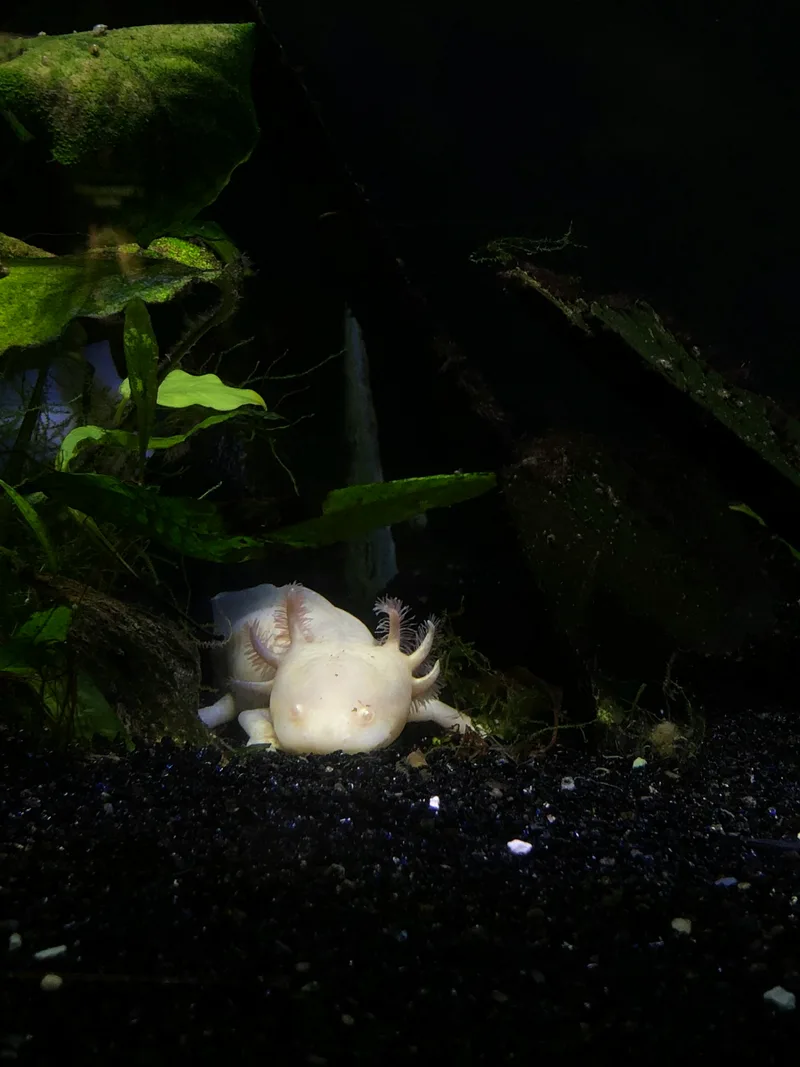
Yes, for one adult, if it is a 29 long. No, if it is a 29 tall, and no for two adults either way. Both tanks wear the same 29-gallon label, but the long is about 30 inches across the bottom and the tall is closer to 24, and an axolotl spends almost its entire life walking that floor. The number on the box is gallons. The number the animal actually lives on is the length of the floor.
Is There a Difference Between a 29 Long and a 29 Tall?
A 29 long and a 29 tall hold the same water but give your axolotl very different homes. The 29 long is the common shape you see at pet stores: about 30 inches long, 12 inches wide, 18 inches tall. A 29 tall trades length and width for height. Same gallons, smaller floor.
For most fish, that difference is cosmetic. For an axolotl, it is the whole game. Axolotls have no swim bladder and are negatively buoyant, so they sink the moment they stop kicking. They spend almost all of their lives walking the bottom on four short legs. Height is water they pass through; the floor is where they live.
An adult axolotl is 9 to 12 inches from nose to tail tip. Put one in a tank that is only 12 inches wide and it has barely enough room to turn around without draping its tail along the glass. That is why the 29 long works as a minimum for one adult and the 29 tall does not. The 30-inch length gives an adult a full body-length of walking space; the 12-inch width is already on the narrow side. Shrink either dimension and you are asking a floor-dwelling animal to live in a vertical fish tank.
If you are looking at a used tank online, or a package deal at a store, the single most useful thing you can do is measure the base before you buy. Length and width in inches. Ignore the gallon label until you know the footprint.
| Tank format | Dimensions (L x W x H) | Floor space | Works for one axolotl? |
|---|---|---|---|
| 29 gallon long | 30" x 12" x 18" | 360 sq. in. | Yes, but it is the minimum. Full body-length of walking space, narrow width. |
| 29 gallon tall | 24" x 12" x 24" (approx.) | 288 sq. in. | No. Same water, shorter footprint. An adult cannot comfortably turn around. |
| 40 gallon breeder | 36" x 18" x 17" | 648 sq. in. | Yes, and the recommended size. Wider footprint, more stable chemistry, barely more money. |
Did you know? When an axolotl sits on the bottom with its body curled slightly, it is not lounging, it is using gravity. Without a swim bladder, holding position in open water costs effort. Resting on the substrate is the default state, which is why floor space, not tank height, maps to how much of the tank they actually use.
What Tank Size Works Better If You Can Size Up?
If the 29 long is the floor, the 40 gallon breeder is where most keepers stop. It is the same kind of tank every pet store carries, usually costs only a little more than a 29, and the 36-by-18-inch footprint changes how the animal uses the space. An adult axolotl in a 40 breeder has room to walk in a straight line without turning, room to choose a corner to sit in versus the one with the filter outflow, room to pass a hide without bumping into the glass. None of that is visible to you in the first week; all of it adds up over the years an axolotl lives (10 to 15 with decent care).
The bigger jumps (55, 75, 125) are worth it for multiple axolotls, for breeding setups, or if you just want the visual of more scape. For a single adult, the returns flatten past the 40 breeder. More water is easier to keep cool and easier to keep stable chemically, but you are not giving the animal a qualitatively different life. The 40 is where the line is.
When you are picking a tank, these are the variables that matter, in order:
- Floor length of at least 30 inches. An adult needs a body-length of walking room.
- Floor width of at least 12 inches, with 18 preferred. This is the dimension that turns a workable tank into a comfortable one.
- Water kept under 68°F year-round. Axolotls are cold-water amphibians, and warm water is a bigger killer than tank size.
- Fine sand or a bare bottom. Gravel small enough to swallow causes impaction; large gravel is hard on their soft bellies.
Gallons do not appear on that list because they are downstream of the first two items. Get the footprint right and the volume takes care of itself.
Is a 29 Gallon Enough for Two Axolotls?
No. One adult in a 29 long is the minimum; two is too many.
The old forum math is where the confusion starts. The 10-gallons-per-axolotl rule of thumb says a 29 should hold two with room to spare. On paper it does. In practice it does not, and the reason is the same reason a 29 tall is not enough for one: the rule measures water, and axolotls do not live in water the way fish do. They live on the floor of it. Two 10-inch adults sharing a 30 by 12 inch floor means they are crossing each other's space constantly, which leads to tail nips, missed meals when one bullies the other off food, and in the worst case, lost limbs. Axolotls can regrow a lost leg, but you do not want to put that to the test.
There is also a water-quality layer. Two axolotls produce roughly twice the waste of one, and a 29 gallon is already on the thin side for one adult's waste load between weekly water changes. Doubling the bioload in the same volume means ammonia climbs faster, nitrate climbs faster, and the margin for a late water change shrinks to almost nothing.
If you are actually planning for two, the question is not "can I make a 29 work" but "what size do I actually need," and the right footprint for two adult axolotls starts closer to a 40 breeder and is more comfortable at a 55 long. If you are still on the fence about whether to get a second one at all, keeping a single axolotl is both simpler and often the better choice, since they do not actually need a companion to be healthy. Whichever direction you go, the useful thing to hold onto is that gallons are a label on the box, and floor length is the number your axolotl is actually standing on. Once that clicks, most tank-size questions answer themselves.