Can axolotls live in a 10 gallon tank?
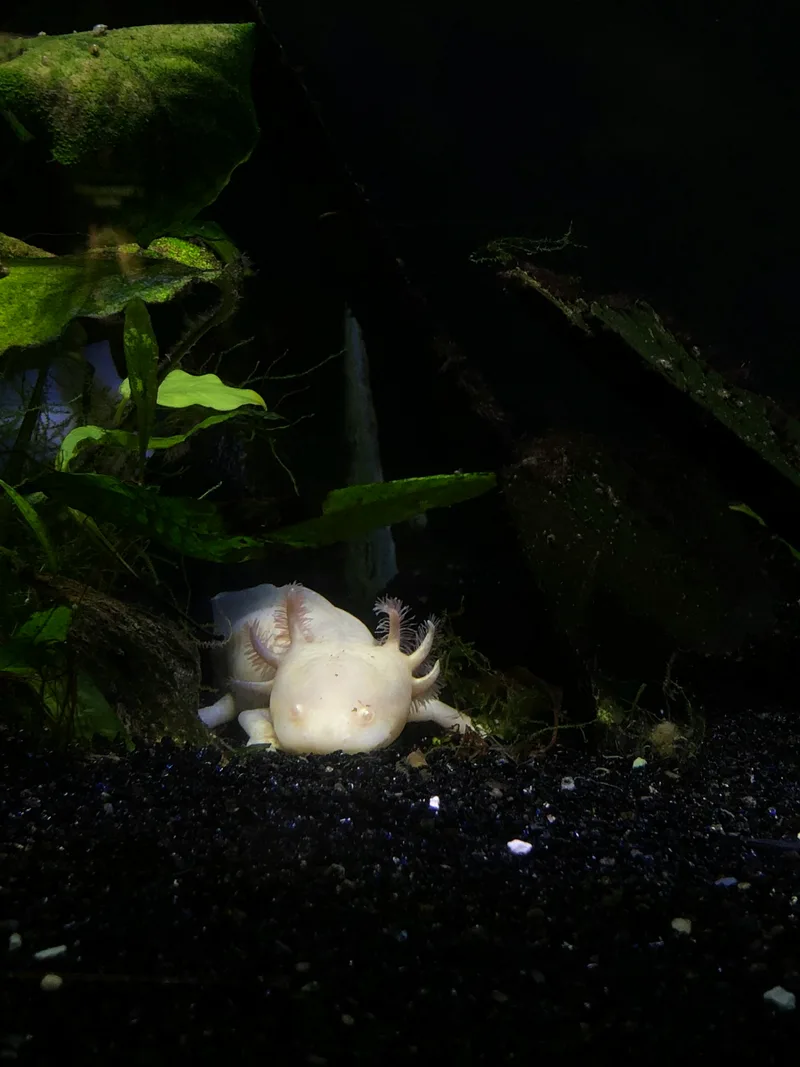
No, a 10 gallon tank is too small for an adult axolotl (Ambystoma mexicanum). A full-grown axolotl is 9 to 12 inches long, which is roughly the entire front-to-back width of a standard 10 gallon. The animal can't turn around without folding its body. The widely accepted minimum is a 20 gallon long, and the reason isn't only the floor space. It's also that 10 gallons of water can't dilute the waste of a heavy-eating amphibian, and it can't hold a steady cool temperature on a warm afternoon.
What size tank does an axolotl actually need?
Twenty gallons is the minimum for one adult axolotl, and it needs to be a 20 gallon long, not a 20 gallon tall. Axolotls spend almost all their time on the bottom, so what matters is the footprint of the tank, not the height of the water column. A 20 long gives you roughly 30 by 12 inches of floor space. A 20 tall gives you 24 by 12. That difference matters when the animal itself is close to a foot long.
For two axolotls, you need at least 30 gallons, and 40 is better. Every additional axolotl adds to the waste load and the competition for floor space.
Bigger tanks are also easier to keep stable. More water means temperature swings are slower, ammonia spikes are more forgiving, and you have a wider margin between water changes. A 20 gallon long is the starting point for a single axolotl, not the ideal.
| Scenario | Minimum tank size | Recommended size | Key dimension |
|---|---|---|---|
| 1 juvenile (under 6 inches) | 10 gallon (temporary) | 20 gallon long | At least 24 inches of floor length |
| 1 adult | 20 gallon long | 29 gallon | At least 30 inches of floor length |
| 2 adults | 30 gallon | 40 gallon breeder | At least 36 inches of floor length |
Why is 10 gallons too small?
Three things go wrong in a 10 gallon tank, and they compound each other.
Physical space. A standard 10 gallon is 20 inches long and 10 inches wide. An adult axolotl can be 10 to 12 inches. That means the animal is nearly as long as the tank and wider than half the tank's depth front to back. It can't turn without folding its body. Axolotls don't swim much, but they do walk, and a tank this size gives them almost nowhere to go.
Waste load. Axolotls are messy. They produce far more ammonia than a similarly sized fish because they eat large, protein-rich meals and pass bulky waste. In 10 gallons of water, ammonia can spike between water changes faster than most keepers expect. You end up doing water changes every day or two just to keep levels safe, and one missed day can push ammonia into the range that damages gills. In a 20 gallon long, you have twice the water volume diluting the same waste, which gives you a realistic maintenance schedule instead of an emergency one.
Keeping water parameters in the safe range is one of the most important parts of axolotl care, and tank volume is the single biggest variable working in your favor.
Temperature instability. Axolotls need cool water, ideally 60 to 68°F (15 to 20°C). Small volumes of water heat up fast. A 10 gallon tank in a room that hits 75°F on a summer afternoon can climb above safe temperatures in hours. A 20 gallon long heats up more slowly, and a fan or clip-on chiller has more water to work with. The margin between "fine" and "dangerously warm" is wider in a bigger tank.
Can a juvenile axolotl start in a 10 gallon?
If you already own a 10 gallon tank, a small juvenile (under 4 to 5 inches) can live in it temporarily. This is a bridge, not a destination. Water changes need to happen every one to two days, and you should be testing ammonia and nitrite regularly with a liquid test kit.
Most juvenile axolotls grow fast in their first few months. A 2 inch hatchling can reach 5 to 6 inches within three to four months under good conditions. That means your window for using a 10 gallon is short, often less than a single season.
Plan to upgrade before the axolotl reaches about 6 inches. At that point, the waste load and the animal's physical size start outpacing what 10 gallons can handle. Waiting until problems appear means the axolotl has already been stressed.
Signs it's time to move up:
- The axolotl's body length is approaching the tank's front-to-back width (about 10 inches on a standard 10 gallon)
- Ammonia or nitrite readings climb noticeably between water changes, even with a good filter
- The axolotl surfaces frequently or paces the glass more than usual
- You're struggling to keep the water below 68°F during warmer months
Does tank shape matter as much as tank size?
For axolotls, shape matters more than the gallon number on the label. A 20 gallon long (30 by 12 inches of floor) is a better axolotl tank than a 20 gallon tall (24 by 12 inches) even though they hold the same water. The axolotl lives on the bottom and rarely uses the upper water column, so vertical space is wasted space.
When you're shopping for a tank, check the footprint first. Long, wide tanks give axolotls more room to move than tall, narrow ones of the same volume. A 40 gallon breeder (36 by 18 inches of floor) works well for a pair because the footprint is generous and the water depth is moderate.
The real question isn't whether your axolotl can survive in a given tank. It's what tank lets the animal be comfortable for the next 10 to 15 years. A 20 gallon long costs only a little more than a 10 gallon, and the difference in day-to-day maintenance is enormous. Fewer emergency water changes, more stable temperatures, and a calmer animal that actually uses its space.