How big a tank does an axolotl need?
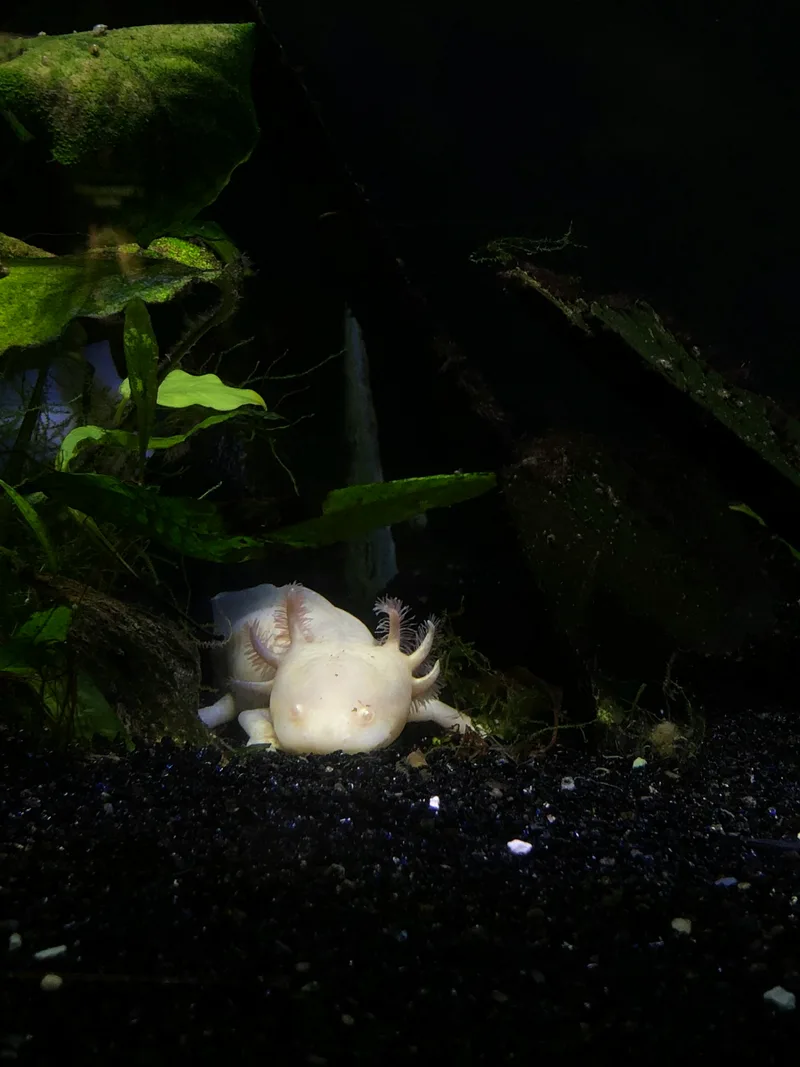
A single adult axolotl needs at least a 20-gallon long tank. A 40-gallon breeder is better if you have the space, and for a pair you should start at 55 gallons. The catch is that axolotls don't have a swim bladder, so they don't really swim. They walk along the bottom on four stubby legs, which means a 20-gallon long and a 20-gallon tall hold the same water but aren't the same tank: the long one gives roughly 50% more floor area, and floor area is the dimension they actually live in.
Why Does Floor Space Matter More Than Water Volume?
Axolotls don't swim the way fish do. They have no swim bladder at all. They're negatively buoyant, which means they sink unless they actively kick upward, and they spend almost all their time walking along the substrate on four stubby legs. Their body plan is built for life on the bottom of a shallow lake bed, not for cruising through open water.
This changes what "tank size" means in practice. A standard 20-gallon tall tank and a 20-gallon long tank hold the same amount of water, but the long version gives roughly 50% more floor area. For a fish that occupies the middle of the water column, the difference is minor. For an axolotl, the tall tank is a smaller home.
When you're shopping, look at the length and width dimensions first. A tank that is 30 inches long and 12 inches wide gives your axolotl about 360 square inches of floor. A tank that is 24 inches long and 12 inches wide, even if it holds the same water, drops that to 288. That lost floor area is lost living space.
Water depth still matters, but as a secondary concern. You want the water at least slightly deeper than the axolotl's body length so it can turn around without scraping the surface. For most adults, that means 12 inches of water depth is plenty.
Did you know? Most aquarium fish control their depth with a swim bladder, a gas-filled organ that works like an internal buoyancy vest. Axolotls never evolved one. They sink the moment they stop swimming, which is why they default to walking along the bottom rather than hovering in the water column the way a goldfish or a tetra does.
What Tank Sizes Actually Work?
Not every 20-gallon tank is the same shape, and the gallon number on the label doesn't tell you how much floor your axolotl gets. These are the standard sizes you'll find at most pet stores:
| Tank size | Dimensions (L x W x H) | Works for | Notes |
|---|---|---|---|
| 20-gallon long | 30" x 12" x 12" | 1 adult axolotl (minimum) | The true minimum. Enough floor space for one adult, but water changes need to be consistent because the margin for error on waste is thin. |
| 29-gallon | 30" x 12" x 18" | 1 adult axolotl | Same footprint as the 20 long, just taller. The extra water volume helps dilute waste, but you're not gaining floor space. Workable, not ideal. |
| 40-gallon breeder | 36" x 18" x 16" | 1 adult axolotl (recommended) | The sweet spot for a single axolotl. Wide footprint, easy to clean, and enough water volume that parameters stay stable between weekly water changes. |
| 55-gallon | 48" x 13" x 20" | 2 axolotls (minimum) | Long but narrow. Enough floor for two adults to have their own territory, though the 13-inch width means they'll pass each other often. |
If you're deciding between a 20-gallon long and a 40-gallon breeder, the breeder is worth the upgrade almost every time. The wider footprint (18 inches vs. 12) gives the axolotl noticeably more room to move, and the larger water volume makes your maintenance schedule more forgiving.
Axolotls generally do better in long, wide tanks than tall ones, so when you're choosing between two tanks at the store, pick the one with the bigger footprint even if the other one holds more water.
Does the Size Change for a Baby Axolotl?
A juvenile axolotl can start in a 10-gallon tank for the first few months. At 2 to 3 inches long, a baby has plenty of room in a 10-gallon, and the smaller volume makes it easier to find and remove uneaten food (which matters, because baby axolotls are messy eaters).
The catch is how fast they grow. Axolotls put on roughly an inch per month in their first year and reach adult size (8 to 12 inches) within 12 to 18 months. That 10-gallon tank goes from spacious to cramped quickly. Most keepers who start small end up buying the adult-size tank within six months anyway.
If your budget allows it, starting with the 20-gallon long (or the 40-gallon breeder) from day one saves you from buying two tanks. The baby won't be bothered by the extra space. Some breeders raise juveniles in plastic tubs rather than glass tanks during the grow-out phase, which keeps costs down and makes daily water changes simple, but that's a temporary setup, not a long-term home.
If you're trying to figure out where your juvenile is in the growth curve, a 3-inch axolotl is typically around 2 to 3 months old and still has most of its growing ahead of it.
What Happens if the Tank Is Too Small?
The 20-gallon minimum isn't an arbitrary tradition. It comes down to waste and water chemistry.
Axolotls produce a lot of waste relative to their size. They eat whole prey items (earthworms, pellets, frozen bloodworms), and their digestion is not particularly efficient. In a small tank, ammonia and nitrate concentrations rise fast between water changes. A 10-gallon tank with one adult axolotl can see ammonia spike within a couple of days of a water change, even with a good filter running.
In a larger tank, the same amount of waste dissolves into more water, so concentrations climb more slowly. A 40-gallon breeder gives you roughly twice the dilution buffer of a 20-gallon long. That doesn't mean you can skip water changes, but it means a missed day or a late water change is less likely to push parameters into the danger zone.
There's a spatial problem, too. In a cramped tank, the axolotl can't move away from its own waste. Axolotl gills are external and feathery, with a huge surface area exposed directly to the water. When ammonia levels climb, the gill tissue is the first thing affected. You'll see the gills curl forward against the head, a direct chemical response to poor water quality.
Keeping your water parameters in the right range is easier when the tank gives you a margin for error, and that margin is what the size recommendation is really about. A 10-gallon tank can technically hold an axolotl, but it leaves you no room for the small lapses that happen in real life: a busy week, a filter that needs cleaning, a hot day that warms the water faster than expected. The 20-gallon minimum is the point where weekly water changes are enough to keep the chemistry stable for an animal that produces this much waste.