What size tank do I need for 2 axolotls?
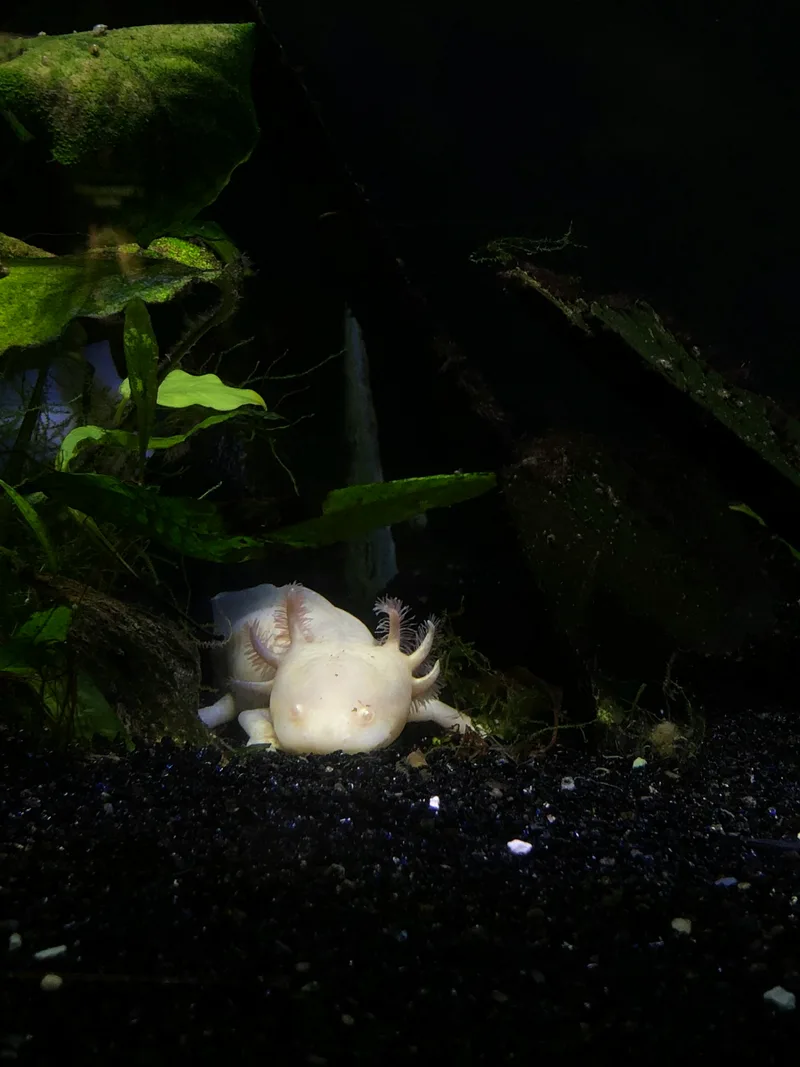
A 40-gallon breeder is the right tank for two adult axolotls: 36 inches long, 18 inches front-to-back, 648 square inches of floor for them to walk on. The catch is that two common alternatives, a 29-gallon and a 55-gallon, both look bigger than they are. A 29 has the same gallons as a 30-gallon long but a smaller, narrower floor; a 55 is taller and longer but only 13 inches front-to-back, with most of the extra volume sitting above your animals' heads. The number that matters for sizing two axolotls is not gallons at all.
What tank dimensions should I actually look for?
The rule is simple: at least 36 inches long, at least 12 inches front-to-back, 18 inches front-to-back if you can get it. Height does not matter much. Axolotls live on the floor, and every inch of height above about 14 to 16 inches is water you are paying to heat and cycle without your animals ever using it.
Within that rule, the 40-gallon breeder is the pick. It is 36 by 18 by 16 inches, which gives 648 square inches of floor, enough for two adult axolotls (Ambystoma mexicanum) to settle into separate zones. Most big-box fish stores stock it, and it often goes on sale as part of a "dollar-per-gallon" promotion.
A 30-gallon long is the realistic minimum. Same 36-inch length, but only 12 inches front-to-back, so 432 square inches of floor. Two axolotls fit, but the tank feels busier and leaves less margin when one animal wants to walk around the other.
Skip anything 29 gallons or smaller. A standard 29 is 30 by 12 inches, which is both too short and too shallow for the footprint two adults need. Tall tanks in the same gallon range are even worse because the extra gallons sit above the heads of animals that never use them.
| Tank | Dimensions (L x W x H, in) | Floor area (sq in) | Verdict for 2 adult axolotls |
|---|---|---|---|
| 20-gallon long | 30 x 12 x 12 | 360 | Too small. Fine for one adult, cramped for two. |
| 29-gallon | 30 x 12 x 18 | 360 | Too narrow and too short. Extra height wasted. |
| 30-gallon long | 36 x 12 x 12 | 432 | Workable minimum. Adequate floor, no margin. |
| 40-gallon breeder | 36 x 18 x 16 | 648 | Ideal. Best balance of floor space, cost, and availability. |
| 55-gallon | 48 x 13 x 20 | 624 | Usable but not ideal. Long and narrow, lots of wasted height. |
If you are shopping used or custom, the quick check is floor area. Anything under 400 square inches is not enough for two adults. Anything over 600 square inches with a footprint at least 36 inches long is plenty.
Why does floor space matter more than gallons?
Axolotls are not swimmers in the way most aquarium fish are. They are bottom-dwelling walkers. They spend their day sitting on the substrate, ambling short distances, and occasionally pushing off to grab a breath of air from the surface. The water above them is scenery.
Two axolotls in a narrow footprint will crowd each other even when the tank holds plenty of water by volume. A tall 29-gallon has the same gallons as a 30-gallon long, but the axolotls are stuck on a strip of floor half as wide. They cross each other's paths constantly. One tends to claim the open area, the other learns to stay in the corner, and both animals show the low-grade stress that comes with not being able to move freely.
Floor area also governs two things that gallons by themselves don't. The first is surface area for gas exchange. A wider tank has more surface touching the air, which matters because axolotls rely on a mix of gill breathing and occasional gulps from the surface. The second is how waste distributes. Poop, uneaten food, and shed slime coat all settle. A larger footprint means a lower concentration of waste per square inch of substrate, which makes the filter's job easier and keeps nitrate from climbing as fast between water changes.
The general rule the hobby repeats is "20 gallons for the first axolotl, 10 gallons for each additional." That gets you to 30 gallons for two, which is close to right but measures the wrong thing. Replace it with: 36 inches long and at least 12 inches front-to-back for the first animal, with another 6 inches of width for the second. A 30-gallon long hits that floor. A 40-gallon breeder exceeds it comfortably.
Did you know? Wild axolotls live in what remains of Lake Xochimilco, a shallow canal system near Mexico City where the water rarely reaches 3 feet (1 m) deep. Their flat, wide body plan evolved for that spread-out habitat, not for deep water. Give them floor, not depth, and you are matching the shape of the space they are built for.
Can I start with a smaller tank while they're still young?
Juvenile axolotls under about 6 inches can live in a 20-gallon long (30 by 12 inches) for a few months, but they will outgrow it fast. Most axolotls reach adult size (9 to 12 inches) within their first year, with the steepest growth between 4 and 8 months old. The tank that felt roomy for two 4-inch juveniles becomes tight by the time they hit 7 inches, and it is too small somewhere around 9.
If you are buying juveniles now, buy the full-size tank too. Starting with a 40-gallon breeder saves you the cost of a second tank later, and more importantly it saves your axolotls a move. Catching, bagging, and transferring an adult axolotl into a different water chemistry is stressful enough that many keepers report a few days of clamped gills and lost appetite after an upgrade. Skipping that step is worth the 20 or 30 dollars more you pay up front.
If you already own a smaller tank, the rough timeline for two juveniles is this. At under 5 inches each, a 20-gallon long buys you two to three months. By 6 to 7 inches, you need at least the 30-gallon long. By adult size, you want the 40 breeder. Anything smaller runs out even faster: a 10-gallon tank holds two juveniles for only a few weeks of grow-out and is not a permanent home for even one adult.
How do I know if my tank is too small for two?
Watch the animals for the first few weeks after you put a second axolotl in. Overcrowding usually shows up before the water tests do.
- Nipped or shortened gill filaments. Axolotls will bite gills, tails, or legs when they cross each other in a tight space. Small nicks regenerate, but you should not be seeing fresh nips every week.
- One axolotl always hiding, the other always out. Axolotls are territorial about floor space. If one has claimed the open area and the second only leaves its hide to eat, the tank is too small for both to feel settled.
- Ammonia above zero despite regular water changes. Two animals produce more waste than one, and a cramped footprint concentrates it. If your ammonia sits at 0.25 ppm or higher after a 30% weekly change, the biological load is outpacing the tank.
- Gills curled forward instead of fanning out. Relaxed gills fan out from the head like little feathery trees. Gills that curl forward toward the face are a direct chemical response to poor water quality at the gill surface, which happens faster in a small, overstocked tank.
- Reduced appetite in one or both. A stressed axolotl that used to eat every other day starts refusing food or only taking it half-heartedly. Paired with any of the signs above, this points to the space, not the food.
These signs can also point to water quality or temperature on their own, so run a test kit first. If the parameters come back clean and you are still seeing them, the footprint is the next thing to fix. A stressed axolotl shows the same curled gills and hooked tail whether the cause is ammonia, temperature, or space, so the signs tell you something is wrong without telling you which thing.
If you buy the 40-gallon breeder up front, you are set for the life of both axolotls. No upgrades. No second-guessing. The thing worth watching after that is not the gallon number on the side of the box but the animals themselves: relaxed gills fanning gently, both axolotls using the full floor, water parameters staying stable between changes. That is how you know the space is right.