Is 30 gallons enough for 2 axolotls?
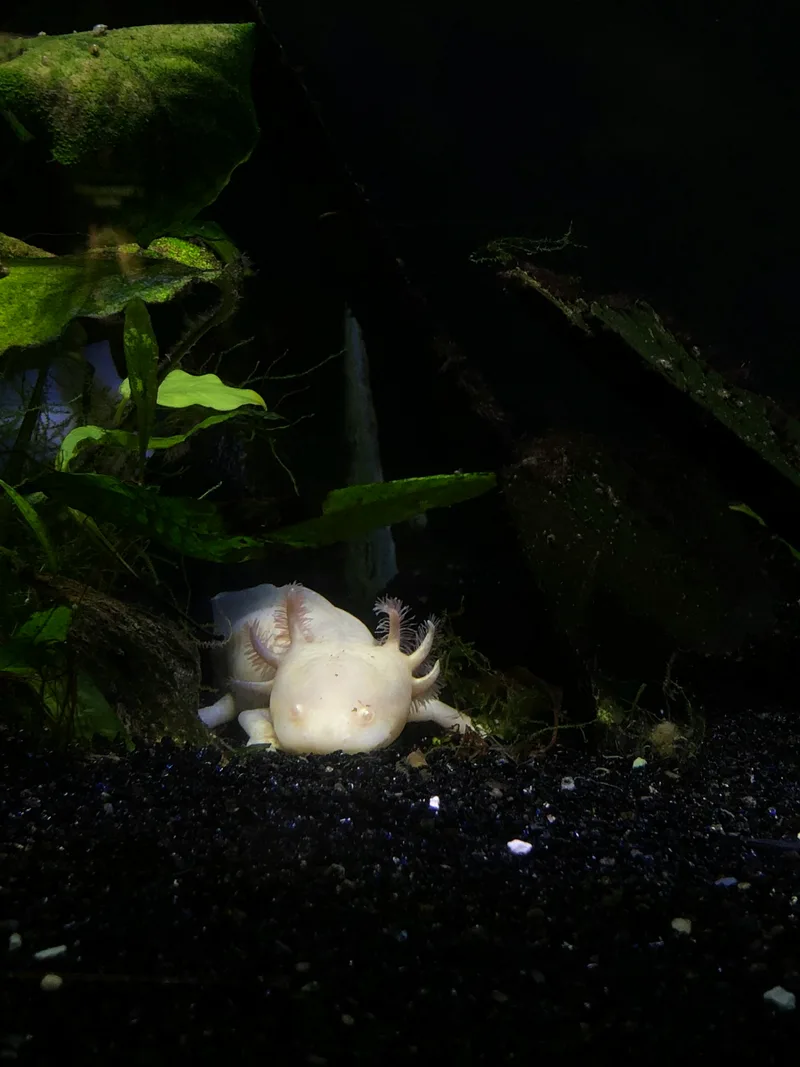
Yes, if it's the right shape of 30. A 30-gallon long (36 inches across) gives two adult axolotls (Ambystoma mexicanum) the floor they need to claim their own walking space. A 30-gallon hex holds the same water and fails the same animals. Axolotls pace the bottom rather than swim, so the number on the box only matters once you know how much floor it buys you.
What tank dimensions should I actually look for?
Two adult axolotls need a footprint of at least 36 inches long and 12 inches front-to-back. That rules out some tanks sold as "30 gallons" and includes others that most people overlook.
A standard 30-gallon long (36 x 12 x 16 inches) gives 432 square inches of floor and is the most common option that works. A 30-gallon breeder (36 x 18 x 12 inches) is even better because the extra 6 inches of depth gives each axolotl more room to move past the other without contact. If you have not bought a tank yet, a 40-gallon breeder (36 x 18 x 16 inches) is usually within the same price range and gives roughly 50% more floor space.
The one to avoid is the standard 29-gallon (30 x 12 x 18 inches). It is only 30 inches long, and two axolotls that each reach 10 to 12 inches as adults will crowd a floor that short.
| Tank | Dimensions (L x W x H) | Floor area | Works for 2 axolotls? |
|---|---|---|---|
| 29 gallon | 30 x 12 x 18 in | 360 sq in | No, too short |
| 30 long | 36 x 12 x 16 in | 432 sq in | Yes |
| 30 breeder | 36 x 18 x 12 in | 648 sq in | Yes, more comfortable |
| 40 breeder | 36 x 18 x 16 in | 648 sq in | Yes, best common option |
Why does floor space matter more than gallons?
Axolotls are bottom-dwelling walkers. They do not swim laps the way a fish does. They spend most of their time sitting on the substrate or walking slowly across it, and each animal stakes out its own patch of floor. Two axolotls in a narrow tank will bump into each other even if there is plenty of water above them.
Floor area also affects water quality in ways that the gallon number misses. A wider surface area means more gas exchange between the water and the air, which helps keep dissolved oxygen up and CO2 down. Waste spreads across more substrate instead of concentrating in one spot, giving your filter a better chance of processing it before ammonia spikes.
This is why the 20+10 gallon rule works as a rough starting point but falls apart without a shape check. A tall 30-gallon hex tank holds the right number of gallons but packs its floor into a small footprint. The math says it should work. The axolotls say otherwise.
Did you know? Wild axolotls in Lake Xochimilco lived in water rarely deeper than 3 feet, spread across a shallow lake system of canals and wetlands. Their body plan is built for flat, wide habitats. Depth was never the resource they needed.
Would a 40-gallon breeder be a better choice?
If you are still shopping for a tank, the 40-gallon breeder is the better buy. It shares the same 36 x 18-inch footprint as the 30 breeder, adds 4 inches of height, and usually costs only $10 to $20 more. The extra water volume makes parameter swings less dramatic. You also get more vertical room for hides and sight-line breaks, which matter when two territorial animals share a floor.
If you already own a 30-gallon long and it measures at least 36 x 12 inches, you do not need to upgrade. The tank is adequate for two adults. Spend the money on a second hide instead, so each axolotl has a retreat it does not have to share.
The general sizing decision for a pair of axolotls depends on the same floor-space principle, just without the 30-gallon constraint.
How do I know if my tank is too crowded?
Even in a tank that meets the minimum dimensions, two individual axolotls can run into trouble. Watch for these signs in the first few weeks and during any changes to the setup:
- Nipped or ragged gills. Axolotl gill filaments are exposed and fragile. If one animal is nipping the other's gills, the space is not giving them enough separation.
- One axolotl always hiding while the other claims the open floor. This is territorial displacement. The hiding animal is not choosing to be shy; it is being pushed out.
- Ammonia above 0 ppm despite regular water changes. In a properly cycled tank, persistent ammonia means the bioload is outrunning the filtration for that footprint. More floor space (or a stronger filter) helps distribute waste.
- Gills curling forward. The gill filaments fold toward the face when ammonia or nitrite irritates them. This is a direct chemical reaction in the tissue, not a behavioral choice. It means water quality has slipped.
- Reduced appetite in one or both animals. Stress from crowding often shows up as food refusal before any visible physical damage.
If you see one or two of these signs, check your water parameters first. Ammonia and nitrite should be at 0 ppm, nitrate below 20 ppm. If the parameters are fine and the behavior continues, adding more hides and sight-line breaks (tall plants, slate dividers) can help. If stress signs persist after that, the tank may genuinely be too small for the two animals you have, and a larger footprint is the fix.
A 30-gallon long is a solid home for two axolotls. The number on the tank matters less than what you see inside it: relaxed, feathery gills, both animals using the full floor, and water parameters that hold steady between changes. That is how you know the space is working.