Are axolotls high maintenance?
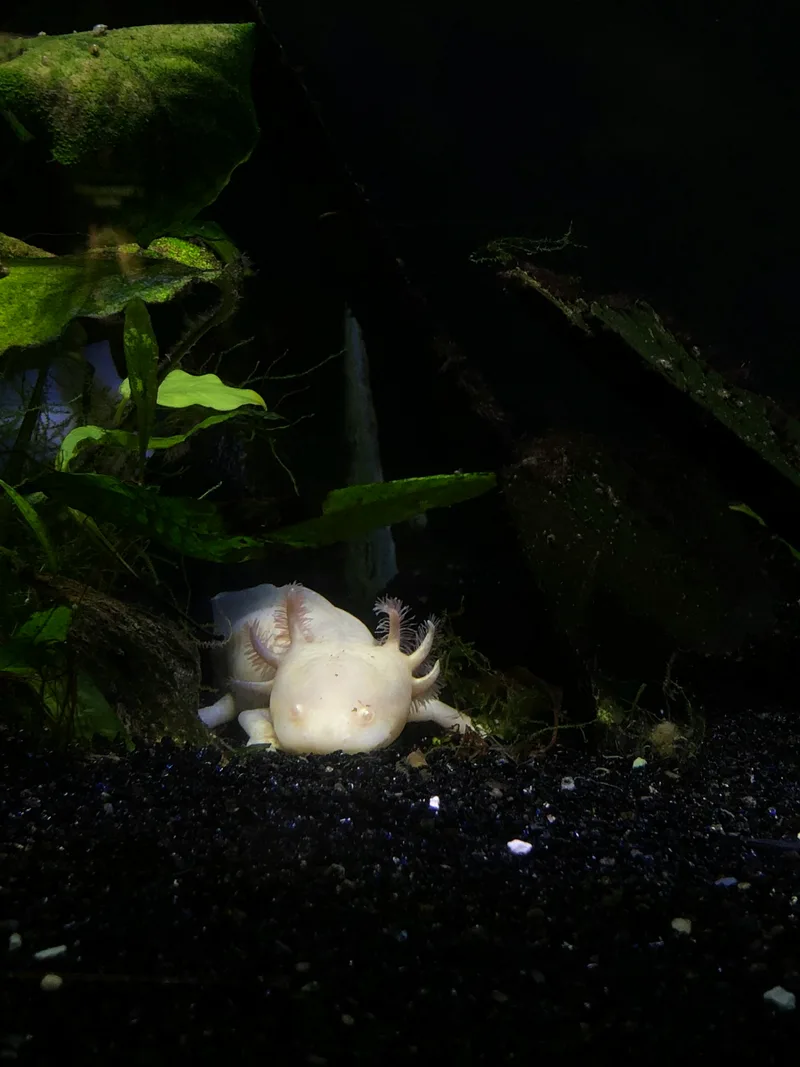
Not really, once the tank is set up. A healthy adult axolotl asks for under an hour of hands-on time a week: two or three feedings, one water change, a quick test for ammonia and nitrite. The catch is the setup, and it's unforgiving in three specific ways. The water has to stay below 68°F (20°C). One axolotl per tank, no exceptions. The substrate has to be fine sand or bare glass. If those three fit your home, an axolotl is lower-effort than most people expect. If any of them don't, no amount of weekly care will fix it. The rest of this piece walks through what a week actually looks like, how the work compares to a fish tank, and why those three rules carry so much weight.
What Does a Week with an Axolotl Actually Look Like?
Once the tank is set up and cycled, the routine is short. You feed two or three times a week, change 20 to 30 percent of the water on the weekend, siphon any waste you see between changes, and run a test for ammonia, nitrite, and nitrate. Total hands-on time over seven days is usually under an hour.
The low feeding frequency surprises people coming from fishkeeping. Juveniles eat daily, but an adult axolotl (Ambystoma mexicanum) has a slow metabolism and will actively refuse food if offered every day. Most keepers settle into a rhythm of earthworms or sinking pellets two or three times a week and find the animal stays a healthy weight without fuss.
Here's the weekly checklist in full:
- Feed two or three times: earthworms, nightcrawlers, or sinking axolotl pellets
- Change 20 to 30 percent of the water, matched for temperature and dechlorinated
- Spot-siphon any visible poop or uneaten food between water changes
- Test ammonia, nitrite, and nitrate with a liquid kit; all three should read low, with ammonia and nitrite at zero
- Rinse filter media in the old tank water once a month (never tap water, which kills the bacterial colony)
- Check the tank thermometer daily during warm months
The catch is that missing a week hits harder than it would with a community tank. A planted tank with a dozen small fish has biological inertia: a single light load, spread across several small bioloads, absorbs a skipped water change. A one-axolotl tank has one relatively large waste producer and no backup. Ammonia climbs faster than you expect, and axolotls show it on their gills before they show it in their behavior.
Is It More Work Than a Goldfish or a Community Tank?
If you already keep a fish tank, the total time commitment lands in the same neighborhood. The water change is the water change. The testing is the testing. The differences are about what's hard, not what's frequent.
Two things are harder. The first is that you can't hide mistakes across a group. In a community tank, ten small fish dilute the impact of an overfeeding or a skipped siphon; the bioload is spread across bodies and across gills. An axolotl tank has one animal doing all the waste production and one animal absorbing every parameter mistake. The second is temperature. A heater is a three-minute setup in a tropical tank. Keeping an axolotl tank below 68°F in a house that warms up in summer is either free (cool basement, cool room) or it's a chiller and a real bill. There is no version where you wing it.
Two things are easier. You don't have stocking ratios, aggression, or compatibility to solve: it's one animal, alone, by design. And there's no lighting schedule to build, because axolotls come from dim lake-bottom habitats and prefer low light anyway. You can skip the timer and the planted-tank lighting logic entirely.
If you are moving from a tropical community tank, not all the equipment carries over. Your test kit, siphon, bucket, and dechlorinator all come with you. A lot of other habits need rethinking, and knowing what not to put in an axolotl tank is usually the faster route than converting a fish setup piece by piece.
Why Are Temperature, Solo Keeping, and Substrate Non-Negotiable?
Each of the three setup rules exists because of a specific biological mechanism, and each failure mode is slow enough to miss until it's serious. Understanding the mechanism is what turns the rules from things to memorize into things you can reason from.
Temperature. Axolotls evolved in the cool high-altitude lakes around Mexico City, where the water sits in the mid-60s Fahrenheit year-round. Their immune system and the slime coat on their skin are both tuned to that range. Above roughly 72°F (22°C), the slime coat thins, bacterial and fungal infections set in more easily, and the animal's metabolism runs hot enough to stress its organs. The decline is rarely dramatic. A warm-room axolotl often looks fine for weeks, eats a little less, gets a spot of fungus that won't clear, and the keeper reads the animal as just "not doing well" without connecting it to room temperature.
Solo keeping. Axolotls are opportunistic carnivores that identify food by movement and chemical cue rather than by vision. As juveniles they actively cannibalize tankmates, taking off legs and gills, which regenerate but leave the animal weakened and exposed to infection. As adults they calm down, but they still strike at anything of roughly prey-sized movement near their face, including another axolotl's gills. Cohabitation frequently looks peaceful for months before one morning you find a gill stalk missing. Pairs also compete for food at feeding time, which means one animal gets fat and the other gets thin.
Substrate. Axolotls don't pick up food the way fish do. They inhale it: a sudden gape pulls a current of water into the mouth, and whatever is in front of them goes with it. If the tank floor is gravel, pebbles, or small stones, they will swallow them during feeding. Small gravel passes some of the time; larger pieces lodge in the digestive tract and cause impaction, which is a slow, often fatal blockage. Fine sand (grain size under about 1 mm) passes through safely. A bare glass bottom is also safe and easier to keep clean.
| Rule | Why it exists (mechanism) | What happens if you get it wrong |
|---|---|---|
| Cool water under 68°F (20°C) | Slime coat and immune system tuned to cold lake habitat; heat thins the coat and invites infection | Slow fungal and bacterial infections, reduced appetite, gradual decline often misread as the animal just "doing poorly" |
| One axolotl per tank | Feeding response is a blind inhaling strike; they cannot reliably tell a tankmate's gill from prey | Bitten-off limbs and gills (they regenerate but weaken the animal), food competition, sudden injury after months of calm |
| Fine sand or bare bottom | They inhale food rather than picking it up, swallowing whatever substrate is in the strike zone | Gut impaction from gravel: a slow, often fatal blockage that doesn't show until the animal stops eating |
Did you know? An axolotl's feathery external gills are in direct chemical contact with the tank water. When ammonia rises, the gill filaments react physiologically before the animal changes its behavior at all. That's why curled-forward gills show up days before the animal goes off food, and why experienced keepers learn to read the gill posture the way fishkeepers read fin clamping.
Is an Axolotl the Right Pet for You?
The question "are axolotls high maintenance" is usually the wrong one. The workload is low once the setup is right, and impossible when it isn't, so the real question is whether your home and your habits match what an axolotl needs. A short self-check:
- Does your home stay under 72°F year-round, or are you willing to buy and run a chiller?
- Can you commit to a 10 to 15 year timeline? Healthy axolotls regularly outlive the enthusiasm of the person who bought them.
- Is the appeal watching an animal, not handling one? Axolotls are display pets; being picked up is stressful for them.
- Is there someone in the household who will keep up the weekly water change a year in, when it's no longer novel?
If those answers line up, you are looking at one of the lower-maintenance aquatic pets for its size and lifespan. The setup is real work and the rules are rigid, but once the tank is cycled and running, an axolotl asks less of your week than most fishkeepers expect. "High maintenance" turns out to be the wrong axis for this animal. Good fit or wrong fit is the one that actually decides how the next decade goes, and the concrete downsides of owning an axolotl are the specific pressures that push the wrong matches toward rehoming a year in.