Is an axolotl easy to care for?
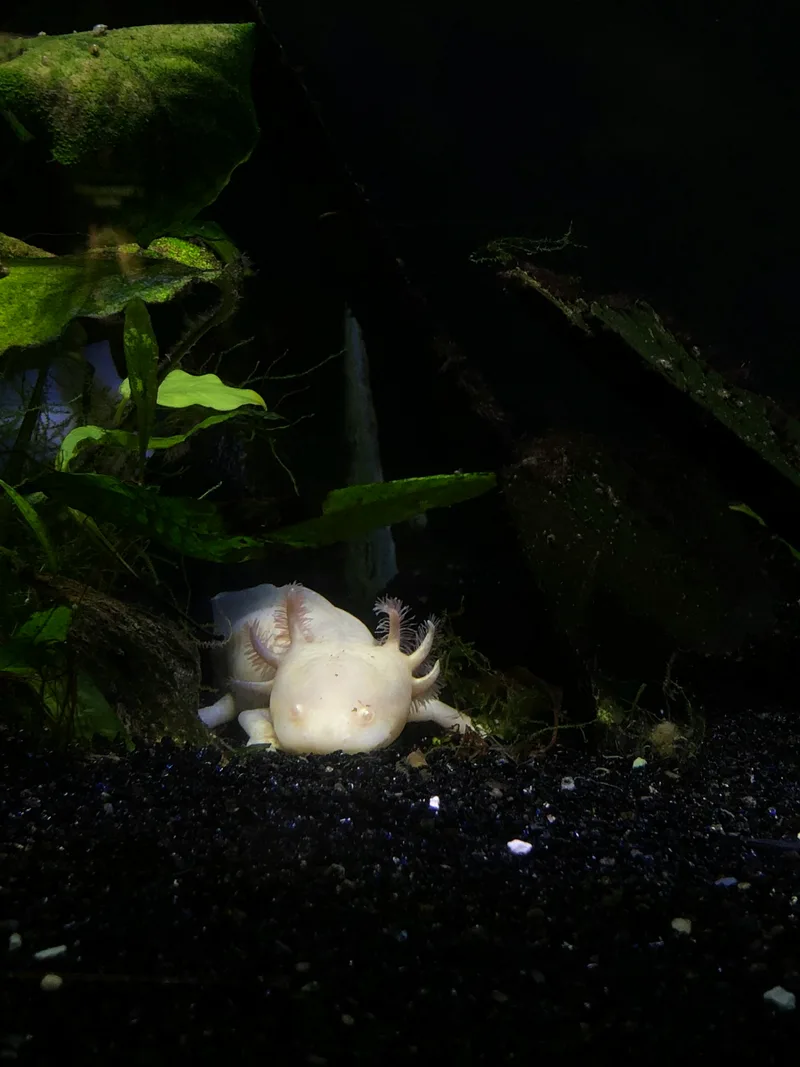
Yes, once the tank is set up right, an axolotl is easier than most tropical fish: no heater on a timer, no schooling group to balance, hardy in cool, well-cycled water. The catch lives inside the words "set up right." Three of the things a fish-keeper's instincts get right for fish (add a heater, use fine gravel, give them tankmates) are the exact three things that kill axolotls. So the honest answer is easy if you respect what they're not, not easy like a goldfish.
What makes an axolotl easy to care for?
Most of the friction in keeping a tropical fish tank is gone. There's no heater on a timer, no group of six to keep balanced, no aggressive tankmate to manage around a peaceful one, and no light schedule to tune for plant growth. You have one animal, alone, in cool water. Once the tank is cycled and the temperature is in range, the routine settles into something most casual owners can absorb without thinking about it.
A healthy adult axolotl (Ambystoma mexicanum) eats two or three times a week and otherwise spends its time visible. They don't bury themselves or hide all day. The reason that matters is practical, not aesthetic: visible animals are diagnosable animals. You can see the gills full and feathery, you can see the body posture, you can see what came out and what didn't. A fish that spends all day behind the driftwood is harder to read than an axolotl sitting on the glass.
The diet is also forgiving. Earthworms, nightcrawlers, and sinking axolotl pellets are cheap, easy to dose, and don't spoil the tank water the way live brine shrimp or frozen bloodworms can in a community setup.
Here's what's specifically easy about them:
- No heater, because room temperature in a normal home is usually within or just above their range
- A simple, cheap diet of earthworms or sinking pellets, fed only two or three times a week
- One animal per tank, so no schooling group, aggression, or compatibility puzzle to solve
- Hardy in stable, well-cycled cool water; they tolerate cycle hiccups better than most tropical fish
- Visible and active during the day, which makes problems easier to spot before they get serious
What makes them hard if you're used to fish?
Three things, and all of them go directly against the habits that work for tropical fish. This is where most new keepers get into trouble, and not because the animal is fragile. It's because the rules are inverted.
Cool water. Axolotls suffer above 72°F (22°C). Their preferred range is 60 to 64°F (16 to 18°C), which is below the comfortable lower bound for almost every tropical fish in the hobby. Add a heater and you are slowly cooking the animal. Park the tank in a sunny living room through July and you are doing the same thing more slowly. The slime coat thins, the immune system loses ground, and bacterial and fungal infections settle in. The decline is rarely dramatic. The keeper sees an animal that "isn't doing well" without connecting it to the room temperature.
The reason for that intolerance lives in their evolutionary history. Axolotls come from the cold, high-altitude lake complex around Mexico City, where the water sits in the high teens Celsius year-round. Their metabolism, their slime coat, their immune response, all of it is tuned to that range. Tropical numbers aren't ambient to them. They're stress.
Substrate. Axolotls don't pick up food the way fish do. They inhale it, opening the mouth into a sudden gape that pulls a current of water in along with whatever is in front of them. If the tank floor is small gravel or pebbles, they swallow it during feeding. Small pieces sometimes pass; larger ones lodge in the gut and cause impaction, which is a slow, often fatal blockage. The safe options are fine sand (grain size under about 1 mm) or a bare glass bottom. Anything bigger than sand and smaller than a fist is a problem.
Tankmates. Fish nip gills. Axolotls inhale small fish. Both stress each other in ways that don't show up immediately and are hard to undo. Fast tropical fish read those feathery external gills as food and graze on them. Axolotls strike at any prey-sized movement near the face, which means they will swallow a guppy, a danio, or even a smaller axolotl. A pair of axolotls together looks peaceful for months and then one morning a gill stalk is missing. The rule is solo, and it's not negotiable.
Did you know? Axolotls evolved in the cold, high-altitude lake complex around Mexico City. Lake Xochimilco sits at roughly 2,200 m (7,200 ft), and the water there hovers in the high teens Celsius year-round. The same room temperature that's chilly for a tropical fish is exactly what an axolotl wants.
What does day-to-day care actually look like?
Once the tank is cycled, a normal week is short. You feed two or three times, change 20 to 30 percent of the water on the weekend, test ammonia and nitrite (and nitrate while you're at it), and run a quick visual check on the gills and posture before you walk away. Total hands-on time is usually under an hour over seven days.
The feeding rhythm catches people. Adult axolotls have a slow metabolism and will actively refuse food if offered every day. Two or three meals a week is plenty, and most keepers settle into a rhythm where they alternate feeding days and skip-days without thinking about it. Juveniles are different and eat daily, but a full-grown axolotl past about a year does not.
Water testing matters more in a one-axolotl tank than in a community tank because there's no biological inertia. Ten small fish spread the bioload across ten gills and ten metabolisms, which buffers the tank against a skipped water change. One axolotl in 20 gallons does not. Ammonia climbs faster than you'd expect, and the gills react before the behavior does.
Here's the weekly checklist:
- Water change of 20 to 30 percent, dechlorinated and matched for temperature
- Test ammonia and nitrite (both should read zero), and watch nitrate stays low
- Feed earthworms or sinking pellets two or three times across the week
- Spot-siphon any visible poop or uneaten food between water changes
- Visual gill and posture check: full and feathery is good, curled forward or shrinking is a warning
In overall workload, this lands less than a planted community tank (no pruning, no algae management, no lighting schedule, no stocking puzzle) and more than a goldfish bowl (real water testing, real cycling, real attention to temperature). It's modest, but it isn't nothing.
Are axolotls a good choice for a first pet or a beginner aquarist?
Easier than most tropical fish, in some specific ways, and harder in others. For someone starting from scratch, an axolotl skips the two things that trip up beginners with a community tank: there's no heater that can fail and cook the fish overnight, and there's no group dynamic to balance. One animal, one set of needs, no compatibility math. That's a real simplification.
The harder side is the temperature ceiling and the cycle. If your home runs warm in summer and you can't keep the tank below 72°F (22°C) without a chiller, an axolotl is the wrong pet. If you don't want to run a cycled tank with weekly testing for the first few months, a betta in a properly sized tank is going to be a less stressful introduction to fishkeeping. And if the appeal is a fish a child can hand-feed and decorate the tank around, axolotls aren't really that animal. They're display pets that do not enjoy being handled, and a planted community tank is more interactive in the ways most kids actually want.
The other piece worth being honest about is the timeline. A healthy axolotl lives 10 to 15 years as a pet, which is a real commitment compared to most beginner fish. Most platies and bettas tap out around 3 to 5 years. The decision you're making isn't "should I get a fish," it's "do I want to keep this same animal through the back end of a decade." That changes the answer for a lot of households.
If you're specifically weighing whether axolotls are easy for beginners, the answer turns more on whether your home stays cool than on your fishkeeping experience. The realistic downsides of owning an axolotl cluster around the same three things that kill them in fish setups, plus the long timeline, and they're worth knowing before you walk out of the shop. Easy is real for the right household, and the right household is the one willing to keep an axolotl as the cool-water oddball it is, instead of trying to keep it like a fish.