How often does an axolotl poop?
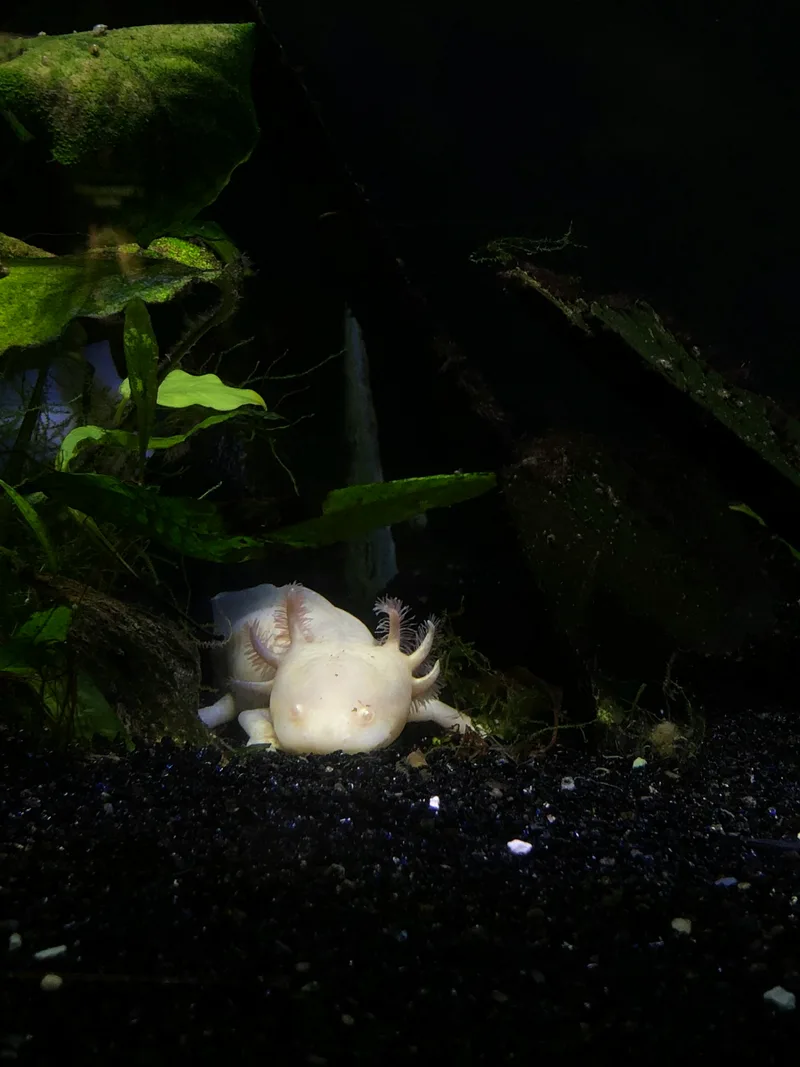
A healthy adult axolotl poops about once a week, sometimes twice. A four- or five-day gap is not constipation; it's the species working as designed. Axolotls run on the metabolism of a cold lake, and at the temperature they actually want, a meal takes days to move through the gut. Juveniles run faster, every one to three days, because they eat every day. Frequency tracks two things and only two: how much you feed, and how cold the water is. If you can't remember the last time you saw a poop, or if you're suddenly seeing several a day, what follows is how to read which way it's off and what to do about it.
What's the Normal Range for a Healthy Axolotl?
For an adult axolotl, once a week is the baseline. Twice a week is also normal, especially if you feed every two or three days. Anything in that window is not a problem.
Juveniles run on a different clock. A young axolotl under six months is still growing fast, eats every day, and poops every one to three days. As it gets older the feeding tapers off and the poops follow.
| Life stage | Typical poop frequency |
|---|---|
| Juvenile (under 6 months) | Every 1 to 2 days |
| Sub-adult (6 to 12 months) | Every 2 to 4 days |
| Adult (12+ months) | Once a week, sometimes twice |
Not every poop gets seen, either. Axolotl poop is fragile and breaks down quickly in the tank, and a poop that lands behind a hide or on dark sand can dissolve into flakes before you ever spot it. So "I haven't seen a poop in five days" is not the same as "my axolotl hasn't pooped in five days."
The simple rule: count from the last visible poop and the last feeding, not from the calendar. If your axolotl ate three days ago and pooped two days ago, you are exactly where you should be.
What If My Axolotl Hasn't Pooped, Or Is Pooping Way More Than This?
Off-range goes two ways, and the fix is different for each.
Too little. If it has been seven to ten days with no visible poop, look at the animal before you do anything. A healthy axolotl that just hasn't pooped yet acts normal: walking on the bottom, gills out, eating when offered. An axolotl that is actually constipated looks different. Watch for these:
- Visible bloating around the belly
- Floating that doesn't pass overnight
- Back legs dragging instead of walking properly
- Refusing food that it normally takes
- Sitting at the surface instead of resting on the bottom
- Sluggishness, slow response to your hand or to food
If you see one or two of these along with the long gap, the first low-stakes move is to skip the next feeding. Let the gut catch up. Many of these cases pass on their own within a day or two.
If skipping a meal doesn't move things and the symptoms are still there, the next step is tubbing in cool, clean water at around 5 to 10°C (40 to 50°F). This is sometimes called "fridging" and that is exactly what it is: a sealed container in the fridge with dechlorinated water at fridge temperature, water changed daily. It slows the metabolism further and gives the body time to pass what it's holding. Most owners see results in two to four days.
Too much. An axolotl pooping multiple times a day is almost always one of two things, and often both: too much food, or water that is too warm. Above 20°C (68°F) the metabolism speeds up enough that the same amount of food moves through the gut much faster, and the animal is also under heat stress, which is its own problem. Get the temperature back down into the 16 to 18°C (60 to 64°F) range and pull back on the feeding amount. If you've been keeping the tank near room temperature, that's worth fixing first because the fix for everything else gets simpler once the water is cool.
Feeding amount is the other knob. Adult axolotls do not need daily food; two to three feedings a week is plenty. The pellet count or worm count per feeding should leave the animal looking fed, not visibly bulging. If you've been feeding every day, cutting back to every two or three days will usually settle the schedule on its own within a week.
Why Does Water Temperature Change How Often They Poop?
Axolotls are cold-blooded, which means they don't run their own thermostat. The water sets the speed of everything inside them, including the gut. At 16 to 18°C (60 to 64°F), the temperature they actually want, digestion takes days. At 22°C (72°F), the same meal moves through in a fraction of the time.
This is why a warm tank both stresses the animal and produces more poop. The metabolism is being driven faster than the body is built for. The poops aren't a sign of a thriving fish; they're a sign of an animal whose engine is over-revving.
Did you know? Axolotls evolved in the lake complex around what is now Mexico City, where the water sits in the high teens year-round. Their digestive enzymes are tuned for that temperature window. A "warm" tank for a tropical fish (24°C / 75°F) is essentially a fever for an axolotl, gut and all.
"Once a week is normal" isn't an arbitrary number someone in the hobby decided on. It falls out of the temperature the species evolved at. So if your axolotl is at the right temperature and pooping once a week, that's the species working as designed, not anything you did.
Does It Change for Juveniles vs Adults?
Yes, quite a lot. Knowing where on the curve your animal sits keeps you from applying adult expectations to a juvenile or vice versa.
A juvenile under six months is in a growth phase. It eats every day, sometimes twice a day, and it poops every one to three days. That's normal and expected. Trying to feed a young axolotl on an adult schedule will slow its growth.
A sub-adult between six and twelve months is in transition. Feedings drop to every other day, then every two or three days, and the poops space out the same way. There isn't a clean line where one becomes the other; the feeding rhythm steps down gradually as the animal stops gaining length.
Adults at twelve months and beyond are eating two to three times a week and pooping accordingly. The total food going in per week is much smaller than during the juvenile phase, even though the animal is bigger.
If you're not sure which stage your axolotl is at, size is the rough proxy: under about four inches it's still firmly in the juvenile schedule, between four and seven inches it's transitioning, and over seven inches it's eating like an adult.
What matters in all three stages is that the food going in and the waste coming out are roughly in sync. There isn't a single right number. The poop schedule follows the food schedule, and the food schedule follows the water temperature. Get those two right and the frequency takes care of itself. You don't need to count days; you need to set the temperature and the feeding rhythm, and let the animal handle the rest.