What should you not put in an axolotl tank?
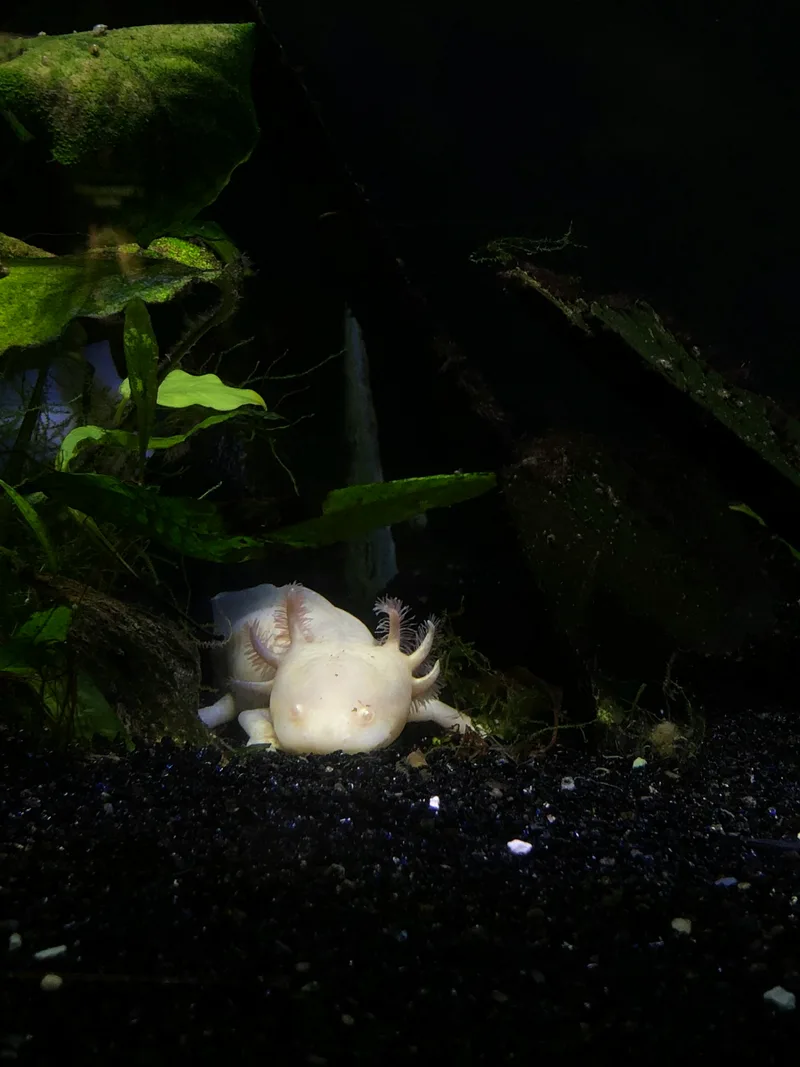
Keep three things out, no matter what else you do: small gravel, a heater, and fish tankmates. Each one kills axolotls (Ambystoma mexicanum) routinely, and each one is a default a fish keeper would bring over without a second thought. That's the trap with this animal. It looks like a fish, sits in a glass tank like a fish, and breaks almost every rule a fish-keeping instinct would carry into the setup. The rest of the list runs on that same pattern, in rough order of how much damage each item does.
Gravel and anything else small enough to swallow
Swallowed substrate is the single most common way a home-kept axolotl dies. Axolotls feed by creating suction. They lunge at food and vacuum up whatever is in front of them, and if that includes pebbles, they swallow pebbles. The stones get stuck in the gut, stop digestion, and the animal starves from a full stomach. This is called an impaction, and by the time you see symptoms (no appetite, bloating, a hunched body shape) it's often too late to fix.
The rule is simple. Either keep the tank bare-bottom, or use stones that are clearly too big to fit in the axolotl's mouth, or use fine sand only once your axolotl is at least 6 inches long. A good check: if a piece of substrate could fit past the axolotl's lips, assume it will end up inside the axolotl eventually.
Ranked from safest to most dangerous:
- Bare bottom glass, zero impaction risk and easiest to clean
- Large smooth river stones, bigger than the axolotl's head
- Fine sand (grains under 1mm), only for adult axolotls over 6 inches
- Pea gravel, which is the standard aquarium gravel size and a reliable killer
- Small colored aquarium gravel, bright enough to trigger even more strikes
- Loose decor fragments, ceramic chips, or anything small enough to fit in the mouth
A heater (or anything that warms the water)
Second most lethal mistake, and the one fish keepers default into without realizing it. Axolotls come from a cool highland lake in Mexico, not a tropical river. They want water between 60 and 64°F (16 to 18°C), and anything above 72°F (22°C) stresses them fast.
Heat stress in an axolotl looks like stopped feeding, a white film or fuzz appearing on the skin and gills (a fungal infection called columnaris, which heat makes much more likely), and eventually organ failure. The tricky part is that fish-keeping instinct says "add a heater" as a baseline move. With an axolotl, a heater is almost never needed in a typical indoor room, and in most homes it's actively harmful. If your room runs hot in summer, the answer is a fan across the water surface or a small chiller, not more heat.
A normal room in the 60s already sits in the right range, so skipping the heater on an axolotl tank is the right default rather than the exception.
Fish, any fish
No fish tankmates. Not small ones, not large ones, not peaceful ones, not ones that "should be fine." This is a category ban, not a species-by-species judgment.
Small fish get eaten, and that sounds like a feature until a swallowed fish causes choking or introduces parasites from whatever stock tank it came from. Medium and large fish nip at the axolotl's external gills, which are the feathery red fronds sticking out from the sides of its head. Those gill filaments are delicate tissue with exposed blood vessels, and they don't reliably regrow without damage. Goldfish are the classic mistake here. People pair them because both are cold-water and both look cute, but goldfish are nippy and will strip an axolotl's gills over a few weeks.
Spiny bottom-dwellers are the worst of all. Plecos and corydoras (Corydoras species) carry locking spines on their fins that can pop out when another animal tries to swallow them. If an axolotl strikes at a cory, the spine lodges in the axolotl's throat or gut, and the outcome is almost always fatal.
The safe answer is solo, or a same-size axolotl of the same age if you have a large enough tank. An axolotl's feeding behavior toward smaller tankmates is a reliable enough pattern that you can plan around it: anything that fits in its mouth is food, eventually.
A strong filter or powerhead
Axolotls aren't built for fast water. They come from slow, still backwaters of a single lake system, and they're genuinely poor swimmers. You'll see yours walk along the bottom more than swim. Drop one into the output of a high-powered canister filter or a powerhead and it gets shoved around, has to fight to hold position, and stresses out.
Flow stress shows up in the gills before anywhere else. The gill filaments curl forward toward the face instead of fanning out sideways, and the animal hunches on the substrate with its head low. Sustained, it leads to weight loss and a cracked immune system. The fix is to drop the flow, not just point the output somewhere else. A sponge filter sized for the tank, a baffled hang-on-back, or a canister with a spray bar aimed at the glass to break up the current will all work. The target is a surface that looks calm, not rippling.
This is a mistake that sneaks in because general fish-tank advice treats strong flow as a quality signal: more filtration, more turnover, more oxygenation. For most tropical fish that's true. For an axolotl it's the opposite. Curled-forward gills and a hunched posture are two of the clearest signs of an axolotl under stress, and both point straight back to flow.
Water conditioners with aloe, iodine, or heavy metals
This one catches people because the bottle says "safe for fish." It's sneaky. Axolotl skin is permeable, which means the animal absorbs a meaningful amount of whatever is dissolved in the water directly through its outer layer. The same traits that let them regenerate a lost limb also mean their skin doesn't keep chemicals out the way a scaled fish's skin does.
That turns ordinary fish-tank products into small hazards. Ingredients to watch for on the label:
- Aloe vera, common in "slime coat enhancer" dechlorinators, irritates axolotl skin and gills
- Iodine or iodide, sometimes added to salt mixes or breeder products, toxic at low doses
- Copper sulfate, the active ingredient in most ich treatments, a poison to axolotls
- Malachite green, a fish-parasite treatment, also toxic
- Formalin, another external-parasite treatment, also toxic
Stick to a plain dechlorinator that neutralizes chlorine and chloramine and nothing else. Seachem Prime and API Tap Water Conditioner are both reliable, cheap, and don't contain anything on the list above. If your axolotl gets sick and you're tempted to reach for a fish medication, stop and look up the specific compound for axolotls first. Most of what works on fish will poison an axolotl.
Liquid fertilizers, root tabs, and high-light planted-tank gear
Another fish-tank habit that backfires. Modern planted-tank setups run on dosed liquid fertilizers and nutrient-rich root tabs, both of which contain nitrates, ammonium salts, and trace metals designed to push plant growth. Axolotl skin absorbs all of it.
Light is the other half of the problem. Bright planted-tank lighting is too much for an axolotl's eyes and nervous system. In the wild they live in shaded, turbid water, and in a tank they spend most of their time avoiding direct overhead light. High-output LEDs force them into hides all day and raise their stress baseline even when nothing else is wrong.
The path that works is the opposite of a modern high-tech planted tank. Pick plants that live on nothing but the ammonia and nitrate your axolotl already produces, skip any kind of dosing, and run a dim or shaded light. Good candidates:
- Java fern, anchors to driftwood and needs no substrate
- Anubias, same deal and happy in low light
- Java moss, clings to rock or wood and tolerates almost anything
- Amazon frogbit, floating plant that shades the tank from above
- Hornwort, floating or planted and grows fast on waste nitrogen
- Elodea, hardy and cold-tolerant, a good nitrate soak
Live feeder fish or insects
Live feeders feel right, since axolotls are predators and live prey seems closer to what they'd eat in the wild. In practice, live feeders are one of the most common ways axolotls pick up diseases and parasites.
Feeder goldfish and minnows are the biggest risk. They're bred in high density and shipped through systems that carry a long list of parasites, and axolotls eating them regularly take on whatever the feeders were carrying. Goldfish specifically also contain thiaminase, an enzyme that destroys vitamin B1. A short-term treat is fine, but fed as a staple, thiaminase-heavy prey causes a vitamin deficiency that slowly damages the nervous system.
Most insects are a different problem. Mealworms, crickets, and similar feeders have tough chitin exoskeletons that axolotls can't break down. The chitin sits in the gut and contributes to the same impaction risk as swallowed gravel.
The staples that actually work are earthworms (from a clean, pesticide-free source), live or frozen blackworms, and good-quality sinking axolotl pellets. Rotating through those three handles most of the nutritional bases. When you're picking the best daily food for an axolotl, the standard is boring protein from clean sources, not variety for its own sake.
How to audit your tank before the axolotl arrives
The point of all this isn't to remember seven don'ts. It's to internalize one pattern: axolotls look like fish but break every fish-keeping default. Cool water instead of warm. Bare bottom instead of gravel. Slow flow instead of strong. Solo instead of community. Plain water instead of dosed. Once you're running that filter, most new decisions answer themselves. When a fish-keeping instinct kicks in, stop and ask whether it still holds for an animal with permeable skin, a suction-feeding mouth, and no scales.
Before you introduce the axolotl, walk the tank bench-by-bench through this audit:
| Area | Do | Don't |
|---|---|---|
| Substrate | Bare bottom, large stones, or fine sand for 6"+ adults | Gravel, pea pebbles, small decor fragments |
| Temperature | 60 to 64°F (16 to 18°C), no heater in a normal room | Any heater set above 68°F, or a room that runs hot |
| Tankmates | Solo, or another same-age axolotl in a bigger tank | Any fish, including goldfish, plecos, and corydoras |
| Filter | Sponge filter, baffled HOB, or spray bar on glass | High-flow canister output or powerhead |
| Water treatments | Plain dechlorinator (Prime, API Tap Water Conditioner) | Aloe-based slime coat products, iodine, copper-based meds |
| Plants | Low-light species fed by waste nitrogen | Liquid fertilizers, root tabs, high-output planted lighting |
| Food | Earthworms, blackworms, sinking axolotl pellets | Feeder goldfish, minnows, crickets, mealworms |
If every row on the "Do" side matches your setup, the tank is safe for an axolotl today. The checklist is useful, but the rule is the thing to carry: when you're about to apply a fish-keeping default, stop and ask whether it still holds here. That single question is what keeps the next surprise off the "do not" list.