What are the types of goldfish?
A shubunkin can spend the winter in an outdoor pond under a layer of ice and be fine. A ranchu in the same pond would be dead by morning. They're the same species, Carassius auratus, and they sat in the same fish-store tank a year ago. The difference is that goldfish split into two functional groups centuries ago: the streamlined commons (common, comet, shubunkin), which kept the wild-carp body and can grow over a foot long, and the round-bodied fancies (fantail, oranda, ryukin, and the specialty shapes), which were bred for shape at the cost of swimming power and hardiness. Which group sits in your tank decides what size that tank has to be, whether a pond is on the table, and which tank mates will leave it alone at feeding time.
Common vs. Fancy: The Split That Governs Everything
The split isn't cosmetic. Commons kept the original wild-carp body plan: long, hydrodynamic, strong-swimming. Fancies have been bred for exaggerated shapes: short round bodies, split tails, head growths, eyes that stick out sideways. Those traits are striking to look at, but they come at a cost. A shorter body has less room for the same length of intestine and swim bladder, so fancies are more prone to digestive and buoyancy trouble. A split tail and shorter fins trade away swimming power. A head growth can eventually cover the eyes.
That one fact drives everything downstream. It's why commons belong in ponds and big tanks with room to run, and why fancies need smaller, calmer water with cleaner parameters and slower tank mates. It's also why a pond in winter is fine for a shubunkin and lethal for a ranchu.
| Feature | Common-bodied | Fancy |
|---|---|---|
| Body shape | Long, torpedo-like | Short, round, egg-shaped |
| Adult size | 25 to 35 cm (10 to 14 in) | 15 to 20 cm (6 to 8 in) |
| Minimum tank per fish | 40 gallons (pond strongly preferred) | 20 gallons |
| Pond-suitable | Yes | Generally no |
| Temperature range | 10 to 24°C (50 to 75°F), tolerates cold | 18 to 24°C (65 to 75°F) |
| Swimming ability | Strong, fast | Weak to moderate, slow |
| Hardiness | Very hardy | Sensitive, depends on variety |
| Example varieties | Common, comet, shubunkin | Fantail, oranda, ryukin, moor, ranchu |
Common Goldfish
The original. A long torpedo-shaped body, a single pointed tail fin, usually solid orange but also red, white, yellow, or a mix. Given enough room, a common goldfish will reach 25 to 35 cm (10 to 14 in) and keep growing through its first few years. The hardiest of all the varieties, it tolerates wide swings in temperature and forgives a lot of beginner mistakes.
The catch is size. A full-grown common produces more waste than a typical aquarium filter can keep up with, and it will pace a tank that's too small. Realistically, this is a pond fish once it's past the juvenile stage, or a resident of a very large indoor tank with pond-scale filtration. It's the goldfish people buy cheapest at the fish store and the one most often stuck in a setup it will outgrow within a year or two.
Comet Goldfish
The comet has the same common-bodied build but with a longer, flowing single tail fin that trails behind it when it swims. It's the variety most people picture when they hear the word "goldfish." Bred in the United States in the late 1800s from common stock, it's just as hardy as the common and equally at home in a pond.
One color morph you'll see constantly at fish stores is the sarasa comet, a red-and-white pattern with the red concentrated along the back. It's the same fish as a plain orange comet, just with different pigment.
Shubunkin Goldfish
The shubunkin is a common-bodied goldfish with calico coloring: a mottled mix of orange, black, white, and a blue-gray that only shows up on translucent, non-metallic scales. That blue is rare and sought-after, and a shubunkin that develops a strong blue ground is worth holding onto.
Size and hardiness match the common and the comet, so the same pond-or-large-tank rules apply. There are three recognized sub-varieties worth knowing by name: the London shubunkin, with a short rounded tail like a common goldfish; the Bristol shubunkin, with a distinctive heart-shaped tail; and the American shubunkin, with a long flowing tail closer to a comet's. For most readers, the main thing to register is simply "calico common-bodied goldfish."
Fantail Goldfish
Call this the gateway fancy. A fantail has the classic egg-shaped body, a paired (split) tail fin that looks like two fans joined at the base, and a single dorsal fin on top. Adults top out around 15 to 20 cm (6 to 8 in), noticeably smaller than any common-bodied variety.
The fantail is also the hardiest fancy. It tolerates a wider temperature range than most of its relatives and is less prone to the buoyancy problems that plague rounder-bodied fancies. If you're setting up your first fancy goldfish tank and want a variety that forgives the occasional beginner mistake, this is the one. It's also the most common starter fancy at fish stores.
Oranda Goldfish
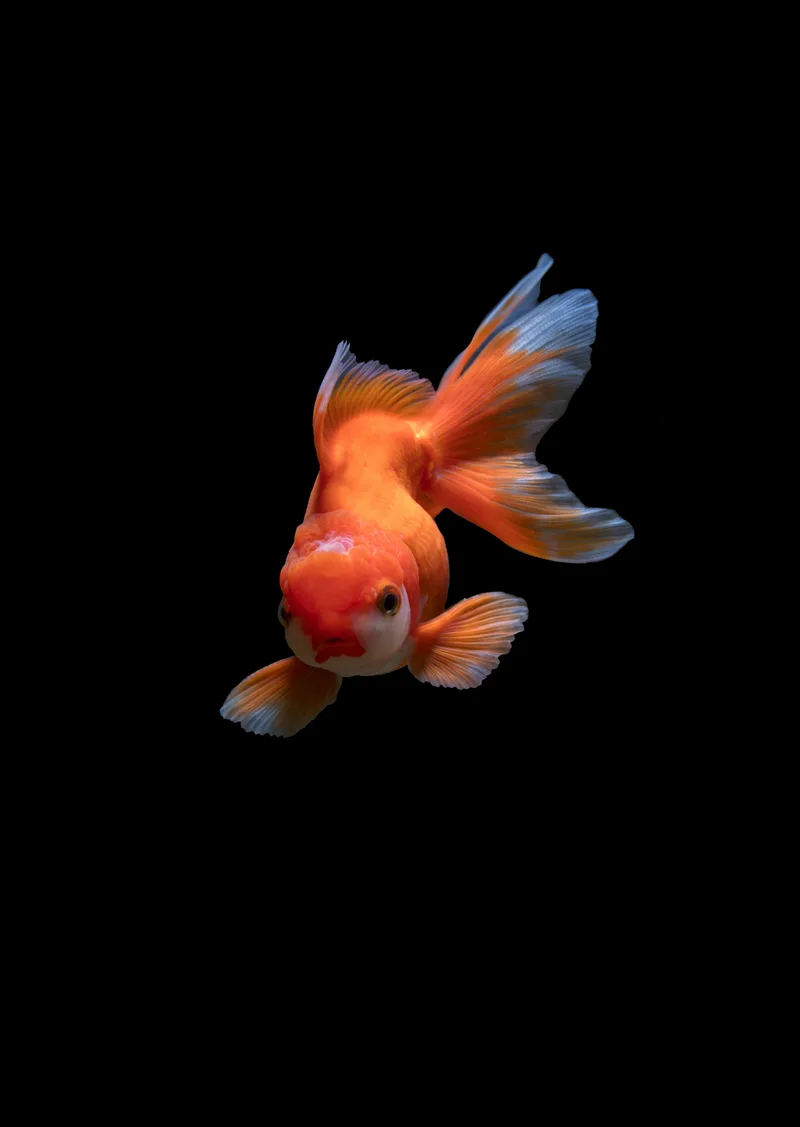
The oranda has the fantail's egg-shaped body and split tail, plus one extra feature: a raspberry-like growth called a wen that covers the top of the head and sometimes the cheeks. The wen starts as a faint bumpy texture on a juvenile and develops slowly over the first one to two years. In an adult, it can get thick enough to partially cover the eyes.
Wen care is most of what makes orandas different from other fancies. The texture traps debris, so water quality has to stay cleaner than for a plain fantail. A neglected wen can develop bacterial or fungal infections, which show up as discolored patches or white fuzz on the growth itself. The popular red-cap oranda (solid white body, bright red wen) is the one most readers will recognize on sight.
Did you know? The wen isn't a tumor or a deformity of the skull. It's a thickening of the fish's own skin, made up of small bumps of fatty tissue. It keeps growing slowly throughout the fish's life, which is why an old oranda can end up looking like it's wearing a berry-shaped helmet.
Ryukin Goldfish
Ryukins are built around a single dramatic feature: a pronounced hump directly behind the head that makes the back look almost triangular from the side. The body is deep and short, the tail is paired, and the fins can be either short or long depending on the line.
Ryukins are strong swimmers by fancy standards, which matters more than it sounds. In a mixed fancy tank, a ryukin will out-compete slower varieties for food at feeding time, and the slower varieties will lose weight while the ryukin thrives. If you want to keep ryukins with ranchus or bubble-eyes, you have to hand-target the slower fish or feed at two separate spots in the tank.
Black Moor and Telescope-Eye Goldfish
These two get grouped together because they share a single defining feature: eyes that project outward on stalks from the sides of the head. The black moor is specifically the velvety black-bodied version of the telescope-eye, and in every other respect the two are handled the same way.
The care implication is that these fish don't see well. Their depth perception is poor, so they miss food that sinks quickly and get outcompeted by faster tank mates at feeding time. The protruding eyes also catch on sharp decor, which can tear the delicate tissue and cause infections. Keep telescope-eyed varieties with other slow-moving fancies, avoid any decor with hard points or rough edges, and never mix them with fast-swimming commons or comets. One more note on appearance: the jet-black color of a young black moor fades with age, and a fifteen-year-old black moor is often more of a bronze or dark orange than black.
Ranchu and Lionhead Goldfish
Ranchus and lionheads are the dorsal-less fancies: no back fin at all, just a smooth curve from head to tail. Ranchus have a more sharply arched back and a tail that tucks underneath. Lionheads are flatter along the back and usually have a more pronounced wen on the head and cheeks, almost like an oranda without the dorsal fin.
These are the weakest swimmers and the slowest eaters of any common goldfish variety. They're also the most sensitive to poor water quality. Ranchus and lionheads do best in a species-only tank or with other dorsal-less fancies, and they need a filter tuned to produce gentle flow rather than a strong current. The biggest practical mistake keepers make with these fish is stocking them alongside faster varieties (including most other fancies), where they lose the race to the food every single time.
Which Goldfish Is Right for Your Setup?
Match the variety to the water you can realistically give it.
- If you have a pond, or plan to build one, or have space for a 75+ gallon tank with pond-scale filtration: commons, comets, or shubunkins. These are the only varieties that will actually thrive at full adult size, and they're the hardiest of the bunch.
- If you have a 20 to 40 gallon indoor tank and want something striking but manageable: a fantail or an oranda. Both stay a reasonable size, both handle typical indoor conditions, and the oranda adds the wen if you want a more dramatic look. A ryukin fits here too if you want a single statement fish rather than a group.
- If you're willing to run a heavily filtered, carefully stocked species-only tank and pay close attention to water quality: ranchu, lionhead, or the specialty fancies (pearlscale, bubble-eye, celestial). These are not beginner fish. They reward keepers who enjoy the intensive end of the hobby.
A lot of goldfish tank-size questions answer themselves once you know which of these three groups you're working with, since the variety sets the floor. The same goes for mixing varieties: some pairings of different goldfish types work well together and others are functionally unfair to the slower fish, with the common-versus-fancy split as the first filter. The structural difference between fancy and common goldfish is the single most useful concept to have in your head before you walk into a fish store.
Every variety in the list is the same species, reshaped by a thousand years of selective breeding. The type you pick is less a question of looks than of what the fish still remembers how to do: a long-bodied common can still outrun a pond predator, while a ranchu has been bred so far from its origins that a strong filter current is a problem. Picking a goldfish is, quietly, picking which piece of that history lives in your tank.