How big do fancy goldfish get?
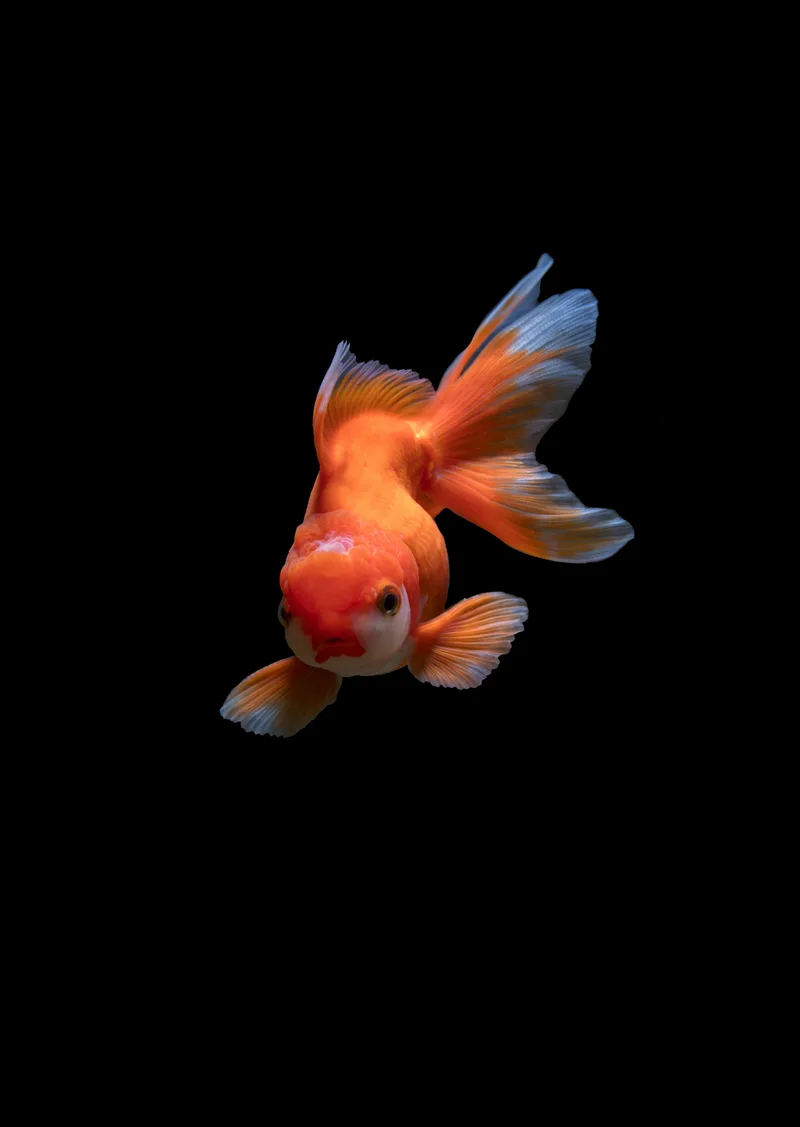
A fancy goldfish reaches roughly 6 to 8 inches (15 to 20 cm) in body length once it's fully grown, and the size of the tank has almost nothing to do with it. The old idea that a goldfish grows only as big as its bowl is backwards, which is part of why the number is so much bigger than the 2- to 3-inch fish most people picture when they buy one. The other complication is the fins: a lot of the "giant goldfish" you see online are being measured tail and all, so the same fish reads as small or huge depending on where someone starts the tape. Sort out those two things and the real ceiling is set by something fixed long before your fish was born.
Does It Depend on the Variety? (Oranda, Ryukin, Fantail)
Yes, but less than you'd think. Most fancy varieties land in the same 6- to 8-inch body-length range once they're done growing, with a few shapes running a little larger or smaller depending on how they were bred. A Fantail and a Black Moor will end up close in size; an Oranda or a Ryukin can push past the top of the range, and the small egg-bodied types like the Bubble Eye and Pearlscale tend to stay at the lower end.
Here's where the varieties you're most likely to own settle. All figures are body length, measured from the snout to the base of the tail. They do not count the fins.
| Variety | Typical adult body size | Note |
|---|---|---|
| Oranda | 7 to 9 in (18 to 23 cm) | One of the larger fancies; the head growth (the "wen") adds visual bulk on top of body length |
| Ryukin | 6 to 8 in (15 to 20 cm) | Deep, high-backed body makes it look bigger than its length suggests |
| Fantail | 6 to 8 in (15 to 20 cm) | The hardy, middle-of-the-road fancy; a reliable benchmark for the group |
| Black Moor | 6 to 8 in (15 to 20 cm) | A telescope-eyed Fantail in body terms; same size class |
| Ranchu | 5 to 8 in (13 to 20 cm) | No back fin and a short, round body; tops out a touch smaller |
| Telescope / Bubble Eye | 5 to 7 in (13 to 18 cm) | Stays on the smaller side, partly because the delicate eyes limit how aggressively they're fed |
| Pearlscale | 5 to 6 in (13 to 15 cm) | The golf-ball body shape caps length earlier than the longer-bodied fancies |
So when you map the number onto your own fish, start at 6 to 8 inches and nudge it up for an Oranda or Ryukin, down for a Pearlscale or Bubble Eye. A healthy, well-fed fancy of any of these varieties will outgrow the little container it came home in by a wide margin, and it gets there over two to three years rather than all at once.
Why Do People Quote Such Different Sizes?
The figures swing wildly, from "about 4 inches" all the way up to "a grapefruit-sized 12 inches," and the reason is simple: some people are measuring the body, and some are measuring the fish from the tip of its nose to the very end of its tail. On a fancy goldfish, that difference is enormous.
A fancy is bred for flowing, oversized finnage. The tail alone can be as long as the body, sometimes longer, and it splits and trails behind the fish like fabric. So a goldfish with a 7-inch body can easily measure 12 inches or more when you include the tail spread, which is exactly how a fish you'd call medium-sized ends up quoted as a foot long. The fish hasn't changed. The tape measure just started in a different place.
Did you know? On a fully finned Oranda, the tail can account for nearly half the fish's total length. The same animal reads as "small" or "huge" depending entirely on whether someone counted the fins, which is why two honest people can give you size figures that are twice as far apart as they should be.
For your own purposes, judge by the body. When you're deciding whether a tank is big enough or whether two fish will get along, the body is what takes up swimming room and produces waste, so that's the measurement that matters. The fins are mostly water and drift. Just don't be startled when your "7-inch" goldfish takes up the better part of a foot of glass once it's spread out and cruising.
Don't Goldfish Just Grow to the Size of Their Tank?
No. This is the single most damaging myth in goldfish keeping, and a small tank does not politely keep a healthy fish at a smaller size. What it does instead is stunt the fish, and stunting is not the same thing as staying small.
In a cramped tank, waste builds up faster than the water can dilute it, and the growth hormones a goldfish releases into the water start to accumulate around it. The visible body length stalls, which is the part people see and mistake for the fish "fitting" its container. But the internal organs keep developing on the fish's genetic schedule, growing to fit a body that the outside has stopped matching. The result is a fish that looks small and is quietly failing, with a shortened life rather than a happily compact one. A goldfish that should live 10 to 15 years can lose most of that to a tank that was never going to let it grow.
The genetic size potential is set by the variety, not by the glass around it. An Oranda is going to try to become a 7- to 9-inch Oranda whether you give it room or not. The kind thing is to give it the room. The way a goldfish grows to the size of its tank is really a story about stunted growth and shortened lives, not a tidy size dial you can turn down by buying a smaller tank.
How Does a Fancy Compare to a Common or Comet?
This is where most of the confusing size numbers come from, because "common" and "fancy" are really two different fish wearing the same name. A common goldfish or a comet is a long, single-tailed, torpedo-shaped swimmer built for distance, and it reaches 10 to 14 inches (25 to 35 cm) of body length, with pond-raised fish running larger still. A fancy is half that fish. It was bred for a short, deep, round body, and it tops out at the 6 to 8 inches we started with.
| Body shape | Typical adult body length | Built for | |
|---|---|---|---|
| Common / Comet | Long, slim, single tail | 10 to 14 in (25 to 35 cm) | Strong, sustained swimming |
| Fancy (Oranda, Ryukin, Fantail, etc.) | Short, deep, double tail | 6 to 8 in (15 to 20 cm) | Body shape over athletic ability |
That size gap isn't an accident of feeding or tank size. It's the whole point of the breeding. Selecting goldfish for a rounder, more ornamental body over many generations also selected away the streamlined frame that lets a common goldfish power through open water, which is the same reason fancies swim slower and are less hardy than their single-tailed cousins. The trade was shape for athleticism, and a smaller adult size came as part of the deal. If you're not sure which kind you actually have, the difference between fancy and common goldfish comes down to that body shape and tail before anything else.
Knowing where your fish lands is the part that helps. A fancy goldfish's modest, pond-shy size isn't a shortfall to apologize for. It's the direct result of a thousand years of breeding for that round, particular body, and the same choice that fixed its shape fixed its size. The number isn't a disappointment. It's the thing that lets you build a setup the fish can grow into.