Can an axolotl be in 70 degree water?
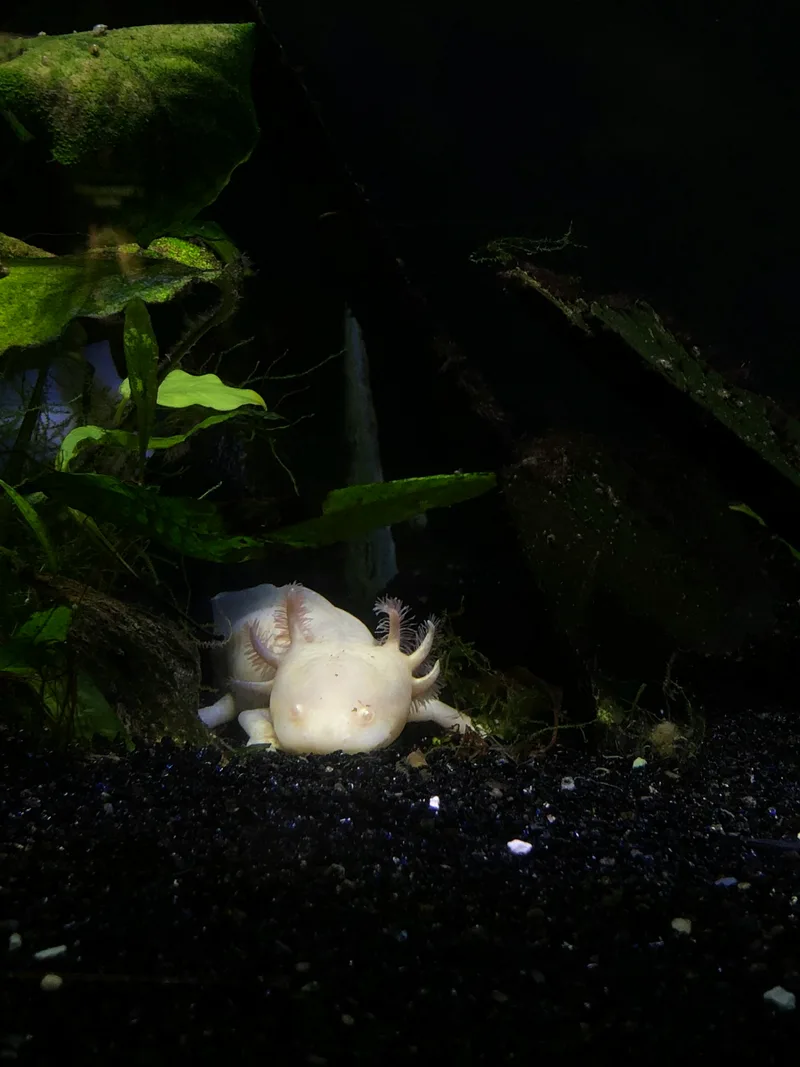
70°F (21°C) will not kill a healthy adult axolotl in a day, which is the part that makes it dangerous. Because the animal keeps eating and moving, the temperature reads as a non-issue, but under the surface the immune system is already compromised, oxygen uptake is harder than it should be, and every additional stressor in the tank now hits an animal with less capacity to handle it. The line between survivable for now and causing harm depends almost entirely on how long it stays there.
What signs tell you the heat is already affecting your axolotl?
Check these before anything else. If you see more than one of them together, your axolotl is under heat stress and the tank needs to cool down now.
- Gills curled forward. Healthy gills fan out behind the head. When they fold forward toward the snout, the axolotl is trying to move water across them more actively. It is the clearest early sign of thermal or water-quality stress.
- Floating near the surface. Axolotls are bottom-dwellers. If yours is hovering near the top, it is searching for cooler or better-oxygenated water. Do not ignore this.
- Loss of appetite. An axolotl that refuses food at 70°F is not being picky. Digestive function drops when the metabolic system is stressed, and a healthy axolotl almost always eats when food is offered.
- Pale or blotchy skin patches. Uneven coloration that appears suddenly can signal early immune compromise. It is subtler than gill changes, but take it seriously when it appears alongside any of the others.
- Rapid gill movement. If the feathery gill branches are pulsing visibly faster than usual, the animal is working harder to pull oxygen from warmer, less oxygenated water.
- Spending time in a corner or hiding constantly. Axolotls are curious and active at the right temperature. An animal that retreats and stays there is telling you something is wrong.
How do you bring the temperature down without shocking your axolotl?
Do not drop the temperature more than a degree or two at a time. A sudden cold shift causes shock just as surely as heat does. The goal is below 68°F (20°C), ideally between 60 and 64°F (16 to 18°C).
| Method | How much it helps | Best for | Limitations |
|---|---|---|---|
| Clip-on fan across the water surface | Up to 5 to 6°F (3°C) through evaporation | Quick response, cheap, easy to add | Works better in dry air; less effective in humid rooms |
| Frozen water bottle in the tank | 2 to 4°F short-term | Immediate fix while you set up something better | Temporary; needs constant replacing |
| Keeping room cool (AC or shading the tank) | Prevents the problem entirely | Long-term control | Depends on room layout and climate |
| Water chiller | Precise and permanent | Consistently warm rooms | Expensive upfront; requires installation |
Start with the fan and a water bottle while you figure out a longer-term fix. Move the tank away from direct sunlight and any warm appliances nearby. If your room runs consistently above 72°F in summer, a chiller is worth the investment.
Why does 70°F cause problems when 68°F is usually considered fine?
Axolotls (Ambystoma mexicanum) are ectotherms, which means their body temperature tracks the water around them. Every biological process they run, from digestion to immune response to how much oxygen their blood can carry, is calibrated to a specific temperature range. At 68°F (20°C), they are already near the top of that range. At 70°F (21°C), metabolic rate climbs further, oxygen demand goes up, and the water they are breathing holds less dissolved oxygen than it did at 65°F. The immune system takes the worst hit: it begins to falter at the top of the thermal range, leaving the axolotl more exposed to bacterial and fungal infections that a healthy animal would normally shrug off.
The 2°F gap sounds small in human terms. For an animal whose entire physiology is built around cool water, it compounds over days.
Did you know? Axolotls evolved in the lake complex around Mexico City at high altitude, where water historically stayed well below 68°F. The same canal system they called home was described as cold even by local standards. What feels like a mild spring day to you registers as abnormal heat to the animal in your tank.
Does temperature affect water quality in an axolotl tank?
It does, and the two problems amplify each other. At 70°F, the water holds less dissolved oxygen, so the axolotl is already breathing harder before any other parameter shifts. Heat also speeds up the activity of the beneficial bacteria in your filter, which can cause ammonia to spike during the adjustment period. Waste breaks down faster, which raises nitrate levels faster. An axolotl sitting at the edge of its temperature tolerance has less capacity to handle any of these at the same time.
For axolotls, ammonia and nitrite need to stay at zero, pH between 7.0 and 8.0, and hardness high enough to buffer the water. A tank running warm is a tank where those numbers shift faster than usual. Test more often when the temperature is elevated.
A healthy adult axolotl that has been at 70°F for a day or two is not doomed. Get the tank back below 68°F within a couple of days and the animal will recover without lasting harm. The point is to treat it as a situation to fix, not a new normal to live with.