Do you change the water while tubbing?
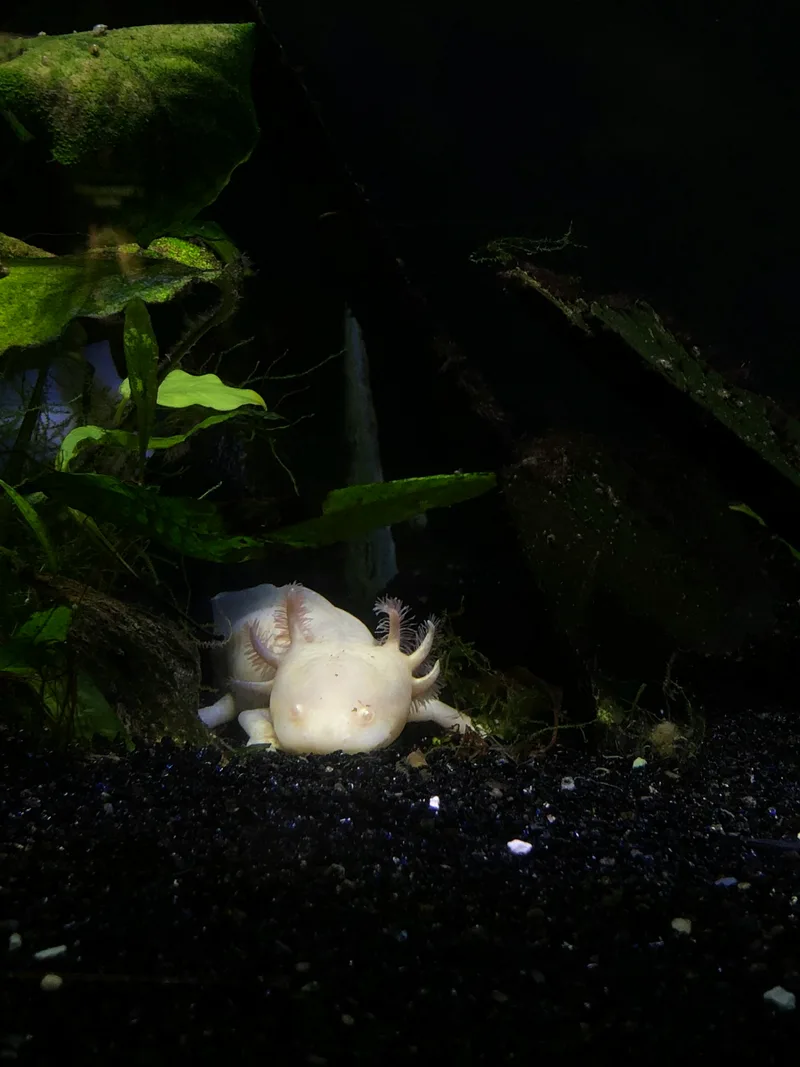
Yes, and the water change isn't a chore added on top of tubbing. It is tubbing. A tub has no filter and no cycle, so ammonia from the axolotl is climbing the moment you put the animal in, and you, doing a full 100% change once or twice a day, are the only thing pulling it back down. The default cadence is every 12 hours for axolotls 3 inches and under and every 24 hours for larger animals, with cool, dechlorinated water and a bump to twice a day in any room above 68°F. That schedule is the whole job. The reason it works, and the reason it sometimes isn't enough, is in the rest of this piece.
How Often Should I Actually Change the Tub Water?
The simplest version of the schedule is size-based. Small axolotls (3 inches or under) get a full 100% water change every 12 hours, morning and night. Larger axolotls can usually go 24 hours between changes, though that window shrinks as soon as anything else changes too: a warm room, a recent meal, a stressed animal that's eating less efficiently and excreting more.
Feeding always pushes the dial. A meal in a tub means a same-day change, even if you just changed it. Pull out any uneaten food and waste with a turkey baster the moment you see it, then plan a full change within a few hours. Fish waste sitting in unfiltered water for a full day is the fastest way to spike ammonia in a tub.
There are a handful of signs that override the schedule entirely. Cloudy water, slime on the sides of the tub, the axolotl floating involuntarily, gills curling forward toward the head: any of these means change the water now and don't wait until the next slot. The schedule is a default, not a ceiling.
- Under 3 inches: full change every 12 hours
- 3 inches and up: full change every 24 hours
- After a meal: spot-clean waste, full change within a few hours
- Tub above 68°F (20°C): twice a day regardless of size
- Sliming, floating, or gills curled forward: change immediately
Why Does the Tub Need a Full Water Change Every Day?
A normal tank has a colony of nitrifying bacteria living on the filter media and substrate. They convert ammonia, which is toxic, into nitrate, which is mostly harmless, as fast as the axolotl produces it. That colony is what people mean by a "cycled" tank, and it's the reason a tank with a working filter doesn't need daily water changes.
A tub has none of that. It is a bucket of clean water with an axolotl in it. Every breath the axolotl takes and every bit of waste it produces dumps ammonia directly into the water with nothing to break it down. Within a few hours the ammonia is high enough to start stressing the animal, and within a day it can be high enough to do real damage.
Ammonia hits axolotls harder than it hits most fish because of how much surface area is in contact with the water. Their feathery external gills are exposed tissue sitting in the tub. Their skin is permeable. Both are reacting to the chemistry of the water all the time, and there's nowhere for the animal to retreat to. The classic "gills curling forward" stress posture isn't a behavior the axolotl chooses, it's the gill tissue physically reacting to ammonia in the water.
Changing the water is, functionally, the filter. You are doing in 30 seconds what a cycled tank does continuously, and you have to do it on schedule because nothing else will.
Did you know? Axolotls breathe through three different organs at once: their feathery external gills, their lungs (they gulp air at the surface), and their skin. That's three separate surfaces sitting in the tub water, which is why ammonia poisoning shows up faster in axolotls than it does in most fish.
Does the Schedule Change with Fridging or a Cooler Room?
Fridging means tubbing in a refrigerator at around 5 to 8°C (41 to 46°F), and it changes the math in a few ways at once. Cold slows the axolotl's metabolism: it eats less, excretes less, and moves less. Cold also slows the chemistry of ammonia toxicity itself, since ammonia equilibrium shifts toward the less toxic ammonium form at lower pH and lower temperatures. A fridged axolotl is a quieter system on every front.
In a fridge tub, once-daily changes are the standard. Some keepers stretch to every 36 to 48 hours for an animal that isn't being fed, especially during fungal or stress-related fridge stays where minimizing handling is the point. Don't stretch beyond that. Even a slowed-down axolotl is still adding waste to a sealed bucket.
A cool room is a different situation. Anything under 68°F (20°C) is cooler than most tanks but well above fridge temperature. The axolotl is still fully active there, eating normally, excreting normally. Stay on the standard 12 to 24 hour schedule based on size. Don't borrow the fridge cadence just because the room feels cold.
Warm rooms push the cadence the other way. At room temperature in summer, with the tub sitting somewhere above 70°F, twice a day is the floor for any size. The chemistry runs faster, the animal is more stressed by the heat itself, and the safety margin you have between changes shrinks fast.
How Do I Actually Do the Change Without Stressing the Axolotl?
The two-tub method is the standard, and it's the gentlest on the animal. You keep two food-safe plastic tubs (the 6-quart shoebox containers most keepers use are a good size). One holds the axolotl. The other sits clean and ready. Fill the clean one ahead of time with cool, dechlorinated water at the same temperature as the current tub, add water conditioner, and let it sit for 10 to 15 minutes so the conditioner has time to do its work.
Move the axolotl over by netting it gently with a soft fine-mesh net or, better, by letting it swim into a soft container you lower into the water. Direct handling stresses them, and the slime coat on their skin is fragile. Once the animal is in the new tub, dump the dirty water and rinse the old tub with plain hot water. No soap, no cleaner, no scrubbing pad. A paper towel for any stuck waste, and that's it.
Temperature matching matters more than people expect. A 5°F swing between the old tub and the new one is enough to shock an axolotl, and the animal is already in a tub because something is wrong, which means it has less margin than usual. Keep a thermometer in the prep tub and check both tubs against each other before the transfer.
- Two food-safe plastic tubs (6-quart shoebox containers are the standard)
- Water conditioner that neutralizes chloramine, like Seachem Prime
- A soft fine-mesh net or a scoop cup the axolotl can swim into
- A thermometer to match temperatures between tubs
- A turkey baster for spot-cleaning waste between full changes
What Should the Tub Water Test At Between Changes?
Most casual owners won't have a test kit, and that's the whole point of the schedule: it's built so you don't need one. If you do have one, use it as a sanity check rather than a substitute for changing the water. Target ammonia under 0.25 ppm, nitrite at 0, and pH stable somewhere in the 7.4 to 7.6 range.
If ammonia is climbing above 0.25 ppm before your next scheduled change, the message isn't "test more often." It's that something about the setup is wrong. The tub is too small for the animal, the room is too warm, or the schedule needs to be tighter than the size rule suggests. Change the water, then change the variable.
Visible signs override any test result. Cloudy water, gills curling forward toward the head, the axolotl floating involuntarily, a sudden refusal to settle on the bottom: any of those means change now. The test kit confirms what your eyes are already telling you, but your eyes get there first.
| Reading | What it means | What to do |
|---|---|---|
| Ammonia 0–0.25 ppm | Safe range | Stay on schedule |
| Ammonia 0.25–1 ppm | Stressed | Change immediately, increase cadence |
| Ammonia above 1 ppm | Emergency | Change immediately, check tub size and temperature |
| Nitrite above 0 | Rare in a fresh tub, suggests contamination | Change and rinse the tub |
| pH below 7.0 | Water is acidifying from CO₂ | Change immediately |
How Long Can I Keep Doing This Before the Axolotl Goes Back?
Tubbing is meant to be temporary, but how temporary depends on why the animal is tubbed. A few weeks for a tank cycle or a course of medication is fine, with daily water changes throughout. Months are possible if the keeper is meticulous, though long-term tubbing isn't ideal because the axolotl benefits from stable, filtered water once the underlying problem is fixed.
The cue to move them back isn't the calendar. It's the tank. The tank's ammonia and nitrite need to be at zero and the temperature stable in range before the axolotl goes home, and whatever drove the tubbing in the first place needs to be resolved. Moving an axolotl out of a tub and back into a tank that hasn't recovered just starts the same problem over.
The reasons people tub in the first place are worth holding in mind when you're mid-tubbing and second-guessing yourself: a stalled cycle, ammonia in the tank, fungus, impaction, an aggressive tank mate. The water changes feel intense the first time, but tubbing is actually the simplest thing in fishkeeping. There's no cycle to balance, no test kit to read, no biology to wait for. You are the filter. Change the water on schedule and the tub stays safe, and that clarity is part of why the method works as well as it does.