Is a 20 gallon tank ok for an axolotl?
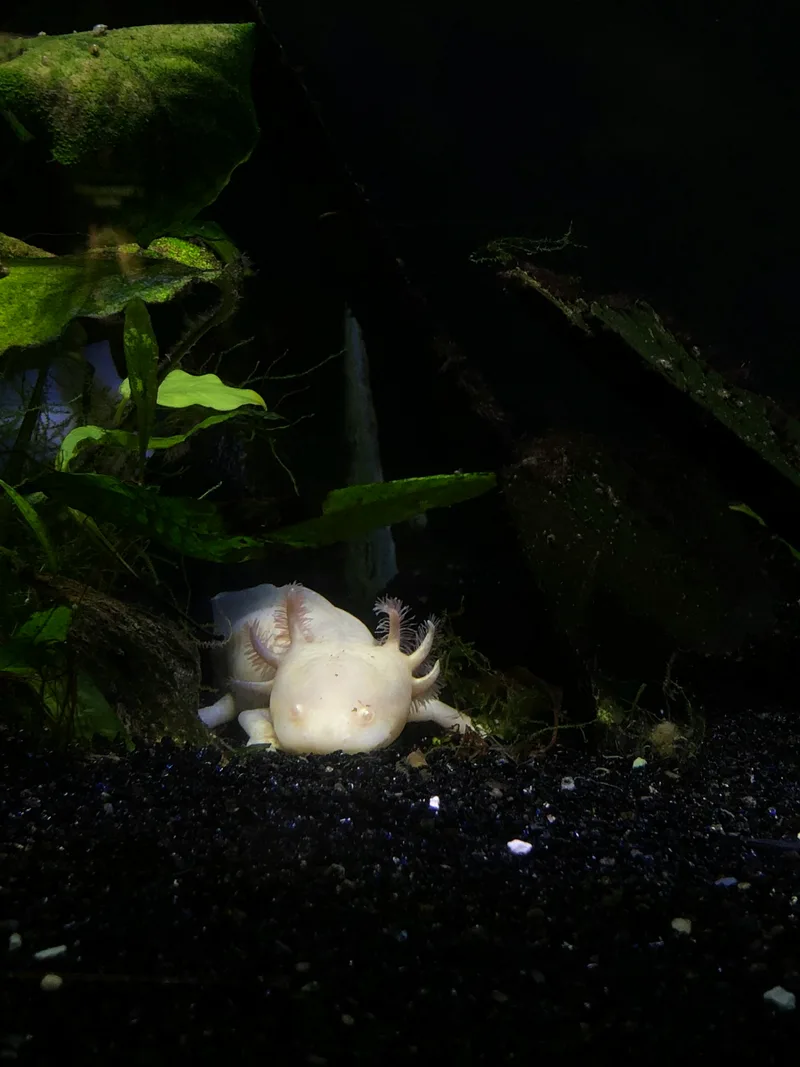
Yes, if it is a 20 gallon long. The 20 gallon long and the 20 gallon tall hold the same water but give your axolotl very different amounts of the thing that actually matters, which is floor space. The long has about 25% more walkable ground, and your axolotl spends nearly every waking moment walking it. The shape of the tank ends up doing more work than the gallon number on the box.
Does It Matter Whether the 20 Gallon Is Long or Tall?
It matters a lot. Axolotls (Ambystoma mexicanum) spend nearly all their time on the bottom of the tank, walking across the substrate and resting in hides. They don't swim laps through open water the way fish do. What they use is floor space, and the difference between a 20 gallon long and a 20 gallon tall is about 25% more walkable ground.
| Tank variant | Dimensions (L x W x H) | Floor area | Verdict for one axolotl |
|---|---|---|---|
| 20 gallon long | 30 x 12 x 12 in | 360 sq in | Good fit. Enough room to walk, turn, and have a hide at each end. |
| 20 gallon high/tall | 24 x 12 x 16 in | 288 sq in | Tight. The extra height adds water volume your axolotl won't use. |
A 20 gallon long gives your axolotl roughly 30 inches of length to move through. That is enough for one adult (they typically reach 9 to 12 inches) to have a cool side, a hide, and some open ground between them. A 20 gallon tall squeezes that down to 24 inches and stacks the saved space vertically, where it does nothing for a bottom-dweller.
If you already own a 20 gallon tall, it can still house a single axolotl. You are not starting from scratch. But keep the décor minimal so you are not eating into the already limited floor space, and plan your filtration and water changes more carefully because the smaller footprint concentrates waste in a tighter zone.
How Often Will I Need to Do Water Changes in a 20 Gallon?
Axolotls are messy. They produce more waste per inch of body than most aquarium fish, and in 20 gallons there is very little water to absorb that load before parameters start drifting. Plan on 20 to 25% water changes at least twice a week to keep nitrates under 20 ppm.
That is not a crisis schedule. It is just the reality of a large, waste-heavy animal in a small volume of water. A good canister filter or oversized sponge filter helps by processing ammonia and nitrite between changes, but no filter removes nitrate on its own. Only fresh water does that.
If twice-weekly changes feel manageable, a 20 gallon is perfectly workable. If they start to feel like a chore after a couple of months, that is not a failure on your part. It is the tank telling you that a consistent water-change routine for your axolotl gets easier with more water volume. A 30 or 40 gallon tank doesn't change how much waste the axolotl makes, but it gives you a bigger dilution buffer between changes.
Why Does a Bigger Tank Make Axolotl Keeping Easier?
More water does not mean more swimming room. Axolotls will use roughly the same amount of floor space whether they are in 20 gallons or 40. What you gain is stability.
A larger volume of water changes temperature more slowly. Axolotls need water between 60 and 68°F (15 to 20°C), and in a 20 gallon tank, a warm afternoon can push the temperature up faster than you might expect. In 40 gallons, the same room temperature hits a bigger thermal mass and the swing is smaller and slower.
Water chemistry works the same way. An ammonia spike from a missed feeding or a dead snail is diluted across more water in a bigger tank, giving you more time to catch it. In 20 gallons, that same spike hits a higher concentration faster.
None of this means 20 gallons is inadequate. It means you have less room for error, and you need to pay closer attention. For a keeper who tests their water regularly and stays on schedule with changes, 20 gallons works fine. For someone who wants a more forgiving setup, 30 to 40 gallons buys that forgiveness.
Did you know? Axolotls breathe partly through their skin and through those feathery external gills that fan out from the sides of their head. Both surfaces sit in direct contact with the water, so a shift in water quality reaches their tissue faster and harder than it would for a fish of the same size, whose gills are tucked behind a bony gill cover.
What If I Want to Keep Two Axolotls Later?
A 20 gallon tank is a one-axolotl tank. Two axolotls in that space puts both animals under pressure: the waste output doubles with no extra dilution buffer, and axolotls that feel crowded will nip at each other's gills and limbs. They regenerate, but repeated injuries are stressful and open the door to infection.
If you think you might want a second axolotl down the road, start with a 40 gallon breeder now. It costs less than buying a 20, running it for a year, and then replacing it. The 40 breeder (36 x 18 in footprint) gives two adults room to establish their own space and keeps the bioload manageable with a reasonable water-change schedule.
Axolotls are not social animals. A single axolotl in a properly sized tank does not get lonely or bored. If you do keep two, the recommended minimum for a pair is 40 gallons with both animals close to the same size, because a larger axolotl will sometimes treat a smaller one as food. Keeping one axolotl on its own is a perfectly good choice, not a compromise.
The tank you have is not a life sentence. A 20 gallon is a fine place to start, and if the maintenance ever starts feeling like a grind, that is the setup telling you it is time to size up, not a sign you are doing something wrong.