Can water be too deep for an axolotl?
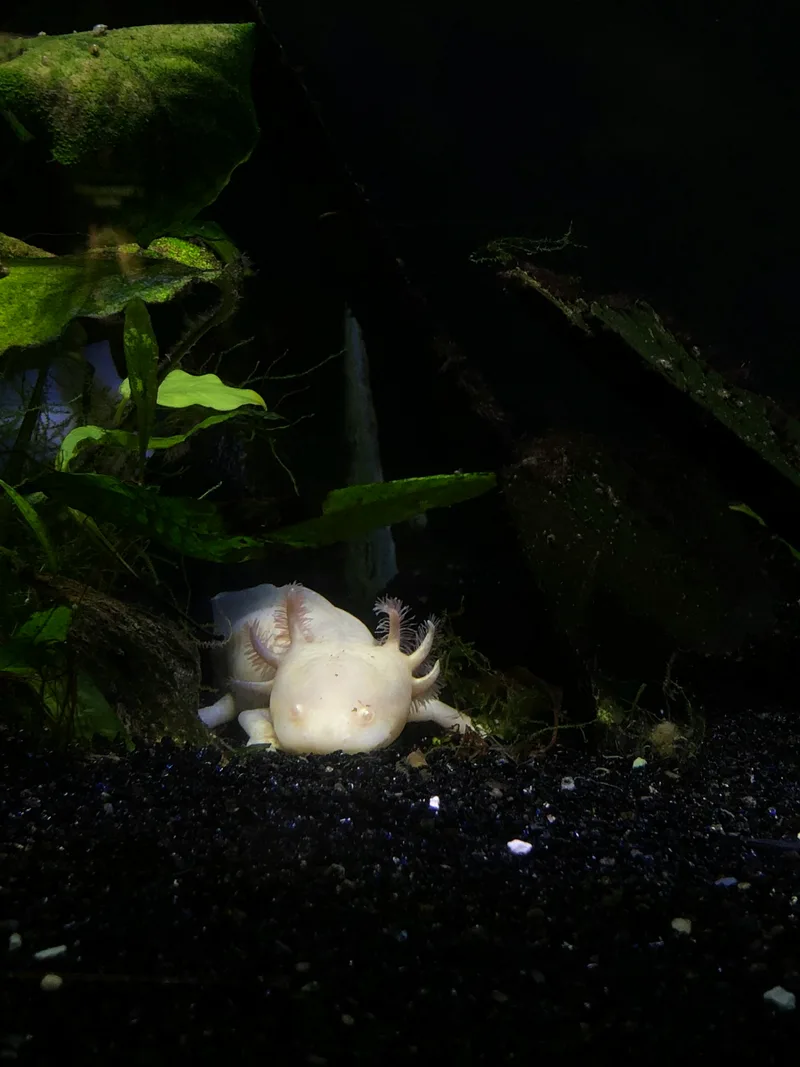
No. For a healthy adult axolotl, depth on its own is almost never the problem. The trap is treating an axolotl like a fish. Fish use a swim bladder to hover at a chosen depth; axolotls don't have one, and they spend most of their lives resting on the bottom of the tank. So the depth only has to clear two practical bars: the surface has to be reachable (roughly the length of the animal), and the lid has to sit a few inches above the water so it can't jump out. The number that actually decides whether your tank works isn't depth at all.
How deep should you actually fill the tank?
The minimum depth for an adult axolotl is roughly the length of its body. A 9-inch axolotl wants at least 9 inches of water, so that if it stretches up from the bottom it can reach the surface without struggling. Below that, things start getting awkward: the animal can't always stay fully submerged, and that's a bigger welfare issue than any amount of "too deep."
The comfortable range for an adult sits around 8 to 12 inches (20 to 30 cm). Most standard aquariums will land in this range once you leave a reasonable headspace gap, and it's what the animal is built for.
Headspace matters more than people expect. Leave at least 2 to 3 inches (5 to 7 cm) of air between the water surface and the lid. Axolotls can and do launch themselves out of open tanks, especially at night, and a low water line with no lid is the setup that leads to finding one on the floor in the morning. The headspace also gives you a buffer for evaporation and top-ups without the water touching the lid.
If you're keeping your axolotl in a tall tank, you don't need to fill it to the brim. Partial filling is completely fine. Footprint is what matters for an axolotl, not water column, so a tall tank filled to 10 inches is a better home than the same tank filled to 18 inches.
- Minimum water depth: roughly the length of your axolotl from nose to tail tip
- Adult comfort zone: 8 to 12 inches (20 to 30 cm)
- Headspace to the lid: at least 2 to 3 inches (5 to 7 cm)
- Tall tank? Partial fill is fine, lower the water line rather than fight the shape
- Keep filter flow gentle at any depth, a strong current is harder on an axolotl than the depth itself
When is water depth actually a problem?
Depth rarely hurts an axolotl on its own. What hurts is depth combined with something else. A few specific setups turn into real trouble, and naming them makes it easier to match what you're seeing to a real cause.
Water so shallow the animal can't stay submerged. If the water line is near body-thickness, the axolotl can't lie flat on the bottom without part of it breaking the surface. That's a welfare issue, not a "too deep" one, but it's the most common depth mistake and deserves the first spot on the list.
A strong filter flow in a tall column. A deep tank with a high-output filter creates a current the axolotl has to fight through the full height of the water. You'll see a resting animal pushed sideways, gills curled forward, or constant slow swimming against the current. The depth isn't the problem, the combination of depth and flow is. Cutting flow or adding a baffle fixes it without dropping the water line.
A juvenile in a deep, flowy tank with no resting spots. Young axolotls are weaker swimmers and tire faster. If there's nothing to hide under, no plants to break up the current, and the flow runs the length of the tank, a juvenile can end up floating near the surface just to rest. That's fixable by adding cover and softening flow, not by reducing depth.
Depth plus no lid, or a very low water line. This is the jumping problem. An axolotl startled at night can push off the bottom hard enough to clear several inches of air. If the water sits close to the rim, that's an exit. The fix is a well-fitted lid and a sensible headspace gap, not a shallower fill.
| What you're seeing | What it usually means |
|---|---|
| Constantly swimming at the surface, gills folded back | Flow is too strong for the depth, not the depth itself |
| Gills curled sharply forward | Water quality stress (ammonia, nitrite), not depth |
| Floating at the surface, can't sink | Gas trapped in the gut, unrelated to depth |
| Tail tilted up, body at an angle | Often flow against the animal, sometimes gas |
| Axolotl found on the floor near the tank | Jumping risk, fix the lid and headspace |
Why doesn't depth bother axolotls the way it would a fish?
The short version is that an axolotl (Ambystoma mexicanum) isn't a fish. It's a neotenic salamander, which means it keeps its larval body for life instead of metamorphosing onto land the way most salamanders do. That body is built for walking and resting on the bottom, not for holding position in the water column.
A fish does most of its depth-keeping work with a swim bladder, the internal gas-filled organ that lets it hover at a chosen depth without effort. An axolotl doesn't have one. It paddles with a finned tail, walks with four legs, and spends most of its day resting on the substrate. There's no buoyancy system for depth to interfere with.
They do rise to the surface now and then for a gulp of air. Axolotls have simple lungs alongside their feathery external gills, and a surface trip every so often is normal behavior, not distress. As long as the surface is reachable (back to the body-length rule), that occasional trip isn't an energy cost worth worrying about.
Did you know? Axolotls are one of the very few amphibians that keep their external gills for life, those feathery fronds on either side of the head, while also breathing through simple lungs when they surface. They're effectively running two breathing systems in parallel, which is part of why the occasional gulp at the top of the tank isn't a red flag.
So depth isn't a pressure problem for an axolotl, and it isn't an energy-cost problem either. What matters is whether the surface is still reachable and whether anything in the water column (usually flow) is pushing them around where they actually live, on the floor.
Does tank shape matter more than depth?
Yes, much more. Axolotls do almost everything on the floor of the tank: resting, walking, hunting, hiding. The usable space for them is the footprint, length times width, not the volume. A long, shallow tank will out-perform a tall, narrow tank of the same volume almost every time for an axolotl.
Think of depth as downstream of two other numbers. Tank shape sets how much floor space your axolotl actually has, and flow sets how hard that floor space is to live on. Once those two are right, depth mostly takes care of itself. If you remember that depth is downstream of footprint and flow, you'll make better calls on every future tank, not just this one.