Do axolotls prefer long or tall tanks?
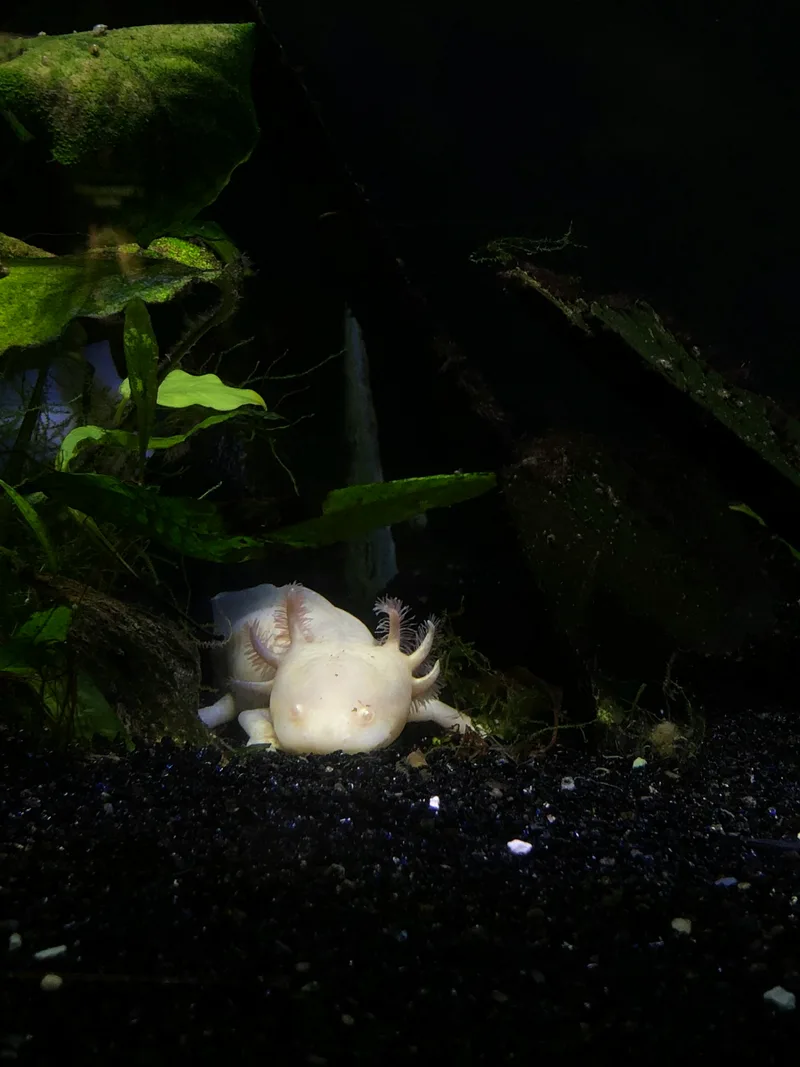
Long, every time. A single adult axolotl wants roughly 36 inches of floor by 18 inches of width, the footprint of a 40-gallon breeder, and almost nothing in the way of height. The reason is that an axolotl is built for two dimensions, not three: a reduced swim bladder and a lake-bed origin in shallow Mexican water mean it walks the bottom of the tank far more than it swims through it. If you already own a tall tank, that doesn't mean you bought wrong. It means the water line, not the glass, is the thing you actually need to think about.
How Long Should the Tank Actually Be?
The working minimum for one adult axolotl (Ambystoma mexicanum) is about 30 inches long by 12 inches wide. That's the footprint of a 20-gallon long, not a 20-gallon standard. The difference matters because the two tanks hold the same water but the long version gives the axolotl a 30-inch runway across the bottom, where it actually lives.
A more comfortable baseline is the 40-gallon breeder, 36 inches by 18 inches. That extra six inches of width lets the axolotl turn around without brushing both walls, and it gives you room for a couple of caves and a clear patrol lane between them.
Gallons alone are the wrong metric at the pet store. A 29-gallon tall tank has the same water volume as a 20-long, but the footprint is identical while the height jumps from 12 to 18 inches. The extra six inches are water the axolotl mostly doesn't use.
A quick shape check you can do on a pet-store tag: length should be at least twice the height. If it isn't, you're looking at a show tank, not a salamander tank.
| Tank | Dimensions (L x W x H) | Good for an axolotl? |
|---|---|---|
| 20-gallon long | 30 x 12 x 12 inches | Yes. The honest single-axolotl minimum. |
| 29-gallon tall | 30 x 12 x 18 inches | Same floor as a 20-long, with six inches of wasted height. Workable with a lowered water line. |
| 40-gallon breeder | 36 x 18 x 16 inches | Recommended baseline for one adult. |
| 55-gallon standard | 48 x 13 x 21 inches | Tall-ish, but the 48-inch length carries it. Lower the water line. |
| 75-gallon | 48 x 18 x 21 inches | Comfortable for two adults. Bring the water down a few inches. |
Did you know? In their original range, axolotls lived in water that was often only a meter or two deep but stretched for acres. A 36-inch-long aquarium imitates that shape surprisingly well. A tall show tank doesn't.
What If I Already Have a Tall Tank?
Plenty of people buy the tank before they read about the animal, and tall tanks look nicer on a shelf. You have two realistic options, and the right one depends entirely on the floor footprint of what you already own.
If the footprint is below roughly 30 by 12 inches, the tank is too small for an adult axolotl regardless of how tall it is. Height doesn't rescue a short, narrow base. In that case the tank is best repurposed as a quarantine setup or a grow-out for something smaller, and the axolotl needs a long tank.
If the footprint is 30 by 12 inches or better and the tank just happens to be tall, you're fine. Bring the water level down so the axolotl can reach the surface in a short, easy trip, and treat the upper portion of the tank as empty space you don't have to decorate. A tall tank with a lowered water line is just a long tank with a tall glass rim.
A few moves that make a tall tank comfortable:
- Lower the water line to about an inch above the tallest point of any decor, so the axolotl isn't making a long vertical push to gulp air.
- Add low-profile caves and hides along the floor rather than tall driftwood. You want refuges, not climbing features.
- Turn the filter flow down. A strong current in a narrow column is harder to dodge than the same flow spread across a long footprint.
- Float a couple of plants or even a few ping-pong balls at the surface. Axolotls will occasionally jump, and a broken surface discourages it.
- Skip anything decorative that eats floor space without adding shelter. Every square inch of the bottom is the animal's living room.
Is Water Depth a Separate Question from Tank Height?
Tank height is the glass. Water depth is how full you fill it. The two are easy to conflate, and the conflation is where a lot of the long-versus-tall confusion comes from.
A 29-gallon tall tank becomes a 20-gallon long tank from the axolotl's point of view the moment you stop filling it to the brim. The footprint is identical, and if the water only reaches a foot up the glass, the animal's actual habitat is the same shape either way.
The working rule on depth is that the water needs to be at least a bit deeper than the axolotl is long, so the animal can fully extend, roll, and turn without hitting the surface or the substrate. A 9-inch juvenile wants more than 9 inches of water. A 12-inch adult wants more than 12. Most sources quote 12 to 18 inches as the comfortable range. Past a certain point, water that is too deep for an axolotl starts to cost the animal surface trips without giving it any useful new space.
Why Do Axolotls Want Floor Space, Not Height?
The shape rule isn't arbitrary. Three things stack to make floor space the thing that matters, and they're linked.
The first is where they come from. Axolotls are from the lake system around Xochimilco, in the high valley south of Mexico City. Those lakes were shallow, slow, and vegetated. The animal's world was the substrate: a two-dimensional plane of rotting leaves, volcanic silt, and plant stems, covered by a thin film of cool water. The water column above wasn't habitat so much as a lid. An axolotl built for that world is built to hunt, hide, and patrol across a flat surface, not to cruise through open water.
The second is anatomical. Most fish have a swim bladder, a gas-filled organ that lets them sit at whatever depth they choose with almost no effort. Axolotls have a reduced version of it, and using the water column above the floor costs them energy that a fish of the same size wouldn't pay. They can swim, and they do, in short bursts. But neutrally hanging in midwater is not something their body is set up for. Give them a tall tank and they mostly still live on the bottom, just with more empty water over their heads.
The third is their gills. The feathery pink branches on either side of an axolotl's head are external gills, and they work by letting water flow across exposed filaments. Gentle, consistent movement across a wide footprint keeps those gills happy. A narrow, tall column either stagnates at the bottom or, if you crank the filter to compensate, hits the animal with a current it has to fight. A long tank lets you spread the same amount of flow across more water, and the gills get what they need without the animal getting pushed around.
Put those three together and the long-over-tall rule stops being a preference or a guideline. It's the shape of the world an axolotl was assembled for.
Does the Same Rule Hold for Two Axolotls?
Yes, and more so. When you add a second axolotl, the pressure on floor space goes up faster than the pressure on volume.
Axolotls aren't social. They tolerate each other at best, and a cramped pair will nip at gills, toes, and tails, which can strip the filaments faster than they regenerate. The fix is territory, and territory for a bottom-dwelling animal is measured in square inches of floor, not in gallons of water. A deeper tank doesn't give two axolotls anywhere new to go. A longer or wider tank does.
The practical upgrade path is almost always more floor: a 40-gallon breeder becomes a 75 or a 125, not a taller 55. The minimum tank size for two axolotls lands around 75 gallons for exactly this reason. The extra volume over a single-axolotl setup is being spent on footprint, not height. Shape is only one piece of the picture, and the rest of an axolotl tank setup has its own rules on substrate, filtration, and temperature that matter just as much as the footprint.
Once you see an axolotl as a shallow-lake-bed creature, the tank stops being a spec sheet. You're picking a shape to match the animal's world, and the gallons follow from there.