What is the best tank setup for an axolotl?
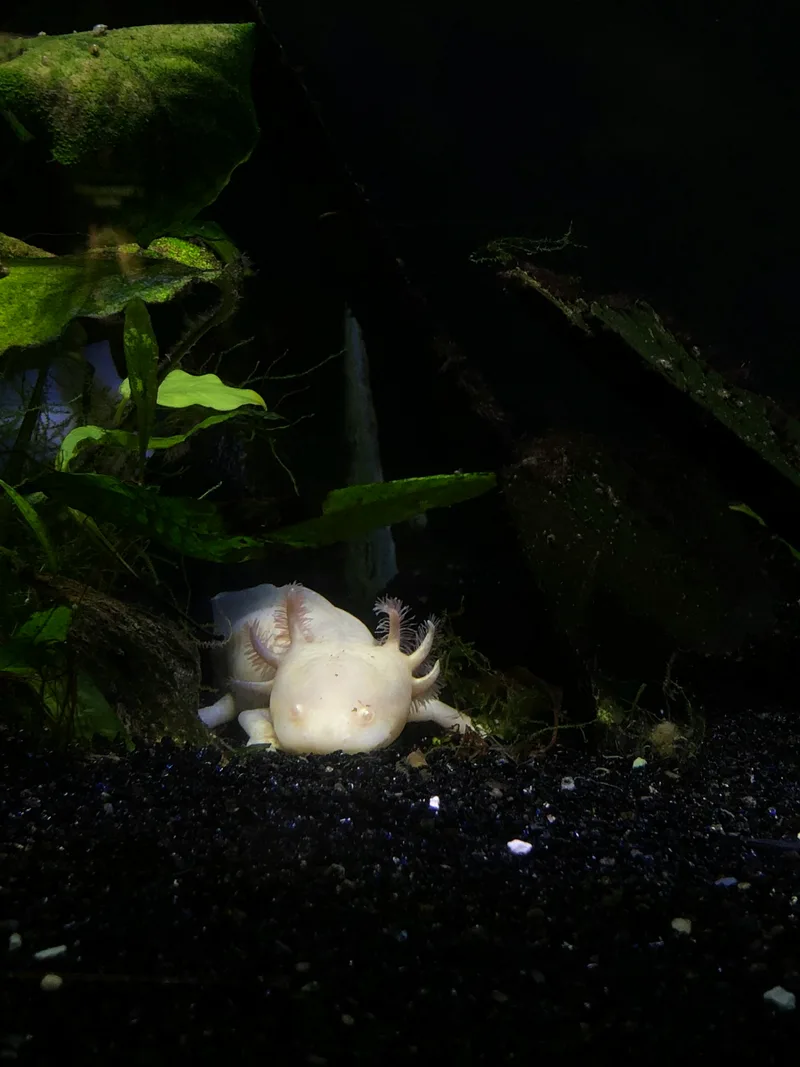
A single adult axolotl (Ambystoma mexicanum) needs a 20-gallon "long" tank (29 to 40 for a pair), cool water at 60 to 68°F (16 to 20°C) with no heater, a cycled filter set to gentle flow, fine aquarium sand or a bare glass bottom (never gravel), at least one hide per animal, dim light, a tight-fitting lid, and no fish tankmates. Three of those are inversions of what a tropical fish tank wants: no heater instead of a heater, fine sand or bare glass instead of gravel, no tankmates instead of a community. Get any of those three wrong and the cost lands on the animal. Warm water kills within days, swallowed gravel kills slowly through impaction, and the wrong tankmate chews the gills off. The rest of this guide is built around getting those three right.
What size and shape tank do you need?
A 20-gallon long is the working minimum for one adult axolotl. A pair needs 29 to 40 gallons. If you are choosing between a 20 long and a 20 tall, pick the long every time.
Floor space matters far more than height. Axolotls live on the bottom of the tank. They walk, rest, and hunt along the glass, and they use the upper water column only to gulp a breath of air now and then. A tall tank gives you more water, but almost none of it is space the animal actually uses. A long tank gives you the same water volume spread out as usable real estate.
Bigger is also kinder to your water chemistry. More water dilutes ammonia spikes, buffers against pH swings, and slows temperature changes on a hot afternoon. For an animal this sensitive to water quality, that margin is worth the extra footprint.
Here is the starter shopping list for a single adult:
- A 20-gallon long tank (75 liters), rimmed glass, at least 30 inches on the long side
- A tight-fitting lid that the animal cannot push off
- A sponge filter driven by an air pump, or a baffled hang-on-back filter
- Fine aquarium sand with grains under 1 mm, or plan on running the tank bare-bottom
- At least one hide: a length of PVC pipe, a ceramic cave, or smooth driftwood with no sharp edges
- An aquarium thermometer you can read at a glance
- A liquid test kit (API Freshwater Master or equivalent, since test strips are too imprecise for an animal this sensitive)
- Dechlorinator, any standard brand that neutralizes chlorine and chloramine
Did you know? Wild axolotls live in what is left of the lake complex around Mexico City, at about 2,200 meters elevation, where water temperatures rarely climb out of the low 60s °F. The cool-water requirement is not a hobby quirk. It is the climate the species is built for.
Why does the water have to stay cool, and how do you keep it there without a heater?
Axolotls evolved in a cold, high-altitude lake. Their metabolism, their immune system, and the gas exchange across their external gills all run on cold water. Anything above 72°F (22°C) is a stressor. Anything above 75°F (24°C) is dangerous, and sustained exposure there will kill an animal within days.
The practical consequence is blunt. If you cannot keep the room where the tank lives below 72°F year-round, an axolotl is not the right pet. This is the one setup decision that can, and should, change a buy decision before you spend money on the rest of the equipment.
For most readers in temperate climates, winter is easy. A room kept in the high 60s does the job on its own. Summer is where the problem lives. The cheapest and most reliable answer is a small clip-on fan aimed across the water surface, which cools by evaporation and can pull the tank four or five degrees below room temperature. Running the tank lid partly open while the fan is on helps, as long as the opening is screened so the animal cannot climb out.
A cool room (a basement, an air-conditioned bedroom) handles the worst weeks on its own. Frozen water bottles floated in the tank work for a brief heat-wave emergency, but they are a panic measure, not a system. If your climate routinely puts your home above 75°F in summer and you cannot move the tank, plan on an aquarium chiller from the start and budget it with the tank.
How do you cycle the tank before bringing the axolotl home?
Cycling has to happen before the animal arrives, not after. Axolotls are unusually sensitive to ammonia because their skin is permeable and their external gills sit directly in the water, absorbing dissolved chemicals straight into the bloodstream. A cycle that is "close enough" in a fish tank will chemically burn an axolotl in a few days.
A fishless cycle takes four to eight weeks. You dose the tank with a controlled ammonia source (either pure household ammonia with no surfactants, or a raw shrimp tail left to rot in a mesh bag) and let the bacterial colonies build up in the filter media. Test ammonia, nitrite, and nitrate every 48 hours so you can see the curve. What you are watching for is ammonia climbing first, then dropping to zero as nitrite climbs, then nitrite also dropping to zero while nitrate starts accumulating. When you can dose 2 ppm of ammonia and the tank processes it to zero ammonia and zero nitrite within 24 hours, the cycle is complete.
Bottled bacteria products (Fritz-Zyme 7, Tetra SafeStart, Seachem Stability) can shorten the wait, but treat them as a speed-up, not a replacement for testing. Dose them, keep testing, and wait for the numbers to confirm.
The simple rule: do not buy the axolotl the same day you buy the tank. If a pet store tells you otherwise, you are talking to the wrong pet store. Zero ammonia and zero nitrite are the two numbers that matter most during cycling, but the ideal water parameters for a cycled axolotl tank extend to pH, hardness, and nitrate ceiling once the tank is running.
What substrate is safe, and what causes impaction?
Suction feeding is how an axolotl eats. It ambushes food by opening its mouth fast, pulling a slug of water in along with whatever is floating near it, and swallowing before it sorts through what came along for the ride. That works beautifully in a silty lake bottom, where anything suckable is either food or settles back out. In a home aquarium with gravel, it kills them.
Gravel pieces get swallowed, lodge in the digestive tract, and cause impaction: a blockage that the animal cannot pass and that requires veterinary intervention to clear, if it can be cleared at all. The rule is not "most axolotls don't swallow gravel." The rule is that the behavior is built in, the risk is cumulative, and a perfectly healthy-looking adult can die from a gravel piece it swallowed a month ago.
Two substrates are safe:
- Fine aquarium sand, grain size under 1 mm, for juveniles around 15 cm (6 inches) and above and for adults. At this size the animal can pass the occasional grain through its gut without trouble, and the sand gives it something to grip as it walks.
- Bare glass bottom, for younger or smaller animals where any ingestion risk is too high. This is the safest option by far, and many keepers run bare-bottom tanks for the animal's entire life.
Everything else goes on the ruled-out list: standard aquarium gravel, pea gravel, decorative pebbles roughly 2 mm up to the width of the animal's head, crushed coral, and anything with a sharp edge. If a piece is small enough to fit in the mouth and too big to pass through the gut, it is a hazard.
There is one quiet reason to prefer sand over permanently bare glass for an adult: the animal has claws on its feet and uses them to grip as it walks. A fully bare tank sometimes causes mild slipping, where you see the legs splay out as the animal tries to push off. Sand solves that. So does a single large flat tile across part of the bottom, which is a clean compromise if you want most of the tank bare.
Did you know? An axolotl will readily suck in objects up to about twice the width of its own head. Substrate choice matters because the animal's instinct is to swallow first and sort later.
What kind of filter and flow level works?
Filtration is non-negotiable, and it needs to be gentle. Axolotls are lake-bottom animals. Their external gills are delicate, feathery structures that sit outside the body and rely on still or slow-moving water to work properly. In a high-flow tank, you will see the animal hold its gills forward against its head as if trying to fold them away from the current, and you will see it refuse to settle anywhere the water is moving. That posture is the animal telling you the filter is too strong.
A sponge filter driven by an air pump is the simplest correct answer. It is cheap, it runs quietly, it produces almost no directed flow, and it doubles as biological filtration once the cycle is established. A single dual-sponge filter rated for 30 to 40 gallons handles a 20-long easily.
The next option up is a hang-on-back filter or a small canister, baffled so the output is diffused. A common baffle is a piece of filter sponge clipped over the spout, or a spray bar aimed at the glass rather than out into the tank. Size the filter for the tank's water volume, not for the axolotl's bioload. A single axolotl does not need massive turnover, and what you are really buying from the filter is the bacterial colony that keeps ammonia and nitrite at zero.
One thing to be honest about: filtration alone is not enough. Axolotls are messy eaters. They rip up worms, leave chunks, and produce heavy-duty waste relative to their body size. Weekly water changes of 20 to 30 percent are part of the system, not an optional extra. The filter handles dissolved ammonia; you handle nitrate and leftover food with the siphon.
What do you put inside the tank: hides, plants, lighting, and a lid?
Four things go inside the tank beyond the filter and substrate. Each earns its place.
Hides. One per animal, minimum. Options include a length of smooth PVC pipe (wide enough that the animal can fit without squeezing), a ceramic cave sold for shrimp or cichlids, or a piece of smooth driftwood with a tunnel underneath. The two tests are that the animal can fully enter (so it feels covered) and that no edge is sharp enough to abrade the skin. Axolotls have soft bodies and no scales. Anything that would be fine in a cichlid tank might not be fine here.
Plants. Live plants are optional, but the ones that tolerate cold water and low light do well. Anubias, java fern, java moss, and marimo moss balls will all survive at 62°F and under dim lighting, which rules out most other aquarium plants. Attach anubias and java fern to driftwood or rock rather than planting them in substrate, since their rhizomes rot when buried. Silk plants are completely fine if live plants feel like too much to learn at once. Avoid plastic plants with hard edges.
Lighting. Dim. Low. Short. Axolotls have no eyelids, and their wild habitat is turbid, silty water where strong light is rare. A low-wattage LED on a 6 to 8 hour timer is plenty, and some keepers skip a dedicated aquarium light entirely and let ambient room light do the job. If your plants need something, pick the lowest-output fixture that keeps them alive. Bright light is a stressor, not an enrichment.
A lid. Tight-fitting, and heavy enough that the animal cannot push it off. Axolotls jump. Not often, but when they do, they can clear the rim of an open tank in one motion. A dried-out axolotl on the floor in the morning is one of the most common avoidable losses in this hobby, and the fix is a single piece of equipment. Glass canopies are ideal. A mesh lid weighted at the corners works if the mesh is fine enough that the gill fronds cannot hook through.
What water parameters should you target?
These are the numbers a cycled, stable axolotl tank should hit. Keep a printout next to your test kit and check them weekly.
| Parameter | Target | Why it matters |
|---|---|---|
| Temperature | 60 to 68°F (16 to 20°C) | Metabolism, immune function, and gill gas exchange all depend on cool water |
| pH | 7.4 to 7.6 (tolerates 6.5 to 8.0) | Stability matters more than the exact number; sudden swings are the danger |
| GH (general hardness) | 7 to 14 dGH | Moderately hard water supports slime coat and gill function |
| KH (carbonate hardness) | 3 to 8 dKH | Buffers the tank against pH crashes |
| Ammonia | 0 ppm | Skin and gills absorb ammonia directly into the bloodstream |
| Nitrite | 0 ppm | Same absorption route, same toxicity at low levels |
| Nitrate | Under 20 ppm (under 40 tolerable) | Chronic exposure wears down a long-lived animal; water changes keep it down |
If any of the first three numbers drifts, adjust slowly (over days, not hours). If ammonia or nitrite reads above zero in a cycled tank, do a 30 to 50 percent water change that day and look for what changed (overfeeding, a dead piece of shrimp buried in the substrate, a filter that stopped).
How is an axolotl tank different from a regular fish tank?
If you already keep a community tank, three of your defaults change completely.
No heater. A tropical tank runs at 78°F. An axolotl tank runs at 64°F. The heater does not just come out. It was never going in, and the rest of the equipment gets chosen around keeping heat out, not in.
No gravel. A gravel bed is the default substrate in almost every fish tank on the market. In an axolotl tank it is a medical hazard. Fine sand or bare bottom only, for the impaction reasons covered earlier.
No tankmates. Community stocking does not translate. Small fish get eaten; larger or warmer-water fish injure the axolotl or need conditions it cannot survive. An axolotl tank is a one-species tank, and usually a one-animal tank.
Three smaller things also flip. Flow runs slower than a standard community tank, because those delicate gills sit in the water column. Lighting runs dimmer than a planted tank, and much dimmer than a reef tank. The lid has to be more secure than most tropical setups, because axolotls are stronger jumpers than most keepers expect.
Most axolotl mistakes trace back to the same error: a keeper applying a tropical-fish mental model to a cold-water amphibian. If you find yourself reaching for a default from your community tank, stop and check whether it still applies.
What about tankmates, and what else should you leave out?
Axolotls are solo animals. No fish tankmates, period. Small fish become food, larger fish chew the gills, and even mid-sized "peaceful" fish like goldfish carry parasites that axolotls have no resistance to. Bottom-dwelling fish that might seem like natural companions (plecos, corydoras) are among the worst options because they occupy the same floor space and one of them will eventually injure the other.
Cohabiting two axolotls is possible, but it requires matched size (one significantly smaller than the other will be eaten or have limbs bitten off, and limbs grow back but only after a hard recovery), enough floor space for both to have their own hide, and a willingness to separate them if one starts harassing the other. If this is your first axolotl, keep one. Even the fish often suggested as safe tankmates for axolotls fail on the same three axes: temperature, size, and floor competition.
A few other things that never go in the tank: heaters, gravel, sharp décor, bright lighting, copper-based medications, and salt at tropical-fish doses. Each has its own mechanism, and the broader question of what not to put in an axolotl tank is worth working through item by item before you shop. For readers still deciding on the tank itself, the trade-off between a long tank and a tall one of the same nominal gallonage comes down to floor space versus water column, and axolotls use floor space.
The choices in this setup look strange through a tropical-fish lens. Cold water, sand, dim light, no tankmates. None of them are restrictions. They are a small piece of a high-altitude Mexican lake brought indoors, and once you picture a salamander that never grew up, living in cool lake shallows at 2,200 meters, the whole blueprint stops being a list of rules and becomes a single coherent environment.