What do axolotls like in their tank?
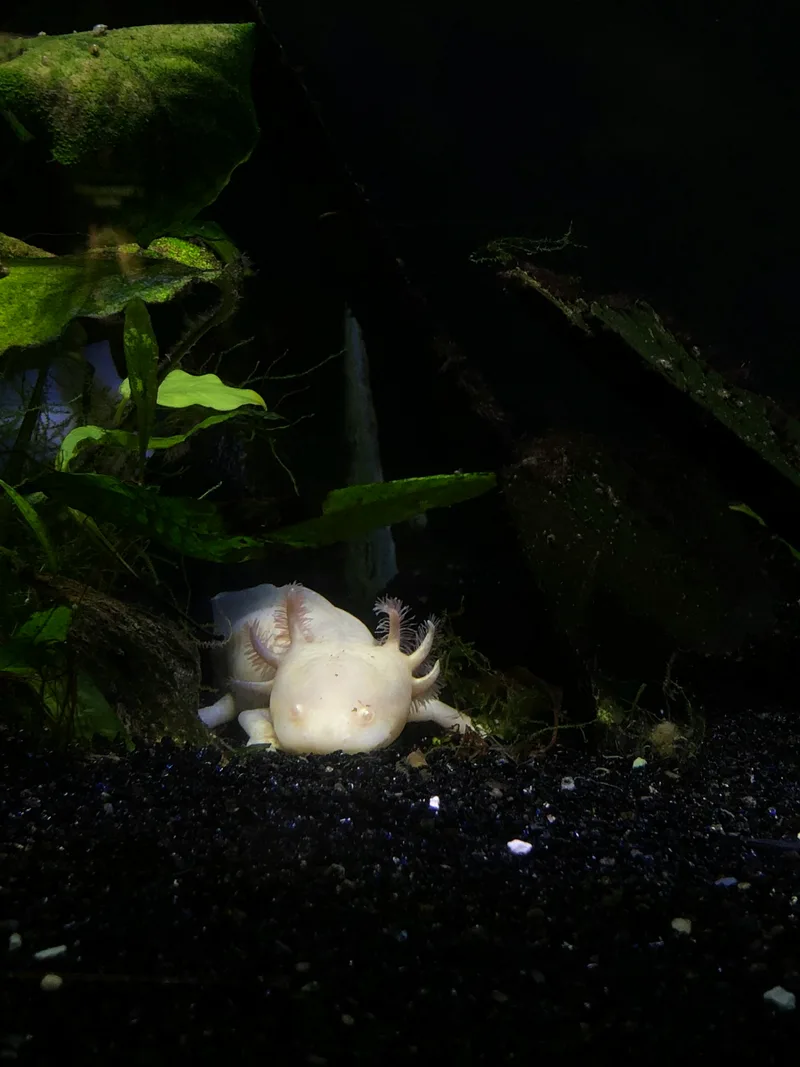
A happy axolotl rests on the bottom with its gill stalks held out wide and fluffy, the filaments red and full. Getting there is simpler than the internet suggests: cool water in the low 60s°F, a soft floor of fine sand or bare glass (never pebbles), a shaded hide, slow flow, dim light, and no tankmates. The catch is that "like" is doing light work here, because an axolotl's gills sit in direct chemical contact with the water around them. The water isn't just around the animal, it passes through it. Match the cold, slow, silty lake water axolotls evolved for, and the gills will tell you, in how they're held, that you got it right.
What should actually be inside the tank?
Think of the inside of the tank from the axolotl's point of view: something to walk on, something to tuck under, something to slow the water down. Not much else.
- Fine sand (grains under 1mm) or a bare glass bottom
- At least one smooth hide per axolotl, placed in shade
- Low-light live or silk plants, nothing spiky
- Smooth decor only, no sharp edges, nothing small enough to swallow
- A sponge filter, or a canister with its outlet baffled so the surface barely ripples
- Dim or indirect lighting
Substrate is the one most people get wrong. Axolotls feed by opening their mouth and vacuuming whatever's in front of them, and they can't pass gravel or small pebbles. The substrate either has to be finer than their throat (sand under 1mm grain size) or nothing at all (bare glass). A bare-bottom tank is easier to clean and perfectly fine for the animal. Sand feels more natural and lets them grip while they walk, but it has to be the right sand.
Hides matter more than people expect. Axolotls are nocturnal ambush predators that spend most of the day tucked under something, and a tank without a shaded hide keeps the animal mildly stressed around the clock. One hide per axolotl is the minimum. Smooth terracotta caves, sections of wide PVC pipe, or aquarium-safe ceramic tubes all work. Put them in the dimmer corners of the tank, not centered under the light.
Plants are optional but useful. They help shade the tank, give the axolotl something to rest against, and soak up some nitrate between water changes. Anubias, java fern, and floating plants like amazon frogbit handle the cool water and low light that axolotls need. Silk plants are a fine substitute if live plants feel like one thing too many. Skip plastic plants with sharp or stiff edges, which can nick gill filaments.
Decor follows one rule: smooth, and too big to swallow. That rules out small polished stones, aquarium gravel used as accent, and most "natural" driftwood with splintery edges. Sanded driftwood, large smooth river stones the size of the axolotl's head or bigger, and ceramic ornaments without glaze chips are all fine.
Flow is where fish-tank instincts work against you. A strong current exhausts an axolotl, because they're not built to swim against anything. A sponge filter on a gentle air pump is the default recommendation for a reason. If you're running a canister, aim the outlet at the glass or use a spray bar to diffuse it, and watch the surface: if it's rippling more than lightly, the flow is too strong.
What conditions does the water need to feel right?
Water chemistry hits axolotls harder than it hits a fish, because they breathe partly through their gills and partly straight through their skin. The water isn't around them, it's in them. "Close enough" is not close enough.
Aim for these:
- Temperature: 60 to 64°F (16 to 18°C) is the comfort zone. The hard ceiling is 72°F (22°C), and sustained temperatures above that stress them fast. Axolotls don't need a heater at normal room temperature, and in summer most homes will need a fan blowing across the surface or, in warmer climates, a small aquarium chiller.
- pH: 7.4 to 7.6. Slightly alkaline, stable. More important than the exact number is that it doesn't swing.
- Hardness: 7 to 14 dGH, moderately hard. Very soft water causes problems with their skin and gill function, which catches a lot of keepers off guard because soft water is treated as a virtue in most aquarium advice.
- Ammonia and nitrite: zero. Not low, zero. A fully cycled tank with an established biological filter is non-negotiable.
- Nitrate: under 20 ppm. Weekly water changes of 20 to 30 percent keep it there.
If your numbers are off, the axolotl usually tells you before the test kit does. Curled gills, a refusal to eat, floating at the surface: any of these alongside a borderline reading means the water is the problem.
The full set of ideal water parameters for axolotls holds steadier than most fish tolerate, with pH, hardness, and nitrate each sitting in a narrower band than a typical tropical community tank would need. And axolotls don't need a heater in most homes, since room temperature sits right in their comfort range most of the year.
How can I tell if my axolotl actually likes the setup?
You don't need to guess. The animal shows you.
A comfortable axolotl rests on the bottom or inside its hide, with its gill stalks held out wide and fluffy, the filaments looking red and full. It eats when food is offered, swims in short bursts rather than constant laps, and sits still without its whole body quivering. That's what "likes it" looks like.
A stressed axolotl tells you just as clearly. Use this as a first-pass diagnostic:
| What you see | What it usually means | First thing to check |
|---|---|---|
| Gills held out wide and fluffy, red filaments | Relaxed, healthy | Keep doing what you're doing |
| Gills curled forward against the head | Heat or ammonia stress | Water temperature and ammonia reading |
| Floating at the surface, can't stay down | Gas buildup or poor water quality | Tub the axolotl in cool clean water, test params |
| Pacing the front glass | Overstimulation or reflection | Dim the lights, cover one or two sides of the tank |
| Refusing food for more than a day or two | Temperature spike, stress, or poor water | Temperature and ammonia first, then nitrite |
| White cottony patches on gills or body | Fungus, usually secondary to stress | Tub in cold clean water, review water quality |
Curled-forward gills in particular are worth learning on sight. Axolotl gill filaments are in direct chemical contact with the water, and when the water is too warm or carrying ammonia, the tissue reacts before the animal "decides" anything. It's a reflex, and it's one of the earliest warning signs you get.
A stressed axolotl usually shows several of these signs at once, not just one, and the combination is often what separates a bad day from a real problem.
What should definitely stay out of the tank?
A handful of things get added to axolotl tanks because they're standard for fish tanks, and they cause most of the avoidable deaths in this hobby.
- Gravel and small pebbles. Axolotls suck food in whole and will swallow any substrate they can fit in their mouth. Swallowed gravel doesn't pass, and impaction is often fatal.
- Fish and shrimp tankmates. Small fish get eaten, larger fish nip gills, and shrimp either get eaten or pick at the axolotl while it rests. Axolotls do best alone or with other similarly sized axolotls.
- Heaters above 72°F. Even a heater set to a fish-friendly 78°F cooks an axolotl. If you have a heater at all, it should be off, or set low enough to only prevent a cold snap.
- Bright full-spectrum aquarium lights. Axolotls have no eyelids and come from deep, shaded water. Strong lighting stresses them and makes them hide around the clock.
- Sharp or metallic decor. Anything sharp can tear a gill filament with one brush past it. Anything metallic can leach copper, which is toxic to axolotls in amounts that fish tolerate fine.
- Strong airstones. Light aeration is okay. An airstone strong enough to push the axolotl around the tank is exhausting them.
- Copper-based medications. Common fish treatments for ich, parasites, and fungus often rely on copper, and axolotls can't handle it. Always check the label before dosing anything in an axolotl tank.
There are other items you shouldn't put in an axolotl tank that don't make the headline list but still cause avoidable problems, including tannin-heavy driftwood and untreated tap water. And if you're weighing whether a specific species could work, the animals that can actually live with axolotls are limited to a very short list, because almost every common tank mate either needs warmer water than an axolotl tolerates or is small enough to be eaten.
What axolotls "like" is really what they evolved for: a cold, slow, silty lake with places to tuck under. A tank that respects those three things (cool water, soft floor, shaded hides) is one an axolotl will quietly thrive in, and that's a lower bar than the internet makes it look. The job is doable.