Why do axolotls turn into salamanders?
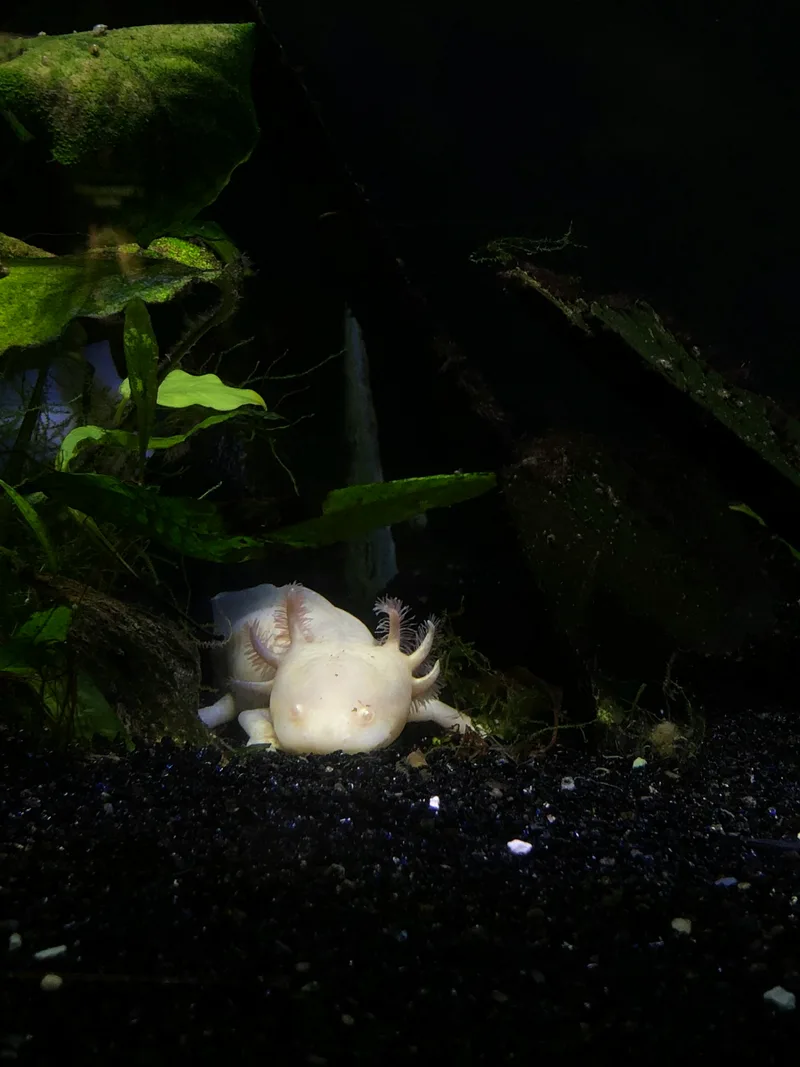
The axolotl in your tank is already a salamander. It's a neotenic one, meaning it stayed in its larval, fully aquatic form for life instead of crawling out of the water like its cousins do, and it almost never trades that form back in for the terrestrial one. When a captive axolotl does morph, the cause is usually something pushing its thyroid system from outside: lab-grade hormones, iodine, or, very rarely, severe long-term stress in an animal that carries a little tiger salamander in its family tree. The "salamander" people picture at the end of that change is a different animal in a real sense, with a shorter, harder life than the one you actually bought.
Should I be worried if I think my axolotl is morphing?
Probably not. Real metamorphosis in a captive axolotl is rare enough that most "is mine morphing?" questions turn out to be something else: cool-water gill bleaching, a fluffy patch of new gill growth, or seasonal color changes. None of those count.
Real early-morph signs look like this:
- Gill filaments shrinking and pulling back toward the head, not just paling
- The dorsal fin (the soft frill running along the back) thinning and shortening
- The body thickening through the shoulders and losing its sleek aquatic shape
- Eyelids appearing where there were none before
- A sudden, persistent drive to climb out of the water or sit at the very top
- Lungs becoming visibly active, with the animal gulping at the surface for air it didn't need before
- Skin texture roughening, losing the smooth wet-rubber look
If you're seeing a cluster of those, the next step is a vet who works with amphibians, not the home internet. Don't reach for iodine, don't crank the heater, and don't "let it run its course." The transition is metabolically brutal and the animal needs supervised care, not improvisation. If you're only seeing one of these and it could be something else, it almost certainly is.
What actually triggers metamorphosis in an axolotl?
It comes down to thyroid hormone. In a normal salamander, the brain ramps up production of thyroxine and that hormone tells the body to reabsorb the gills, switch the circulation over to lungs, remodel the limbs, and crawl out. Axolotls inherited every piece of that machinery. What they lost is the signal at the top of the loop: the hypothalamus and pituitary stay quiet, the thyroid never gets the order, and the body stays larval. The factory is intact. Nobody flips the switch.
That's why the things that trigger metamorphosis in captivity are all ways of flipping the switch from the outside.
The real-world triggers, in order of how often they actually cause it:
- Direct thyroid hormone, injected or added to the water in a lab setting. This is what biologists use when they want the change to happen. It works reliably and it's not something an owner can do by accident.
- Iodine, usually as Lugol's solution. The thyroid needs iodine to make thyroxine, and a sudden spike supplies the missing input. This is the one a curious owner sometimes tries on purpose, and it's the one most likely to hurt an animal that didn't ask for it.
- Tiger salamander ancestry. Axolotls and tiger salamanders (Ambystoma tigrinum and relatives) have been crossed in the pet trade for decades, sometimes deliberately, sometimes not. An animal with even a small amount of tiger DNA can carry a functional top-of-loop signal, which means an ordinary trigger that wouldn't touch a pure axolotl can set this one off.
- Severe sustained environmental stress, in that same kind of part-tiger animal. Chronic warm water, long-term poor water quality, or extreme handling stress can be enough of a push when the genetics are already primed. In a pure axolotl, the same conditions cause illness and death long before they cause morphing.
A warm afternoon, a missed water change, or a noisy week in the room does not metamorphose a pure axolotl. The thyroid axis is too thoroughly disconnected for that. If a pet axolotl morphs, the explanation is almost always either something added to the water or something hiding in the family tree.
Why didn't axolotls evolve out of being able to morph at all?
Because they never needed to. Axolotls come from the cool, spring-fed lake complex around Mexico City, where the water is permanent, the food supply is steady, and the larval form already has everything an adult amphibian would have on land. Reproducing as larvae works there. Crawling out of the water doesn't pay.
So evolution didn't delete the metamorphosis program. It just stopped using it. The genetic toolkit is still in place, intact and assembled, with the top switch turned off. That's why a researcher with a syringe of thyroxine can run the whole sequence in a few weeks, and it's a big part of why axolotls became one of the most-studied animals in developmental biology. What's striking is that the adult form is still right there inside them, packed up and waiting, perfectly preserved by a habitat that never asked for it.
Did you know? A Czech biologist named Vilém Laufberger first induced axolotl metamorphosis in Prague in 1920 by injecting thyroid hormone into a larva. That one experiment put neoteny on the map and is the reason an axolotl shows up on the left side of almost every textbook diagram of amphibian development.
What does life look like for a morphed axolotl?
Different. Shorter. Harder.
The animal loses its gills and the smooth, wet-skinned look that comes with being fully aquatic. The skin thickens and dries out. Eyelids form. The lungs, which had been a small backup organ, take over breathing. The body needs a humid terrestrial setup now: shallow water at one end, damp moss or paper towel for the rest, room-temperature air with no heater. Diet shifts toward worms and insects taken on land rather than in the water.
The numbers tell the rest of the story.
| Aquatic axolotl | Morphed (terrestrial) form | |
|---|---|---|
| Gills | External, feathery, fully functional | Reabsorbed; gone within weeks |
| Skin | Smooth, permeable, kept wet by the water | Thicker, drier, easily damaged when handled |
| Eyelids | Absent | Present |
| Habitat | Aquarium with cool, clean water | Humid terrarium with damp substrate and a small water dish |
| Diet | Worms, blackworms, pellets, taken underwater | Worms and insects, taken on land |
| Lifespan | 10 to 15 years | A few years, sometimes less |
| Care difficulty | Forgiving once cool water is sorted | Fragile, hard to keep stable, easy to lose |
None of this is a hidden upgrade waiting to be turned on. The transition is a one-way trade, and what gets traded away is most of the animal's life.
Is this the same metamorphosis other salamanders go through?
In the mechanism, yes. The hormones are the same, the changes are the same, the underlying genetic program is the same. The axolotl is at the extreme end of a spectrum, not on a different graph.
Their close cousins, the tiger salamander complex (Ambystoma tigrinum, A. mavortium), undergo full metamorphosis as a matter of course: aquatic larva, then a few weeks of dramatic rebuilding, then a stocky terrestrial adult. Some populations of those species are facultatively neotenic, meaning the larvae stay aquatic when the pond is good and morph when conditions force them out. The axolotl is what happens when "the pond is always good" is the only setting any ancestor ever experienced. The latent capacity stays, the trigger goes silent, the larva quietly becomes the whole animal.
Whether what an axolotl undergoes even counts as metamorphosis in the strict textbook sense is a separate question, since the definitions tend to assume a fully terrestrial adult on the other side. The same staying-larval trick is also what keeps an axolotl's famous regenerative toolkit switched on into adulthood, when most amphibians lose it. An axolotl that stays an axolotl isn't failing to become a salamander. It's a salamander that succeeded at a different life, and the one in your tank is the whole animal, not a stalled draft of one.