Can axolotls live for 100 years?
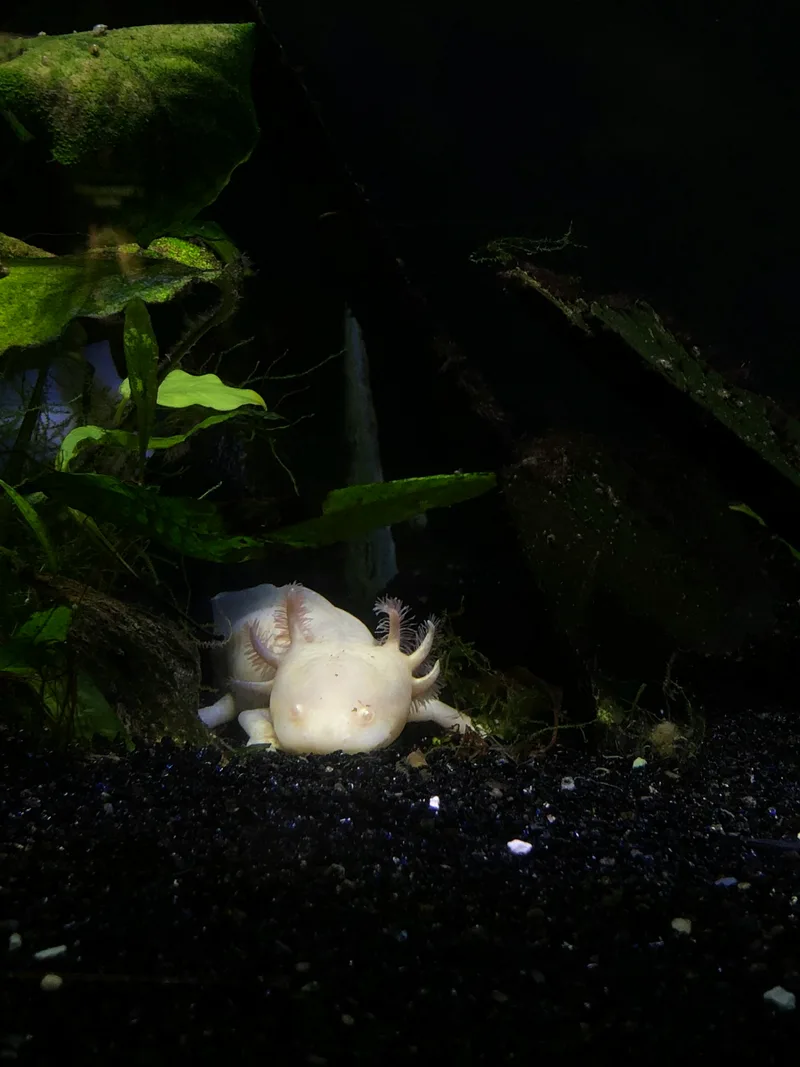
No. An axolotl (Ambystoma mexicanum) lives about 10 to 15 years in a home tank, and a few exceptionally well-kept ones reach their early twenties. The 100-year figure is real, but it answers a different question than the one you asked: axolotls have been bred in captivity for close to a century, an unbroken lineage of parents and offspring, and somewhere along the way "the captive population is 100 years old" got reheard as "an axolotl can live 100 years." Two true things that look like one. The reason the mix-up sticks is that the animal underneath it is strange enough to make a century feel plausible, since this is the creature famous for regrowing lost limbs and aging remarkably slowly, and yet it still rarely outlives a large dog.
So How Long Do Axolotls Actually Live?
In a properly kept home tank, an axolotl lives 10 to 15 years. That is the number to plan around. Some individuals, kept cool and clean their whole lives, push into the low twenties, and a handful of carefully documented animals have reached their mid-twenties. Anything in that range is a good, full axolotl life.
In the wild, the same animal manages only about 5 to 6 years. The gap is large, and it is worth understanding why, because the reason isn't that wild water is somehow worse. An axolotl's native lake complex around Mexico City is a hard place to be a soft-bodied, slow-moving amphibian. There are predators, and there is the seasonal drop in water level that can collapse whole stretches of habitat. A tank removes both. No heron is going to pick your axolotl off the substrate, and the water level never falls. What you are giving a captive axolotl isn't a better version of its life. It is the same life with the two biggest causes of early death taken off the table.
Did you know? The oldest reliably reported axolotls have reached their early-to-mid twenties in captivity, roughly four times what most survive in the wild. Almost all of that extra time comes from a single thing: a tank has no predators and never dries out, so the animal just keeps living past the point where a wild axolotl's luck usually runs out.
Where Does the "100 Years" Number Even Come From?
The number is real, and it is easy to see how it gets scrambled. Axolotls have been bred in captivity for close to 100 years. The laboratory population that most pet and research axolotls descend from traces back to a shipment of animals sent from Mexico to Paris in the 1860s, and they have been kept and bred continuously ever since. So when you read that axolotls "have been bred in captivity for nearly 100 years," that sentence is true. It is a fact about the lineage, the unbroken chain of parents and offspring, not about the age of any one animal in it.
The slide happens in the reading. "The captive population is around 100 years old" quietly becomes "an axolotl can live around 100 years," and the claim moves from the group to the individual without anyone deciding to make it. It is the same error as hearing that a family has farmed the same land for 100 years and picturing one very old farmer. The lineage is ancient. The animals living in it right now are not.
If Axolotls Barely Age, Why Don't They Live Longer?
Once you set the myth aside, a genuine puzzle is left standing. Axolotls show very slow outward signs of aging, and their regenerative ability is extraordinary. They can regrow a lost limb down to the bone, muscle, and nerve. They can rebuild damaged gills, and they can repair parts of the heart and the spinal cord that most animals, including us, can only scar over and lose. So it is a fair question: if this animal can rebuild itself and seems almost reluctant to age, why does it still die at fifteen?
The answer is that regeneration and slow aging are not the same as not dying. An axolotl that can regrow a limb is still an animal whose organs accumulate wear, who can catch an infection, and whose biology has a ceiling like every other animal's. Regeneration is a remarkable repair system, but a repair system fixes specific damage in specific tissues. It does not reset the whole animal, and it does not switch off every process that eventually wears a body out. Being able to regrow a leg buys an axolotl back from injuries that would kill most animals. It does not buy it an escape from time.
Did you know? An axolotl can regrow a fully working limb, complete with bone, muscle, and nerves, in a matter of weeks, and it can do this over and over across its life. Yet all of that repair power does nothing to push the animal's overall lifespan past the low twenties. The body it keeps rebuilding still ages on the same schedule.
What Actually Shortens an Axolotl's Life the Most?
Most axolotls that die young don't die of anything mysterious. They die of a handful of avoidable things, and the order matters, because the most common killer is also the easiest to get wrong if you came to axolotls from keeping fish.
The first is heat. Axolotls are cool-water animals, and they do not want a heater. Above about 22°C (72°F) the water starts to stress them, and sustained warmth is the single most common reason a pet axolotl's life is cut short. Warm water holds less oxygen and pushes the animal's body harder at the same time, and an axolotl has no way to escape it in a closed tank. If you only fix one thing, keep the tank cool. Because "cool" leaves room for error, it pays to know the exact temperature range an axolotl should sit in without any heater and to hold the water there year round.
The second is water quality. An axolotl is a large, messy animal that produces a lot of waste, and in an uncycled or under-maintained tank that waste turns into ammonia, which burns the gills and the skin it has to breathe through. A cycled filter and regular water changes are not optional extras here. They are the thing standing between the animal and a slow chemical injury.
The third is gut impaction. Axolotls feed by suction, gulping in whatever sits in front of the mouth, and they cannot reliably tell food from gravel. Swallowed gravel that is small enough to fit in the mouth but too big to pass through can block the gut, and that blockage can be fatal. The fix is the setup itself: bare bottom, or sand fine enough to pass straight through, and nothing in between. Gravel is only one of the things that don't belong in an axolotl tank, and clearing the hazards out before the animal ever goes in is the cheapest insurance you can give it.
Keep those three in check and you are giving your axolotl its full 10 to 15 years, maybe more. And that is the better way to hold the lifespan number. The marvel of the axolotl was never going to be a long life. It is a slow, repairable one, spent entirely in a permanent larval form, regrowing what it loses along the way. That is a stranger and frankly more interesting kind of staying power than simply running out the clock to a hundred.