Are axolotls hard to keep alive?
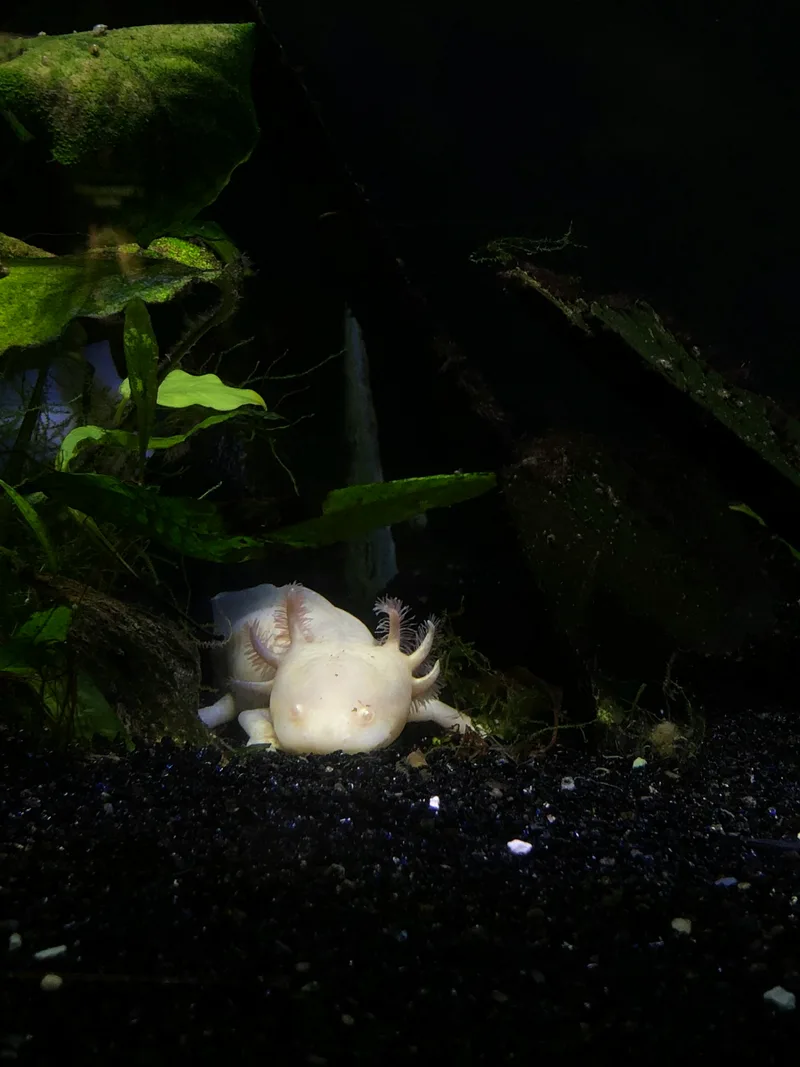
No. Axolotls aren't fragile animals, and a healthy adult in a properly set-up tank is genuinely hard to kill. The catch is that almost every axolotl that dies in a home tank dies from the same four things: warm water, an uncycled tank, swallowable gravel, and fish in the tank with it. Those four are exactly what a normal beginner tropical fish setup hands you on day one, which is why an animal that survives fifteen years in the right tank reads as "hard to keep alive" in the wrong one.
What actually kills axolotls in home tanks?
Almost every premature axolotl death traces back to a small, named list. If your tank avoids these, you have already done most of the work.
- Warm water above 72°F (22°C). Axolotls are cool-water animals, and even a few days of bathwater-warm temperatures tips them into heat stress, where they stop eating, their gills curl forward, and they get sick fast. The biggest single cause of summer deaths is a heater someone forgot to unplug, or a room that climbed during a heatwave.
- An uncycled tank. Putting an axolotl into a brand-new, unfiltered tank means it is sitting in its own ammonia within days. Ammonia burns through the permeable skin and gills before water changes can keep up. Always cycle the tank before the animal goes in.
- Fine gravel substrate. Axolotls feed by suction, so anything small enough to fit in their mouth eventually goes in. Gravel the size of peas or smaller blocks the gut, the axolotl stops passing food, and impaction kills it. Bare-bottom tanks or fine sand are safe; mid-sized gravel is the killer.
- Fish tankmates. Most community fish nip at the feathery external gills, and axolotls have no fast way to defend them. On top of that, the water temperatures that tropical fish want are the temperatures axolotls cannot tolerate. The two animals do not share a viable tank.
- Chlorinated tap water with no dechlorinator. Tap water straight from the faucet contains chlorine or chloramine, and an axolotl's skin and gills absorb it directly. A few drops of dechlorinator in every refill prevents it; skipping that step during a water change has killed more axolotls than any exotic disease.
What are the warning signs that an axolotl is in trouble?
If your axolotl already looks off, the signal is almost always in its body before it is anywhere else. A normal axolotl is pink (or whatever its base color), gills full and feathered out to the sides, sitting calmly on the bottom, eating when offered. Most early problems are reversible if you catch them in the first few days, so the table below is a lookup, not a list of things to memorize.
| What you're seeing | Most likely cause | First thing to check |
|---|---|---|
| Gills curling forward toward the head | Ammonia or heat stress | Water test (ammonia, nitrite) and thermometer reading |
| Gills shrinking back, less feathered | Long-term water quality, low oxygen, or warm water | Nitrate level and tank temperature |
| Pale or grayish color in a normally pink animal | Stress, poor water, or low blood oxygen | Full water test and recent changes to the tank |
| Floating at the surface, cannot sink | Gut gas from overfeeding or early impaction | What it last ate and whether the substrate is safe |
| Refusing food for more than three or four days | Water temperature too high, or ammonia | Thermometer first, then water test |
| White fuzz or fungus on body or gills | Fungal infection, usually downstream of stress | Water quality, and look for the original injury or stressor |
| Hunched, arched, or curled posture | Acute water-quality problem or recent toxin exposure | Test the water immediately and do a partial change with dechlorinated water |
Most of these reverse if the underlying condition is fixed within a day or two. The pattern to watch for is multiple signs together. One off-looking day after a water change usually settles on its own; gills curled forward plus pale color plus refusing food, all on the same day, is a tank emergency.
Why a fish-keeper's instincts get axolotls killed
The three pieces of advice you would give to almost any beginner tropical fish keeper are exactly the three pieces of advice that kill axolotls. That is what makes this animal feel hard. It isn't fragile. It is on a different operating manual.
The first instinct is the heater. Tropical fish want 75 to 80°F, so the heater is the first thing in the box. Axolotls (Ambystoma mexicanum) evolved in the cold, high-altitude lake complex around what is now Mexico City, where water sits in the high 50s to mid 60s year-round. Their entire metabolism is tuned to that band. Above about 72°F their immune system starts to fail and they stop digesting food normally. This isn't a preference. The animal's biology only works in cool water; warm water is, slowly, a poison.
The second instinct is gravel. Most fish pick at the substrate, so small gravel is a sensible default for a community tank. Axolotls don't pick. They suck. They open their mouth, generate a small pressure drop, and pull whatever is in front of them inward, gravel and food together. A few weeks of that and you have a packed lower intestine and an animal that has stopped passing food. Bare-bottom tanks and fine sand (smaller than a sand-grain, so it passes straight through) are both safe; the dangerous zone is anything between those two sizes.
The third instinct is friends in the tank. Community fish keepers like a mixed display, and the obvious thing to do is add a few small, peaceful fish to keep an axolotl company. Two things go wrong. The temperatures don't overlap, so any fish that could live with an axolotl is itself out of its range. And the small peaceful fish (neon tetras, white cloud minnows, danios) happily nip at the gills, which are exposed, blood-rich tissue with no defenses. The axolotl is also breathing partly through its skin, which means whatever stress chemistry it releases from being chased and nipped is being absorbed back through the same surface. Fish tankmates aren't risky in the way two cichlids together are risky. They are not compatible at all.
Did you know? Axolotls breathe partly through those feathery external gills and partly through their permeable skin. That's why warm water, ammonia, and chlorine hit them so much harder than they hit fish: the water isn't just around the animal, it's in chemical contact with the same tissue the animal breathes through. The skin isn't a barrier; it's a participating organ.
Once you stop trying to keep an axolotl like a fish, the difficulty mostly disappears. A bare tank with a sponge filter, a thermometer, dechlorinated water, and nothing else in it is dull to look at and almost impossible to mess up.
If I do this right, how long will my axolotl actually live?
A well-kept axolotl in a stable, cool, cycled tank with no tankmates and a safe substrate will live 10 to 15 years, with the upper end of that range reachable when conditions stay steady. That isn't a fragile decade you have to defend week by week. The difficulty was front-loaded into the tank setup. Once the water is cool, the cycle is established, the substrate is safe, and there are no fish in there with it, the axolotl is one of the more durable pets in the hobby. For the realistic day-to-day lifespan of an axolotl as a pet, the same conditions account for the difference between a five-year axolotl and a fifteen-year one. If you're still deciding whether to bring one home, the easy-vs-hard question is really a question about how much work the setup is, not how much work the animal is once it's living there. Because the temperature ceiling is the single most common killer, the lower edge of an axolotl's safe temperature band is the other number that matters, so you can size your cooling solution to a band rather than just a ceiling.