Should I feed my axolotl every day?
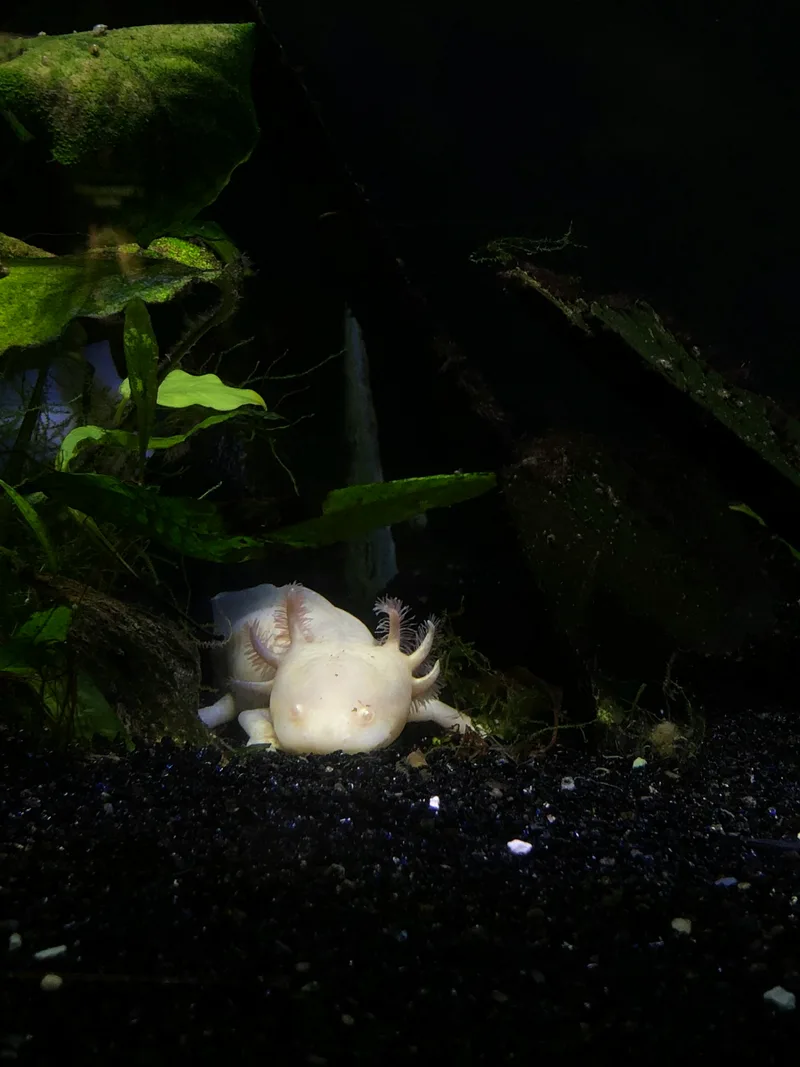
Only while they're young. An axolotl looks like a fish and lives in a fish tank, but it isn't a fish, and the feeding schedule that keeps a tropical fish healthy is the one that makes an adult axolotl bloated and sick. Juveniles under about 6 inches eat every day, but adults over 7.5 inches do best on one feeding every two to three days, because at the 60 to 64°F (16 to 18°C) an axolotl needs, the gut runs slow enough that a daily meal arrives before the last one has cleared. The animal will keep eating long past the point its body is asking for the next meal.
How often should I actually feed my axolotl?
Match the schedule to size, not to a habit. Axolotls grow through three distinct feeding stages, and the cadence that's right at each one is wildly different from the others.
| Size / life stage | Feeding frequency |
|---|---|
| Hatchling (under ~2 inches) | Twice a day |
| Juvenile (2 to 6 inches) | Once a day |
| Subadult (6 to 7.5 inches) | Every other day |
| Adult (7.5+ inches) | Every 2 to 3 days |
Hatchlings need constant fuel. They're growing fast, they have almost no body reserves, and they'll cannibalize a sibling's gill if a meal runs too late. Twice a day, live foods like baby brine shrimp or chopped blackworm, is the floor.
Juveniles slow down to once a day. The body is still building, but the gut is big enough now that a single daily meal covers it.
Somewhere between 6 and 7.5 inches the appetite itself starts to drop. The axolotl will start refusing the second feed of the week, or leaving food on the bottom. That's the signal to step down to every other day, then every two to three days as they cross the adult mark.
The portion at each meal is simple: as much as the axolotl will eat in two or three minutes, then remove what's left. A piece of earthworm the size of the axolotl's head is roughly one adult portion. Leftover food fouls the water fast in a cool tank with no scavengers, and the temptation to leave it in "just in case" is what tips a clean tank into an ammonia spike.
One rule cuts through the whole schedule: appetite, not the calendar, decides the next meal. An adult that refuses food on day two is telling you the day-three slot is the right one. An adult that hunts the front glass at every approach is fine on the every-two-day end of the range. The numbers are a starting point; the animal is the final word.
How do I know if I'm feeding too often?
The signs are all observable, and none of them require a vet visit to spot. Overfeeding is the most common axolotl problem in a home tank, and it's also the most fixable: the corrective move is almost always to skip the next feeding and drop a day from the cycle.
- The belly stays visibly rounded the morning after a meal, instead of flattening back to the line of the body
- Food is still sitting on the substrate ten minutes after it went in
- The axolotl turns away from food it would normally take
- Poop is infrequent, or it floats instead of sinking
- The animal sits flat on the bottom and barely moves between feedings
- The gill filaments curl forward toward the face instead of fanning out cleanly to the sides
A rounded belly that goes down between meals is fine. That's a fed axolotl. A rounded belly that stays rounded between meals, or that gets visibly more rounded over a week, means the gut isn't clearing fast enough. Skip a feeding, then resume on a longer cycle.
Floating poop is the next-clearest sign. It usually means trapped gas from food that's fermented in the gut instead of moving through it, which is what happens when meals stack on top of each other faster than the cool-water gut can process them.
Curled-forward gills are the most underrated of these. Gill curling has more than one cause (ammonia stress is the famous one), but it shows up reliably in overfed animals because the same fouled water that comes from leftover food is what irritates the gill tissue.
None of this is a panic moment. Axolotls are forgiving animals, and the fix is the schedule itself. Pull back to every three days, watch the belly settle, and most of the worrying signs are gone inside a week.
Why don't adult axolotls need to eat every day?
Because the water they live in is cold, and the gut they live in runs at the speed of the water. A healthy axolotl tank sits at 60 to 64°F, well below the temperature most aquarium fish need, and at that temperature the whole metabolism is dialed down. Digestion that would take a tropical fish six hours takes an axolotl closer to two days.
The instinct to feed once a day comes from fishkeeping. Tropical fish in a 78°F tank are running hot, and a daily meal matches the rate they burn through it. Apply that schedule to an axolotl and the meals start arriving faster than the previous one has cleared the gut. Food backs up. The belly stays full between feedings, fermenting instead of digesting, and the result is the bloated, gassy, constipated animal that shows up in every overfeeding photo.
The axolotl will not stop you. They keep accepting food long after their body actually needs it. A hand near the tank reads as a meal whether the previous one is fully digested or not, and the behavior in front of the glass is no guide at all to what's happening inside. The cool water is slowing the gut, the appetite isn't slowing with it, and the keeper is the one who has to call time on the meal the animal would happily take.
Seen that way, the every-two-to-three-days schedule isn't deprivation. It's the cadence matched to the temperature the animal needs to live at.
Did you know? In their native lake habitat (the cool, spring-fed remnants of Lake Xochimilco near Mexico City), wild axolotls likely go through long stretches with little food and pulse-feed hard when prey is available. The slow metabolism that makes them prone to overfeeding in a home tank is built for exactly that boom-and-bust pattern, not a daily meal.
What should I actually feed them on those days?
The staple of an axolotl diet is soft, high-protein, sinkable food: earthworms (European nightcrawlers cut to size are the gold standard), live or frozen blackworms, and high-protein soft pellets formulated for axolotls. The rule of thumb is simple: it should be high in protein, soft enough to swallow whole, and free of the hard exoskeletons (mealworms, dried krill, hobby-store crickets) that an axolotl's gut can't break down. Rotating between a few of the best foods for axolotls keeps the nutrition balanced and stops a picky animal from fixating on one item.
The question "every day?" is the natural one for a fish-keeper to ask, because every fish in the room next to the axolotl tank eats every day. Axolotls aren't fish, though, and the moment the schedule shifts from a fish-keeper's clock to a cool-water amphibian's clock, most of the common axolotl health worries get smaller on their own. The feeding cadence is the door into thinking about the animal on its terms.