Can axolotls go 2 days without food?
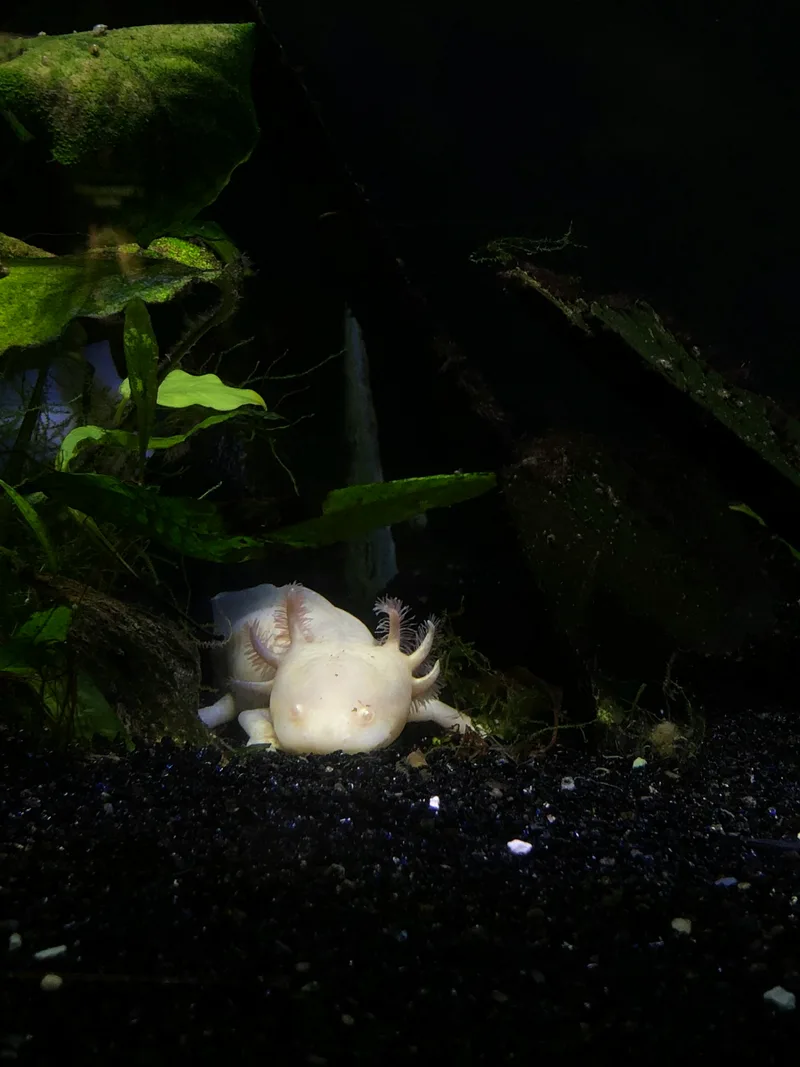
Yes, easily. A healthy adult axolotl in a cool, cycled tank can go two weeks without food and barely notice; two days is well inside the comfort zone. The trick is that "how many days" is the wrong question to ask. The variable that actually decides whether your axolotl handles a weekend away is the temperature of the tank, not the calendar.
How Should I Actually Set Up the Tank Before I Leave?
Most readers landing here are heading out for a weekend. Here is the short pre-departure routine that covers a healthy adult axolotl (Ambystoma mexicanum) for two days, and frankly for three or four:
- Feed a normal meal the day before you leave. Not extra, not a "topping up" feast. A normal portion the day before keeps the animal in its usual rhythm.
- Drop the tank toward the lower end of the safe range, around 16 to 18°C (60 to 64°F). Cooler water means a slower metabolism and a calmer animal.
- Leave the filter running. The biological filter is doing more work than the food bowl during your absence.
- Turn off the tank lights, or set the timer to a short photoperiod. A dim, quiet tank reduces stress.
- Do not drop food into the tank to "tide them over." Uneaten food fouls the water faster than the axolotl going hungry will harm it, and an axolotl is not built to graze on slowly decomposing pellets.
That last point is the one most casual owners get wrong. The instinct to leave food behind comes from a fish-keeping habit. Axolotls are not fish. They hunt, they don't graze, and water quality matters more to them than the next meal does.
Why Can an Axolotl Skip Meals So Easily?
An axolotl is a cold-water carnivore living at 16 to 18°C (60 to 64°F). At those temperatures its metabolism is slow, its oxygen demand is modest, and it spends most of the day doing very little. The body simply isn't burning much fuel.
In its native habitat, the lake complex around Mexico City, food doesn't arrive on a schedule. An axolotl is an opportunistic ambush predator. It sits, it waits, and when something passes close enough it lunges. Days between meals are normal. The animal is built around that pattern, not around a daily breakfast.
This is the part that surprises people coming from a tropical-fish background. Tropical fish run hot, eat constantly, and visibly slim down inside a week of fasting. An axolotl in a cool, well-cycled tank takes a missed weekend in stride. The temperature lever is doing the heavy lifting: at 22°C (72°F) the same animal is metabolically a different creature.
Did you know? Healthy adult axolotls in cool, well-cycled tanks have been observed fasting for two weeks or more without measurable harm. In the wild, opportunistic feeding is the norm. Meals can be days apart, and the body is built for that rhythm.
When Does 2 Days Actually Become a Problem?
Two days is fine for most axolotls in most tanks. There are three situations where it isn't.
The first is age and size. A juvenile under about 15 cm (6 in) is still growing fast and burns through reserves much quicker than an adult. Juveniles need feeding every day or every other day, and a planned two-day fast for a small one is not the same low-stakes event it is for a full-grown animal. If yours is small enough that you're still measuring growth in months, ask a sitter to feed once.
The second is temperature. A tank that has drifted above 22°C (72°F), which happens easily during a summer week or in a room where heating cycles on, speeds up the metabolism and starts to stress the animal. A stressed axolotl in warm water is a fragile axolotl, and the safe-fasting window shortens fast. The fix is the temperature, not extra food. Getting the tank back into the 16 to 18°C range is the single most useful thing you can do.
The third is the case where the axolotl had already stopped eating before you noticed. If the animal refused its last meal or two, that isn't a fasting question, it's a diagnostic one. Refusing food is one of the first signs of warm water, ammonia in the system, or general stress. Heading out the door without checking parameters when the axolotl has gone off its food turns a manageable problem into a serious one.
What If I'm Going to Be Away Longer? 3 Days, a Week, Two Weeks?
The two-day answer extends naturally for a few days, but past about a week the math changes. The fasting clock isn't really the problem. Water quality and temperature stability are. A filter can fail, a heater in another room can warp the temperature, ammonia from natural waste can build, and there is nobody at home to notice.
| Trip length | What to do |
|---|---|
| 1 to 2 days | No special action. Feed the day before, lower the temperature, leave the tank dim. |
| 3 to 5 days | Same as above, plus double-check the tank is fully cycled and the temperature stable. No food in the tank. |
| About a week | Around the upper bound for an unattended healthy adult. Have a sitter visit once for a single feeding and a quick water check. |
| Longer than a week | Get a sitter who can feed on a schedule and do a partial water change. Don't leave it on autopilot. |
The lever is always the same: temperature stability and water quality, not how many missed meals are stacking up.
Should I Worry If My Axolotl Skipped Food on Its Own?
If you landed here because your axolotl refused dinner, not because you're packing a bag, the answer is different. A single missed meal is normal. They have off days, they finish a recent worm and aren't hungry, they're in a quiet phase. One skip on its own is not a signal.
Persistent refusal is. An axolotl that turns down food across several days is telling you something about the tank, not its appetite. Check the temperature first, then ammonia and nitrite, then look for behavior signs of stress. A healthy axolotl does not need a meal every day, so a single skip is not the alarm bell people often think it is. The temperature is usually the more telling check: anything close to 70°F sits at the edge of what an axolotl can tolerate and is enough on its own to make the animal go off food.
Two days isn't a duration question. It's a tank-conditions question. A cool, cycled, well-fed axolotl barely notices a weekend away. A warm, stressed one notices a single skipped meal. Once you've checked the temperature and the water, the calendar stops mattering.