How to tell if axolotls are mating?
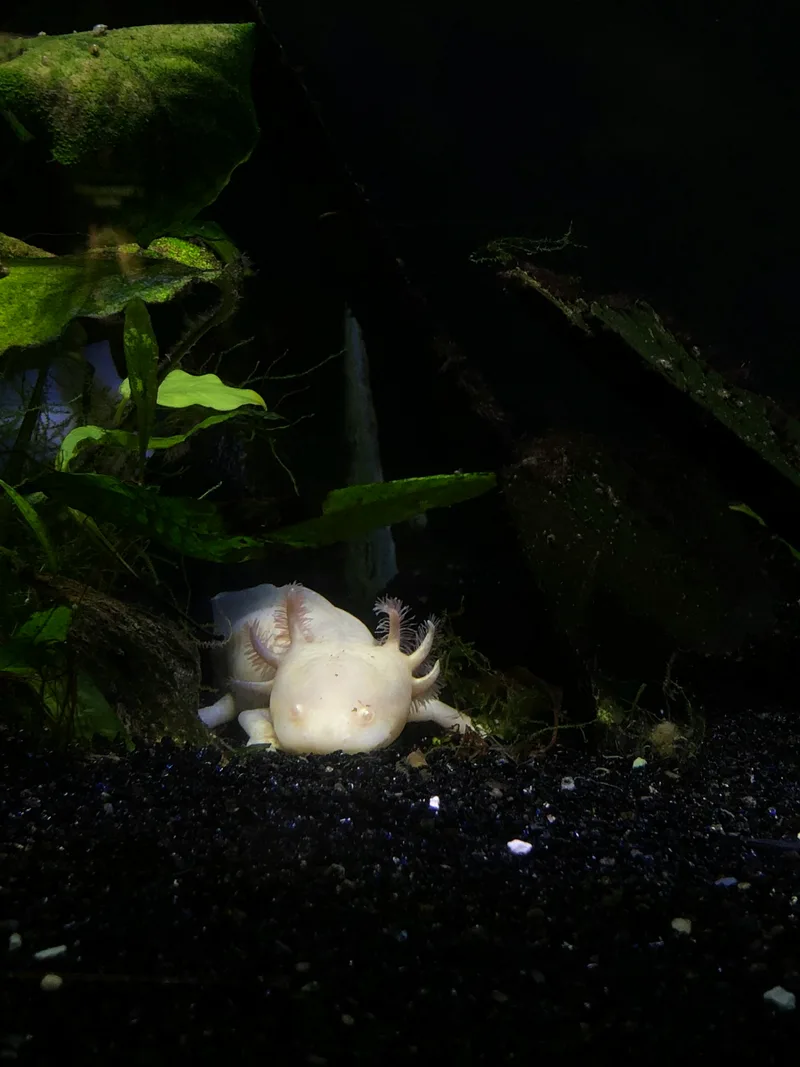
A male with his tail raised, writhing slowly in place and nudging the female's vent, then leading her nose-to-tail in a wide, deliberate circle around the tank for close to an hour. After it, small white jelly cones, shaped like miniature badminton shuttlecocks, scattered on the substrate. Those two things together are the answer: that's mating, happening or just happened. A fast straight-line chase with biting at the gills is something else, and telling them apart matters because one of those pairs needs nothing from you and the other needs separating.
What Does the Courtship Display Actually Look Like?
The male starts it. He becomes restless and unusually active, then approaches the female and begins a slow, deliberate routine: he raises his tail, undulates his body and tail in vigorous writhing motions, and repeatedly nudges her vent (the cloaca, the single opening near the base of the tail) with the tip of his snout. From there he leads her around the tank in a slow nose-to-tail circle, keeping the same pace for stretches that can last up to about an hour.
This is the "hula dance" or "waltz" you'll see in older breeding write-ups and modern fact sheets. The name has stuck because the behavior is consistent across populations. The female, if receptive, follows. She may also nudge the male's vent in return, which is a confirmation cue that she's engaged in the routine and not being herded.
The dance is doing chemical work, not just visual signaling. The writhing distributes pheromones through the water, and those pheromones are part of what brings the female into spawning condition over the course of the display. So the slowness is the point. A frantic, darting chase isn't this behavior, no matter how often it happens.
Did you know? Researchers studying axolotl reproduction in the 1880s already noticed this circling courtship and wrote it up as a "hula dance." The same description still appears in modern San Diego Zoo fact sheets a century and a half later. The behavior is that consistent across captive populations.
What Are the White Jelly Cones Appearing in the Tank?
Those are spermatophores, and they are the single most reliable sign that mating took place. The male deposits them on the substrate, on plants, on hardscape, anywhere flat enough to sit on. They look like tiny pale jelly cones, and the most useful comparison is a miniature badminton shuttlecock: a small round base with a soft tapered top. A single mating session can leave anywhere from 5 to 25 of them scattered around the tank.
Fertilization in axolotls is internal, but the transfer is indirect. The male doesn't deliver sperm to the female; he deposits the cones, then leads her over them, and she picks the sperm cap up with her cloaca as she walks across. So if the cones disappear or get walked over, that is the process working, not a failure. The jelly base is left behind once the cap is collected.
This is why the cones matter so much for confirmation. The dance can stop without any sperm transfer at all. The cones only appear if the male released them. If you see both the dance and the cones, fertilization probably happened. If you see only the dance and no cones, the male was in a courtship mood but didn't follow through.
A lone female can also produce jelly material in her tank without a male present, but unfertilized axolotl reproductive activity looks and behaves differently from a true spermatophore drop.
Could I Be Misreading Normal Activity as Mating?
Two axolotls moving around a tank together can look dramatic without being courtship. Feeding-time excitement, territorial pushing in a tank that's too small, and two males competing all produce activity that, in the wrong light, gets mistaken for mating. The differentiators are mechanical, and once you know them you can read the tank in seconds.
Courtship is male-led. It's slow. It circles rather than darts in a straight line. It involves the tail being raised and writhing in place, not held flat for a sprint. It targets the female's vent specifically and ignores the gills, limbs, and flanks. And it is almost always followed within minutes by spermatophores on the substrate.
If you're seeing biting at the gills or the limbs, no tail display, fast straight-line chases, and no jelly cones afterward, that's aggression, not mating. The pair likely needs separating, especially if it's two males or if the tank is on the small side for the number of animals.
| Sign | Mating | Aggression or just activity |
|---|---|---|
| Who initiates | Male, slow and deliberate | Either, fast and reactive |
| Body posture | Tail raised, writhing in place | Tail flat, straight-line chase |
| Target zone | Female's vent | Gills, flanks, or limbs |
| Spermatophores afterward | Yes, 5 to 25 jelly cones | No |
| Typical duration | Up to about 60 minutes of slow dancing | Brief, repeated bursts |
The table is the diagnostic. If most of the right column matches what you're seeing, treat it as a behavioral problem rather than a breeding event.
What Happens Next, and What Should I Actually Do?
Eggs typically appear 12 to 72 hours after mating, sometimes stretching to about ten days, laid one at a time on plants, decor, or the tank wall. A single female can lay several hundred in a single spawning bout. They're individually wrapped in clear jelly and stuck wherever she places them, which is everywhere a curious axolotl might want to investigate later.
That's where the keeper's actual decision comes in. Axolotls don't parent and will eat eggs given the opportunity, so you have three real options: leave the pair together and let nature thin the clutch, move the eggs into a separate container if you want to raise them, or move the female out so the eggs can be collected without her interest. The numbers matter for that decision, and the count of eggs an axolotl lays at once is larger than most keepers expect when they walk into the room.
You don't have to "do" anything. This is a biologically normal sequence, and the most useful thing a keeper can do up front is decide whether they actually want to raise fry. Once a female is in spawning condition, she'll keep laying. Knowing what raising axolotl fry involves in practice before the eggs are stuck to every plant is what separates a planned breeding from a panicked one.
The calmer reading of all this is that mating itself is a tank-quality signal. Axolotls don't spawn unless temperature, water quality, and stocking feel stable enough to commit reproductive energy. The keeper who is seeing the dance and the cones is, in a quiet way, getting feedback that they've built a tank the animals trust.