Are axolotls easy to breed?
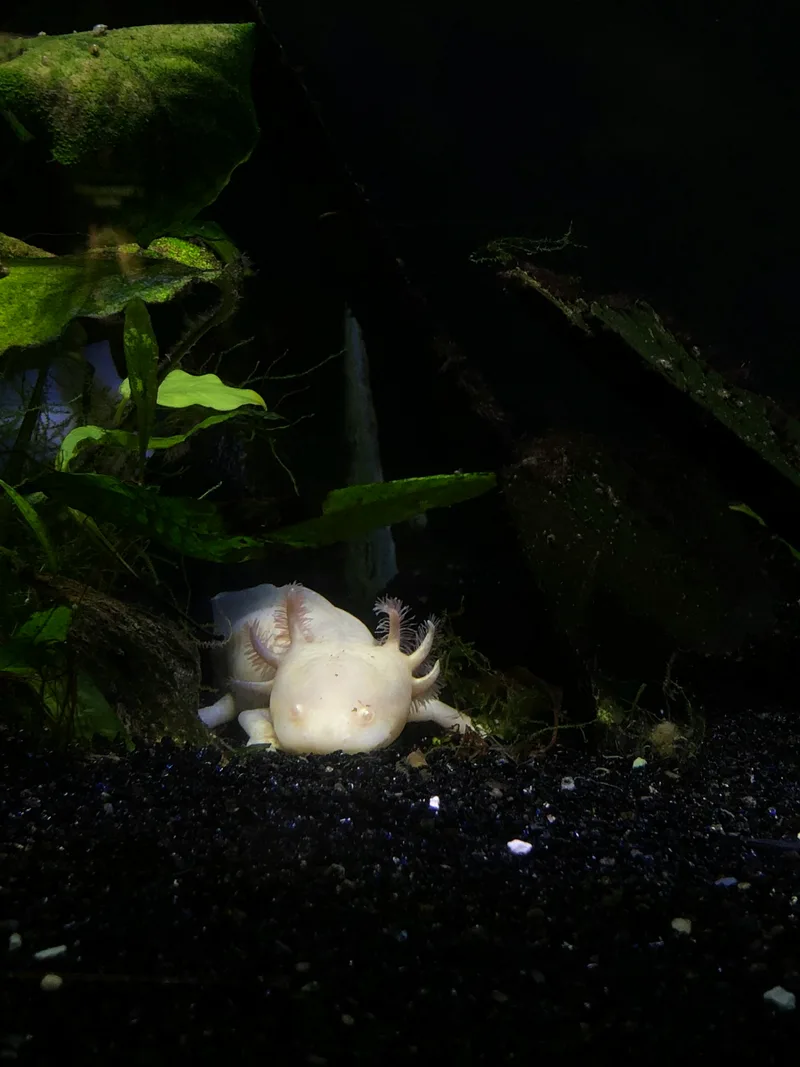
Yes and no, and the split is sharp enough to matter. Getting a healthy pair of axolotls (Ambystoma mexicanum) to spawn is the easy half: cool the water, feed them well, and they pair off and lay eggs on their own, often with no human input at all. Raising the fry is where breeding breaks people. One clutch is 200 to 1,500 eggs, the parents will eat them within hours unless you intervene, and the hatchlings only strike at moving food and will bite each other's gills off. So "are axolotls easy to breed?" splits into two answers most articles fold into one, and the second answer is the one worth reading for.
What does it actually take to get a pair to spawn?
You set the conditions. They do the rest.
A sexually mature, well-conditioned pair will spawn on their own once the water cools into the seasonal range that mimics late winter or early spring in their native Lake Xochimilco. Males are usually ready from around 12 months. Females are best left until 18 to 24 months and full-sized, because producing a clutch of 1,000 eggs is a real metabolic cost and an undersized female pays for it in lifespan. Drop the tank from its usual 16 to 18°C (60 to 65°F) into the 10 to 14°C (50 to 57°F) range gradually over a couple of weeks, feed both animals well in the lead-up, and add some rough-textured surfaces or broad plant leaves the female can attach eggs to. Once courtship starts, the keeper's job is to leave the tank alone.
The courtship itself is worth watching once. The male performs a slow, hula-like waist wiggle in front of the female, leads her over a textured surface, and deposits small white cones of jelly called spermatophores. The female walks over them and picks one up with her cloaca. The eggs come out fertilized over the next 12 to 72 hours, attached one by one to whatever rough surface she can find.
- Males: sexually mature from around 12 months
- Females: hold off until 18 to 24 months and full-sized
- Conditioning temperature: 10 to 14°C (50 to 57°F), reached gradually over 1 to 2 weeks, never as a thermal shock
- Conditioning food: earthworms, blackworms, and high-quality pellets in the weeks before, fed to fullness rather than to a schedule
- Egg-laying surfaces: rough rocks, broad live or silk plant leaves, mesh-textured spawning mops
- Courtship rule: once the male starts the waist wiggle, do not move them, do not feed, do not change the water
Did you know? Realistic success rates from research colonies sit at one in three to one in two pairings actually producing a spawn, even with everything dialed in. A pair that doesn't spawn the first time isn't broken, it's average.
Why is raising the fry the hard part?
A single clutch is 200 to 1,500 eggs. Even at a moderate hatch and survival rate, that's easily 100 or more juveniles you are now responsible for, all at once.
The first decision is fast. Both parents will eat eggs and they will eat hatchlings, so the eggs need to come out of the breeding tank within hours of being laid, or the parents need to. Detach the leaves or scoop the eggs and move them to a separate, gently aerated container with the same water parameters and a slightly cooler temperature. Eggs hatch in 2 to 3 weeks depending on temperature.
What happens next is the part the SERP under-treats. Hatchlings will only strike at moving food. A pellet sitting still on the bottom is invisible to them. Until their front legs develop at around 2 to 3 weeks post-hatch, you are running a live-food kitchen at least twice a day: newly hatched brine shrimp, microworms, and live blackworms once they are big enough. A small brine shrimp hatchery is basically non-negotiable for the first month.
Cannibalism kicks in early and it is not subtle. Fry will bite each other's gills and limbs. Axolotls regrow limbs eventually, but a fry that loses its gill stalks struggles to feed. Density has to drop fast, which means sorting by size into multiple grow-out containers and culling, rehoming, or giving away the smaller animals as they get out-paced. By week six you are running several shallow containers with daily water changes, sorting weekly, feeding twice daily, and watching for the runts. This is the median fry experience, not the unlucky one.
Did you know? Axolotl hatchlings will ignore even the perfect-sized food if it isn't moving. They have no interest in dead food until well after their front legs come in, which is part of why a constant supply of live brine shrimp is the single hardest logistical piece of the first month.
Why might a healthy pair still not breed?
Sometimes you do everything right and they just sit there. Most of the time the cause is one of a small number of things.
The single most common reason is that the tank never actually got cold. A steady 20°C (68°F) tank can suppress spawning indefinitely because the seasonal temperature drop is the trigger. A bedroom-temperature room with a heater on the tank can run for years without a spawn. The second most common is age and condition. A female under 18 months, or a slim female of any age, often won't produce eggs even with a willing male around. A useful body cue: a breeding-ready female has a noticeably oval, rounded shape from above, broader through the body than the male. The third is that you may have two of the same sex. Sexing axolotls is reliable only after they hit maturity, when males develop a visibly swollen cloaca (the small bump just behind the back legs) and females stay rounder-bodied with a flatter cloaca. Two males will sometimes go through partial courtship motions with each other, which adds to the confusion.
Less common, but worth checking: bright tank lighting, fin and gill nipping between the pair, or stress from tankmates can all suppress courtship. And some pairs simply don't click. A healthy mixed-sex pair can co-exist for a year or more without spawning, then do it three times in the next twelve months. That's a normal range, not a failure.
| What you see | Likely cause / what to check |
|---|---|
| No courtship at all after months together | Water never dropped below 16°C; female under 18 months; both same sex; one or both underweight |
| Male performs the waist wiggle, female ignores it or won't follow | Female not fully conditioned; female too young; pair not bonded yet |
| Spermatophores deposited but female doesn't pick any up | Mismatched timing; female not fully receptive; substrate too smooth for her to track |
| Eggs laid but unfertilized (eggs go cloudy and white) | No spermatophore was picked up; old or infertile male; sperm packets were knocked over by flow before pickup |
| Eggs laid then disappear within a day | Parents ate them; eggs need to come out of the tank within hours of being laid |
| Female getting thinner instead of rounder during conditioning | Underlying health issue or food competition; check for parasites and feed her separately |
Should you actually try to breed them on purpose?
If a healthy pair spawns on you and you scramble to keep the eggs alive, that is a different conversation from sitting down and choosing to breed. The choice version deserves more thought than it usually gets.
The genetics are the first reason. The captive axolotl population is heavily inbred, going back to a small founding group brought to Paris in the 1860s. Lineage records for pet-trade animals are almost always unknown, so two random pet-store axolotls bred together are statistically more likely to amplify deformities and genetic weakness than to produce strong offspring. This is also why "breeding to support the species" doesn't apply to pet-trade lines. The conservation work happens in research colonies with traceable pedigrees, and your tank isn't part of that pipeline.
The practical math is the second reason. Even at a 50% survival rate (optimistic), a single 1,000-egg spawn means roughly 500 juveniles to feed, separate, and rehome. They are illegal to keep as pets in California, Maine, New Jersey, Virginia, Hawaii, and Washington D.C., which narrows the rehoming map further. Local fish stores rarely take walk-in juveniles in any quantity. The honest plan is dozens of private rehomings to other keepers, locally, in the weeks after they reach a sellable size.
The welfare angle closes it. Repeat breeding shortens a female's life because each clutch is a real metabolic investment, and a female bred at every cool snap can be a year or more shorter-lived than one left alone. The reasonable position lands somewhere middle: managing an accidental spawn from a pair you keep together is a fine project for a curious keeper. Deliberately conditioning a pair to spawn without a written plan for hundreds of juveniles is a small operation, not a hobby.
How often will they breed, and how many eggs each time?
A healthy pair kept together can spawn several times a year if conditions cycle, with each clutch usually 200 to 1,500 eggs depending on the female's size, age, and condition. Most home setups see one or two spawns a year, because most tanks don't cycle through a real seasonal cool-down more than once or twice.
Within those one or two spawns, a pair will produce another clutch as soon as four to six weeks later under good conditions when the temperature stays cool. The size of any single clutch scales with the female's body length and condition, with first-time spawners on the low end and full-sized females closer to the four-figure range. Before any of that happens you'll usually see the male's slow waist-wiggle dance and the small white spermatophore cones on the substrate, which are the clearest visible signs that mating is actually underway rather than ordinary tank activity.
The eggs are not the project. The system around the eggs is. A healthy pair will spawn whether you're ready or not, so what "are axolotls easy to breed?" is really asking is whether you have a second tank, a brine shrimp hatchery, a rehoming list, and six weeks of free attention. That part only you can answer.