Can axolotls reproduce on their own?
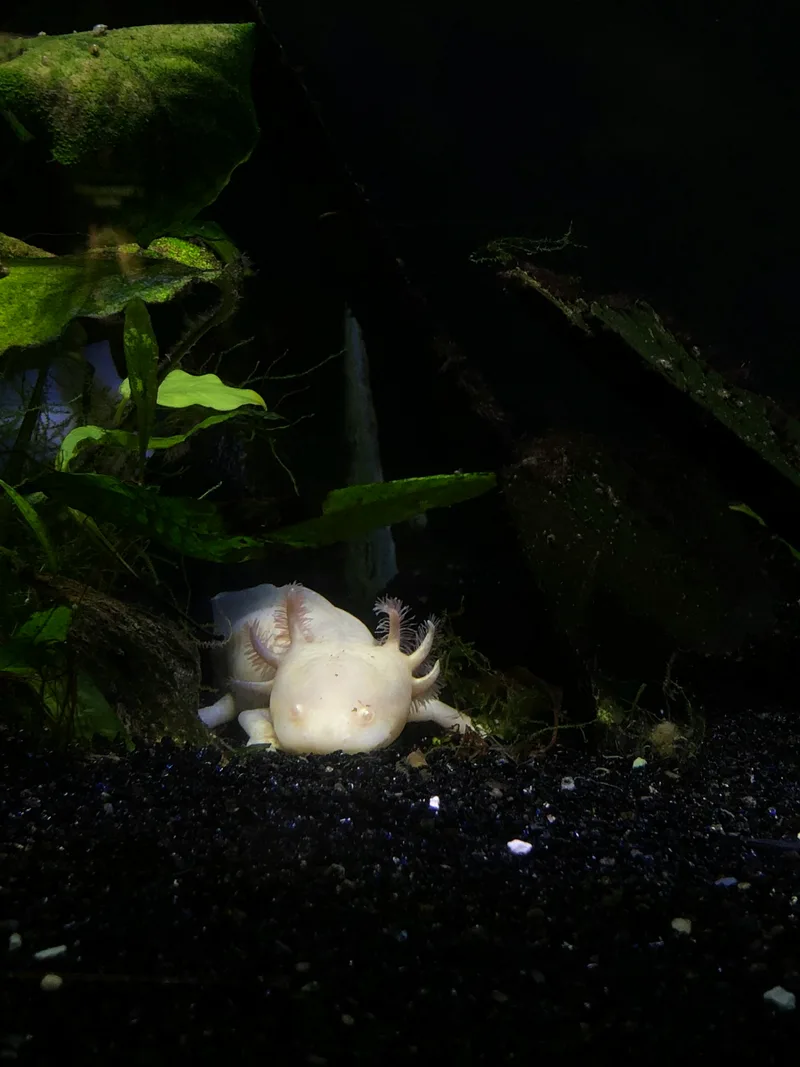
The question has two readings, and the answer flips depending on which one you mean. A single axolotl cannot produce viable young by itself: no parthenogenesis, no self-fertilization, and any eggs an unmated female drops are infertile. An opposite-sex pair sharing a tank, on the other hand, will breed on their own without any human input at all, often before the owner has noticed they're sexually mature. And there is a third case people don't expect: a female who lives alone right now can still lay a fertile clutch, because she stores viable sperm internally for weeks after a long-gone male.
What If My Axolotl Laid Eggs but Lives Alone?
There are three common explanations for a clutch from a female who appears to live by herself, and they are all benign. The first is that she once shared a tank with a male and is using stored sperm. Female axolotls (Ambystoma mexicanum) keep viable sperm inside a structure called the spermatotheca for weeks or even months, and they can fertilize a clutch long after the male is out of the picture. The second is a sexing mistake. Axolotls are commonly sold young, and a tankmate that was labeled female at the store can turn out to be a male once it matures. The third is the most common of all: she is simply dropping unfertilized eggs that were never going to develop.
Telling the three apart is straightforward once you know what to look for. Fertile eggs darken within three to five days as the embryo develops inside the jelly capsule, and you will see a small dark dot that gradually takes shape. Infertile eggs stay clear at first, then turn opaque white or grow a fuzzy coat of fungus as they break down. Neither outcome means anything is wrong with your axolotl. An unmated female laying eggs is not a sign of illness, just of biology running its normal cycle.
A quick checklist for the worried owner:
- Has she ever shared a tank with another axolotl, even briefly? Stored sperm is the most common surprise.
- Within three to five days, do any eggs show a dark spot or visible embryo? That points to fertile eggs from a stored mating.
- Are the eggs clouding up, turning white, or growing fuzz without changing shape? That is normal for unfertilized eggs.
- Is she eating and behaving the way she usually does? If yes, the laying itself is not a health issue.
How Does Axolotl Reproduction Actually Work?
Axolotls use internal fertilization without copulation, which is the single most useful sentence to keep in your head when you are trying to understand what just happened in your tank. The male starts with a courtship dance sometimes called the "hula," where he nudges the female and waves his tail in front of her. He then deposits small jelly cones called spermatophores on the substrate, each one capped with a packet of sperm. The female walks over them and picks the cap up with her cloaca (the single opening at the base of her tail that handles both waste and reproduction). The sperm goes into her spermatotheca, an internal storage organ, and she draws on that store to fertilize each egg as she lays it. The fertilization happens inside her body, but the two animals never actually make contact in the way most people picture mating.
That stored-sperm window is the reason a lone female can produce a fertile clutch long after the male is gone. She is not reproducing on her own in any biological sense. She is finishing a job that was set up earlier.
Did you know? Axolotls share this no-copulation reproductive style with most other salamanders. The spermatophore is essentially a small package of sperm the male leaves on the ground for the female to collect, and it is one of the oldest reproductive strategies in vertebrates. It predates the kind of body-to-body internal fertilization that fish and mammals use.
Do Axolotls Need Help to Breed, or Will They Just Do It?
A sexually mature opposite-sex pair sharing a tank will breed on their own, and many owners do not notice until eggs start appearing on the plants and tank walls one morning. Spawning is triggered by a drop in water temperature combined with longer day length, which is why most accidental clutches in home tanks happen in late winter and early spring. You do not have to do anything to make this happen. You have to actively prevent it if you do not want fry. A single clutch can run from 200 to 1,500 eggs, and a healthy pair will spawn every two to three months under normal home-tank conditions. That is a serious volume of eggs, and breeding back-to-back is hard on the female, who needs that recovery time to rebuild egg mass.
If you keep two axolotls and have not confirmed their sexes, the question is not whether they will breed but when. You have two real options for avoiding it: keep a single-sex pair, or keep them solo. Mixing them and hoping for the best almost always ends in a wall of eggs.
A few things to watch for or check:
- Sexing. Mature males have a noticeably swollen cloaca, the bump at the base of the tail. Females are rounder through the body, especially when carrying eggs.
- Spawn in progress. The hula dance, the male depositing little white cones on the substrate, and eggs appearing on plants and glass within a day or two are the signs.
- Frequency. Every two to three months in a mixed-sex tank is normal under standard conditions.
- Prevention. Single-sex pairs or solo keeping. There is no middle option.
What Should I Do If My Axolotls Spawn Without Me Planning It?
Once eggs are in the tank, you have two paths and only two: remove the eggs, or remove the adults. Leaving fertilized eggs with the parents means the adults will eat them, and leaving any fry that do hatch in the parent tank means the adults will eat the fry too. There is no version where you let nature run its course in the same tank.
The harder question is what to do with the eggs themselves. Most home keepers cannot raise a clutch of several hundred axolotls. The fry need live food (usually brine shrimp or daphnia from the day they start eating), they have to be separated into individual containers fairly early because they will bite each other's gills and limbs off, and they need daily water changes for weeks. That is a serious project for someone with the space and the time. For everyone else, the standard responsible answer is to humanely freeze the surplus eggs before they develop. It feels harsh the first time, but the alternative is hundreds of fry slowly dying in conditions that cannot support them. Intentional axolotl breeding sits at the harder end of freshwater hobby breeding, needing dedicated grow-out space, live food cultures, and weeks of daily attention. A typical axolotl clutch runs to several hundred eggs at once, which is why an unplanned spawn is more decision than triumph for most home keepers.
Axolotls do not reproduce on their own in the lone-animal sense. There is no shortcut around sex for this species. But two axolotls of opposite sexes in the same tank, a slight temperature dip, and a winter night is all it takes. The animal is built for this, has been doing it without any human input for the entire history of its lake, and the only thing missing in a home tank is somebody who knows it is coming.