How long are axolotls pregnant?
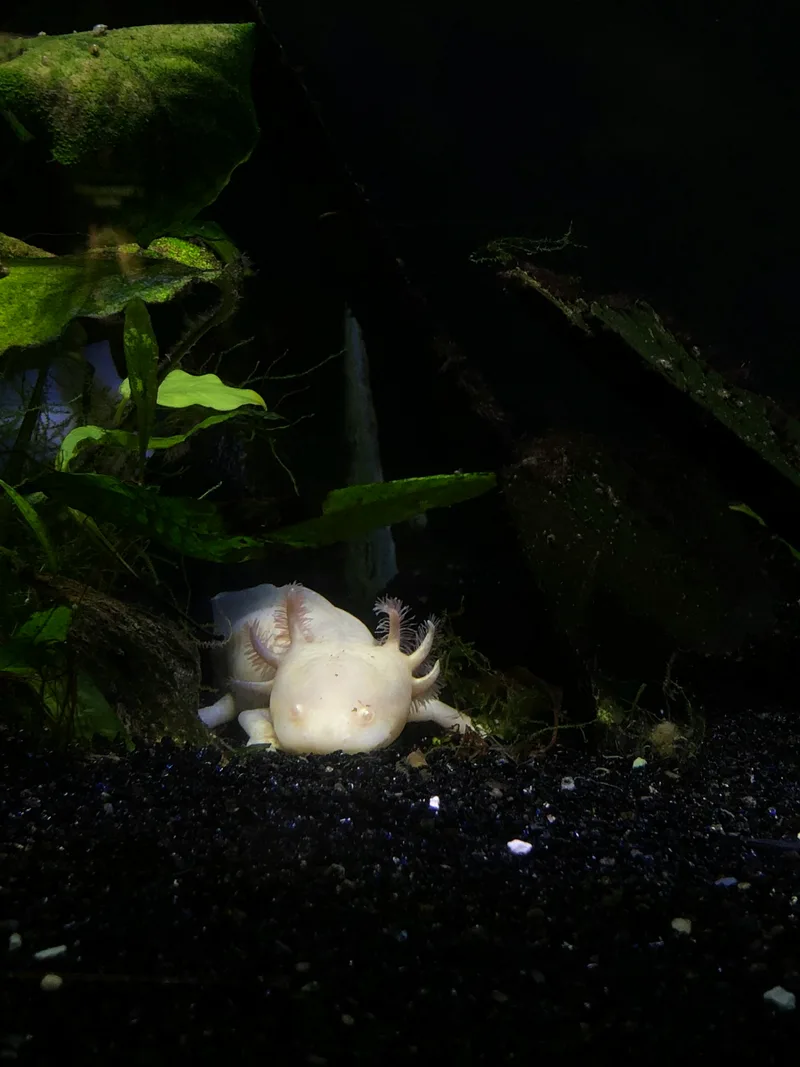
Axolotls don't get pregnant. They're amphibians, and the eggs are fertilized and developed outside the body, so the word for a female full of ripe eggs is "gravid," not pregnant. Once she's picked up a male's sperm packet, she usually drops the whole clutch within 12 to 72 hours. The case that confuses most owners is the one where there's no male in the tank at all, and she still looks suddenly, undeniably round.
What Does "Pregnant" Even Mean for an Axolotl?
The word "pregnant" only fits animals that develop their young inside the body. Mammals do that. Axolotls don't. Like other amphibians, an axolotl (Ambystoma mexicanum) makes eggs internally but lets them develop in the water, and the right hobby term for a female full of mature eggs is gravid.
Gravidity is what you're seeing when a female axolotl looks suddenly round and pale through the lower half of her body. Those small, dark dots you can sometimes catch through her belly wall are mature ova. They are not embryos. They have not started developing yet. They are eggs sitting in the oviducts, ripe and waiting for an exit.
Fertilization, when it happens, happens outside her body too. The eggs only meet sperm as she lays them, one at a time, brushing each one against sperm she has stored internally. The yolks visible through her belly are still unfertilized at that point. So the picture to keep in your head is closer to "ready to lay" than "carrying babies."
Did you know? Axolotl fertilization is external in outcome but internal in mechanism. The male drops a small white packet of sperm called a spermatophore on the tank bottom, and the female walks over it and picks it up with her cloaca (the single opening that handles waste and reproduction in amphibians). She does collect sperm internally, but the eggs are only fertilized at the moment she lays them, one by one.
How Long After Mating Will She Lay?
Once the female has picked up a spermatophore, the clock starts. Most sources put first eggs somewhere between 12 hours and 3 days after pickup. The Indiana University axolotl colony, which has been keeping these animals continuously since 1957, narrows the typical window to 12 to 20 hours, with a small minority of females holding on for two or three days before they start.
Egg-laying itself is slow. A single female sheds anywhere from a few hundred to over a thousand eggs over one to two days, attaching each one individually to plants, decor, or the tank wall with a small dab of jelly. Most of the laying happens at night, which is why owners often wake up to a tank that wasn't full of eggs the evening before.
What this means in practice:
- First eggs typically appear within 12 to 24 hours of spermatophore pickup
- Some females wait 2 to 3 days, which is normal, not a problem to fix
- Once she starts, the full clutch comes out over 1 to 2 days
- Most laying happens overnight, in short bursts
- Eggs go on plants, filter intakes, decor, and the glass, one at a time
If you've watched a successful pickup and 24 hours later the tank is still empty, you're still well inside the normal range. Keep the water cool and clean and let her work.
What If She Looks Gravid but There's No Male?
This is the question behind most "is my axolotl pregnant" searches. A solo female with no male in the tank, suddenly looking fat through the lower belly, and an owner wondering what just happened.
A healthy adult female matures eggs on her own cycle. She doesn't need a male around to do it. She'll fill out, hold the clutch for roughly a month, and then either drop the eggs unfertilized (often onto plants, just like a fertilized clutch, only nothing hatches) or quietly reabsorb them back into her body. Reabsorption is normal. It's how the body recycles a clutch she didn't get to use.
Gravidity itself is not a medical event. The thing worth doing is telling it apart from problems that look similar at a glance:
- Gravid: smooth, even fullness through the lower body on both sides. She still moves, still eats, still uses her gills normally. You may see eggs as small dots through the lower belly wall.
- Bloated or impacted: uneven swelling, often more on one side or higher up. She may sit unusually still, refuse food for several days, or float at the surface unable to settle. Gills may look red or curled forward.
If she's eating, moving, and breathing normally, and the fullness is symmetric, the most likely answer is gravidity and the most useful thing to do is leave her alone. Knowing the solo-female reproductive case saves a lot of unnecessary panic at the pet store and the vet.
How Long Until the Eggs Actually Hatch?
Once the eggs are out and stuck to the plants, the second clock starts, and this one runs on temperature. At a typical axolotl room temperature of around 20°C (68°F), eggs hatch in roughly 2 to 3 weeks. Push the water warmer (the safe ceiling is 25°C / 77°F) and they can hatch in under 14 days. Drop it cooler and you can be waiting 20 days or more.
Fertilized eggs darken and you can watch the embryo curl up inside the jelly capsule over the first week. Unfertilized eggs stay pale, eventually go cloudy, and grow fungus. Pulling the cloudy ones out as they appear keeps the fungus from spreading to the good eggs.
One female in good shape can lay several hundred to over a thousand eggs in a single night, which is its own planning problem when most of them are fertile and you have a 20-gallon tank.
Most of the time, though, this question gets asked by someone watching their axolotl get suddenly round and worrying that something has gone wrong. It almost certainly hasn't. Gravidity is a routine part of being a healthy adult female. Eggs go in, eggs come out, and the body handles it whether or not a male is involved. The timeline is short enough that the only thing you really have to do is keep the water cool and clean and let her get on with it.