What do baby axolotls eat?
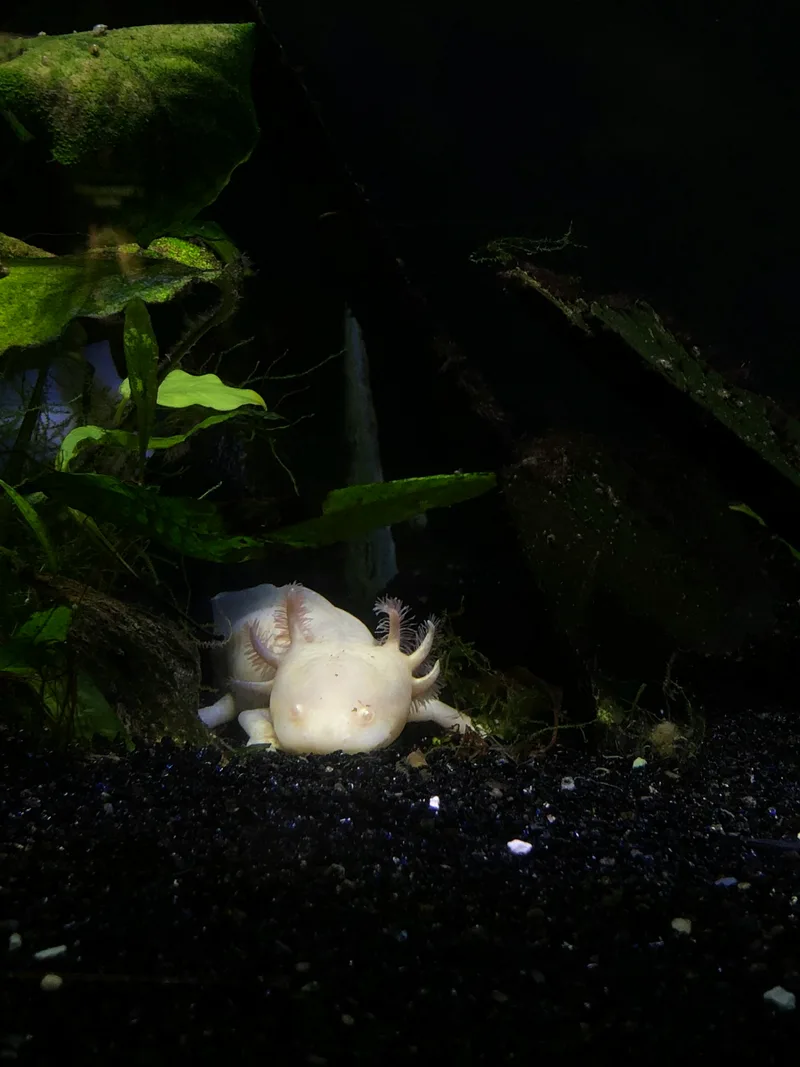
Baby axolotls eat live food only at first: baby brine shrimp, microworms, or daphnia. A hatchling won't touch food that doesn't move, even when it's the same food it would happily eat alive. What works changes as it grows, and the moment that trips most owners up isn't the first feeding but the switch from live to frozen food a few weeks in, when a baby that was eating fine suddenly stops. That stall is the part worth getting right.
What Can I Feed a Baby Axolotl by Size?
Match the food to the size of the axolotl in front of you, not its age. Two babies hatched the same day can grow at very different rates, so size and development tell you far more about what it can eat than a number of weeks.
A hatchling under about 2 cm takes live food only. The standard options are baby brine shrimp, microworms, and daphnia: tiny, alive, and moving. As the front legs come in and it grows past 2 cm, it can handle live blackworms, and you can begin offering chopped frozen bloodworms. Once it reaches a couple of inches as a juvenile, it moves onto bigger pieces, small chunks of earthworm and sinking food made for its size.
The single rule that holds across every stage: nothing wider than the head. An axolotl swallows prey whole by sucking it in, so a piece bigger than its head either gets ignored or, worse, swallowed and brings on choking or gut trouble.
| Size / stage | Best foods | Live only? |
|---|---|---|
| Hatchling, under ~2 cm | Baby brine shrimp, microworms, daphnia | Yes |
| Small juvenile, front legs developing | Live blackworms, then chopped frozen bloodworms introduced | Mostly, transitioning |
| Larger juvenile, 2–5 in (5–13 cm) | Frozen bloodworms, small earthworm pieces, sinking food | No |
How Often Should I Feed a Baby Axolotl?
Babies eat far more often than adults. A hatchling or small juvenile needs feeding once or twice a day, and many keepers simply leave daphnia or baby brine shrimp in the container so there's always something alive to snap at. As the axolotl grows, you can taper toward once a day.
The catch is cleanup. Babies live in small tubs that foul fast, and uneaten live food dies and rots in hours. Pull out anything not eaten, and stay on top of water changes. At this size, clean water matters as much as the food itself. A baby axolotl in fouled water will go off its food no matter how good the meal is, so daily water changes on a small container are normal, not excessive.
Why Won't My Baby Axolotl Eat?
A baby that won't eat is almost always running into one of a few specific problems, and each has a fix.
- The food isn't alive or moving. This is the big one for hatchlings. They strike at movement, full stop. Switch to live baby brine shrimp or daphnia and the problem usually disappears on the spot.
- The piece is too big. Anything wider than the head won't go down. Chop it smaller and try again.
- The water is too warm or fouled. Warm or dirty water suppresses appetite. Get the temperature down into the low 60s°F (around 16–18°C) and do a water change.
- It's mid-transition to frozen food. A baby that ate fine on live food can stall when you first offer still bloodworm, because it doesn't read the motionless piece as food yet. Skewer a small piece of bloodworm on a pipette or a feeding tool and wiggle it right in front of the axolotl. The movement reads as prey, and that's usually what gets the first frozen meal taken.
If your baby was eating and then stopped right as you introduced frozen food, you've found the most common stall point. It isn't sick or being difficult. It just hasn't learned to recognize food that holds still.
When Do Baby Axolotls Start Eating Adult Food?
Once a juvenile is reliably taking frozen bloodworms and has reached a few inches long, it's ready to graduate. At that point it can move onto the staple adult menu of earthworms or nightcrawlers, chopped to size, along with sinking food made for axolotls. Getting it onto a steady adult diet of earthworms and quality sinking food is the last step out of the fiddly baby phase, and it's a relief once you're there.
Why Do Baby Axolotls Need Live Food at All?
The live-food rule isn't a preference, it's wired into how a hatchling finds a meal. A newly hatched axolotl barely smells anything yet; its sense of smell develops later. What it has from the start is a feeding response triggered by movement. A small thing twitching nearby reads as prey, and the axolotl strikes. A motionless piece of the exact same food, sitting on the bottom, registers as nothing at all. That's why still food gets ignored until the animal grows into a fuller set of senses, and why the live-to-frozen switch is really a matter of waiting for the axolotl to catch up rather than forcing the issue.
Did you know? Axolotls don't bite their food, they vacuum it. The mouth snaps open in a fraction of a second and pulls in a pocket of water with the prey inside. For a hatchling locked onto movement, a wiggling speck of brine shrimp is exactly the trigger that sets off that suction strike.
So a baby that ignores still food isn't sick or stubborn. It's doing exactly what its body is built to do. The job isn't to force it to eat, but to keep offering live food, or food you've made convincing by wiggling it, and let the switch arrive on its own. Patience and a moving pipette do the work, not panic.