Can goldfish see you?
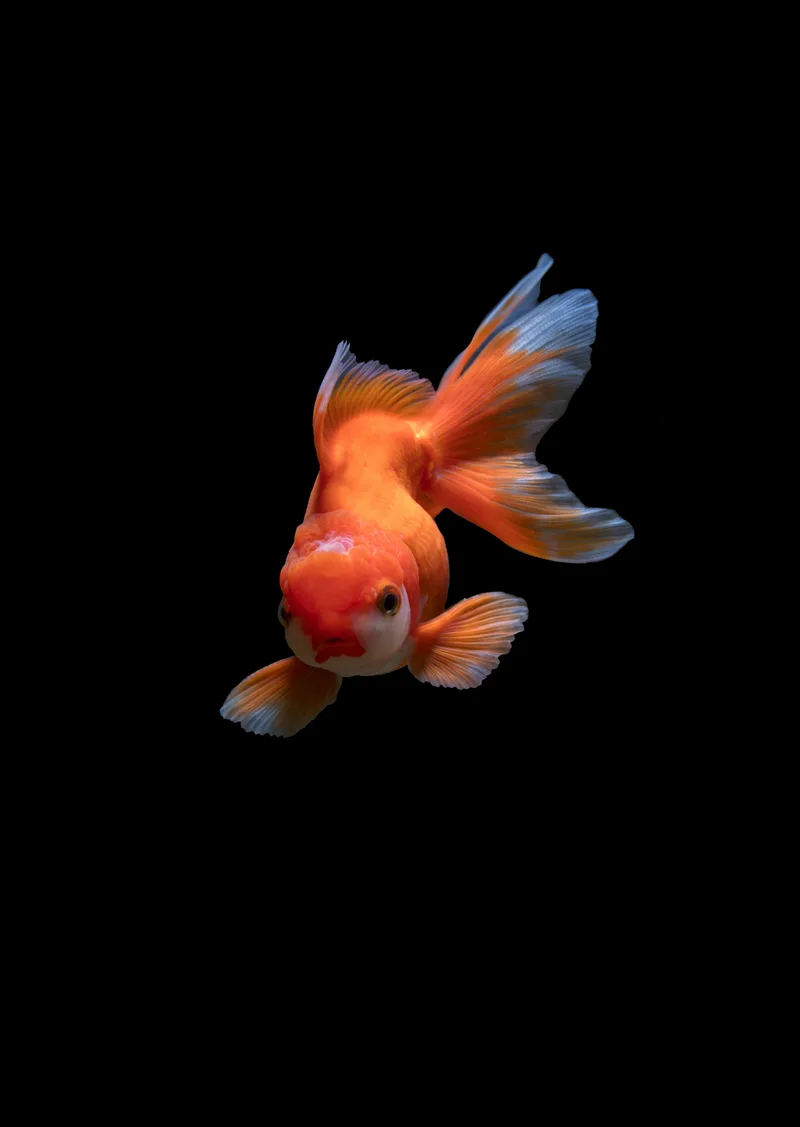
Yes, and in some ways it sees you better than you see it. A goldfish (Carassius auratus) is a tetrachromat with a near 360-degree field of view, so the fish at the front glass is picking up a wide-angle, four-color version of you that includes ultraviolet patterns your own eyes can't register. What it doesn't get is a sharp, detailed face. When your goldfish stares at you across the room, it's reading you the way you'd read a person from the corner of your eye: shape, color, and movement, learned over time and matched against the silhouette that usually brings food.
Why Is My Goldfish Staring at Me?
The goldfish hovering at the front glass when you walk in is almost always doing one thing: watching for food. Your shape above the tank has been paired with food dropping into the water enough times that the fish now reads "human silhouette above the glass" as a reliable signal, and it waits there to see if today is one of those times. This is learned behavior, and it happens faster than most new owners expect. A goldfish can pick up the association in under a week.
It is not the only thing going on at the glass, though. Goldfish are visually curious and will track motion near the tank because it is motion. If you wave a finger across the outside of the glass, a healthy goldfish will often follow it, not because it thinks your finger is food but because moving things are interesting when most of your world is still. A fish that tracks you calmly across the room is comfortable. A fish that darts into a decoration when you walk past is startled by sudden movement, which is a reflex rather than a specific fear of you. Both are normal.
Here are the common things you might be seeing, and what they usually mean:
- Hovering at the front glass when you walk in. The food association. Strongest in tanks where feeding happens at predictable times.
- Following your hand across the glass. Motion tracking and curiosity, not hunger. You can test this by moving a non-food object.
- Darting away when you move suddenly. A startle reflex triggered by fast movement in the peripheral field of view. Not a judgment on you personally.
- Rising to the surface when you approach the tank. Anticipating feeding, same mechanism as the glass-hovering but with more confidence.
- Flaring its gills and staring at the front glass while you're standing there. This one is usually not about you at all. The goldfish is seeing its own reflection in the glass and reacting to what looks like another fish in its space.
None of this tells you what the goldfish is feeling. It tells you what the goldfish has learned, which is a different and more reliable thing to go on.
Did you know? Goldfish can see ultraviolet light, a range that is completely invisible to humans. In the wild this is useful because UV reflections help them spot food particles and other fish against a murky green-water background. To a goldfish, a spotless aquarium viewed through clean glass is a visually unusual environment. The world it evolved to read is a lot dimmer and greener than the one it lives in with you.
What Does a Goldfish Actually See When It Looks at You?
A goldfish's eyes sit on the sides of its head, which gives it an almost 360-degree field of view but very little overlap between the two eyes. That tradeoff matters. It means the fish sees almost everything around it at once, but it has poor depth perception and poor binocular sharpness. So when your goldfish is looking at you, what it is picking up is a large moving shape with distinct coloring and a recognizable outline, not a detailed face the way a dog would see you. Think of the difference between a photograph and the blurry wide-angle peripheral view you get out of the corner of your own eye. The goldfish lives in that second version full time.
Color is where it gets interesting. Humans are trichromats, meaning we see the world through three types of color receptor. Goldfish are tetrachromats: they have four, and the fourth one extends into the ultraviolet range. Your shirt almost certainly looks different to your goldfish than it does to you, and some patterns that read as solid to human eyes have UV detail the fish can see plainly. You are probably more colorful to your goldfish than you are to yourself.
The water-to-air boundary is less of a problem than it sounds. A fish eye is built for focusing underwater, where the cornea does almost none of the bending and the lens does nearly all of it. That same optical setup handles light arriving from the air fine, because the geometry still works once the light has entered the water of the tank. Refraction at the surface does shift and distort the image at shallow angles, but the goldfish's brain is adjusting for that distortion the same way your brain ignores the blind spot in each of your own eyes. It is simply part of how the fish sees.
The exception to all of this is the fancy varieties bred for dramatic eye shape. Bubble-eye goldfish, telescope-eye, and celestial goldfish have had their vision selectively bred into positions and forms that reduce visual acuity significantly. A celestial goldfish has eyes that point permanently upward, so it cannot see directly forward at all. These fish compensate with a stronger reliance on smell and on the lateral line, the row of pressure-sensitive cells along the flanks that reads water movement. If you keep one of these varieties, your fish may be responding to you through a different set of senses than a common or comet goldfish would. It is still noticing you. It is not using its eyes to do most of the work, though.
Can Goldfish Recognize You Specifically, or Just 'A Person'?
Your goldfish probably does treat you differently from a stranger, and there is a real body of research pointing to why. The often-cited archerfish study from Oxford trained fish to distinguish between photographs of human faces and found they could do it with around 81% accuracy, rising to 86% when the faces were standardized for color and head shape. Goldfish specifically have been shown in behavioral studies to learn and remember individual people in their environment for months at a stretch. The three-second-memory thing is a myth, and it has been for decades. Goldfish remember plenty.
What the research does not quite say is that your goldfish is recognizing your face the way a dog does. The more honest description is that it has learned a combined cue: your silhouette, the way you move, the colors you usually wear, the time of day you usually appear near the tank, and the sound of you approaching. All of that together means "the person who brings food," and a stranger walking into the room will not match enough of those cues to trigger the same response. This is still recognition in every functional sense that matters. It just works through a bundle of signals rather than a single facial signature.
A goldfish that learns to tell its regular keeper apart from a visiting stranger is doing so with weeks of accumulated observation, not a flash of facial recognition. And the stubborn idea that goldfish only remember things for fifteen seconds comes from a misreading of old aquarium-trade marketing, not from any study that ever tested memory in a goldfish.
Can Goldfish Hear You Too?
Yes, and better than you would expect from looking at them. Goldfish have something called a Weberian apparatus, a small chain of modified vertebrae that physically couples the swim bladder to the inner ear. The swim bladder acts as an amplifier for underwater pressure waves, and those bones pass the vibrations along to the hearing organ. The result is a fish with surprisingly good hearing across a useful range of frequencies, including the range of human speech. Voices carry through the glass, footsteps carry through the floor and the tank stand, and the fish is picking up more of the room than its quiet life suggests. Goldfish pick up human voices through the glass as low-frequency pressure waves rather than as the articulated sounds you hear, so your fish is registering that you are speaking without making anything of the specific words.
So the goldfish at the front glass, watching you move around the living room, is seeing you in wide-angle color with a UV channel you do not have, hearing your voice through the water, and filing all of that away against a catalog of cues it has been building since the day you brought it home. The aquarium is not just something you look into. It is also a room the fish is looking out of, and you are part of the view.