Why can't we touch axolotls?
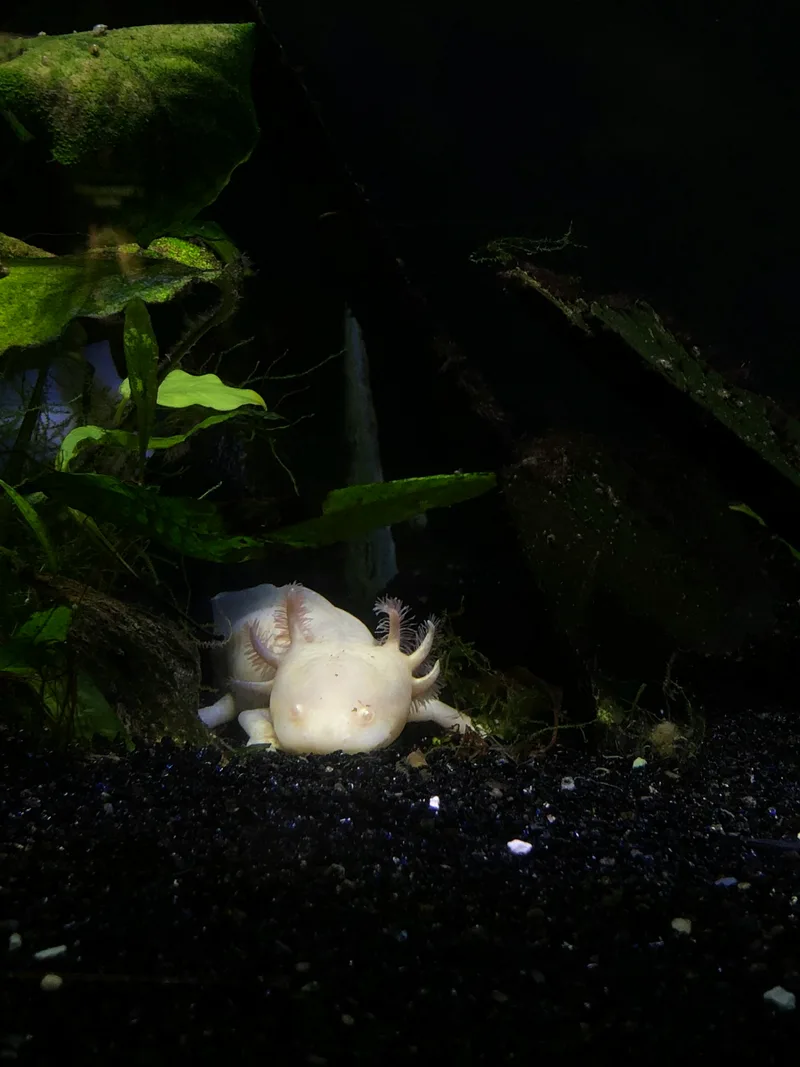
You can briefly and gently touch an axolotl (Ambystoma mexicanum) in the water with clean, wet hands, but you shouldn't make a habit of it, and you shouldn't lift one out to hold or stroke like a pet. What looks like a skin is doing the work a fish spreads across three separate body parts: it breathes, it manages the salts crossing it, and it carries the only barrier the animal has against infection. A fish has gills, scales, and a slime layer to split that load. An axolotl has one sheet of tissue, with no scales over it, and bare fingers wipe its protective coat away on contact. The whole rule comes down to what that skin is quietly doing under your fingertip.
So Are You Ever Allowed to Touch One?
Yes, within narrow limits. A quick, gentle touch underwater with freshly washed, wet hands generally won't harm a calm axolotl. What you want to avoid is the everyday version of "interacting" with a pet: petting, stroking, scooping it up to hold in your hands, and handling it just because it's there. A single careful contact doesn't do the damage. Repetition does, and so does taking the animal out of the water.
You'll see people online insist their axolotl "likes" being petted, and you'll see the opposite warning that you should never touch one at all. Both are reading the same behavior wrong. An axolotl that swims toward your hand or settles into your open palm isn't seeking affection. It's curious, or it associates your hand with food. Axolotls are ambush feeders that respond to movement near them, so a hand in the tank reads as something worth investigating, not someone to bond with. Tolerating contact and benefiting from it are two different things, and only the first one is happening.
There are real situations where you do have to make contact: moving an axolotl to a new tank, checking it over for an injury, or "tubbing" it (keeping it in a container of treated water during a health issue). When you can, move the animal in water rather than in air. Learn what stress looks like before you reach in, so you can stop the moment you see a stressed axolotl curling its gills forward or thrashing.
For the times you genuinely need to make contact:
- Wash your hands first and rinse off every trace of soap, lotion, and hand sanitizer. Residue you can't feel is still on your skin.
- Wet your hands before you touch the animal. Dry skin wicks away more of the slime coat.
- Support the whole body in your palm instead of stroking or pinching any part of it.
- Keep it brief, and keep it in the water whenever the task allows.
- Never chase or grab. A panicked dash into the glass does more damage than the handling itself.
- Move them with a soft container or a fine net rather than lifting them by hand.
What If You've Already Touched Your Axolotl?
If you've already picked yours up, or it nibbled your finger, or it sat in your palm for a minute, it's almost certainly fine. The harm people warn about doesn't come from a single careful touch. It comes from repeated handling, from dry or chemical-coated hands, or from lifting an axolotl out of the water and dropping or squeezing it. A one-off gentle contact lands well inside the safe range.
What's worth doing now is watching, not worrying. Over the next several days, keep an eye on the spots where damage would show up first:
- The slime coat. A healthy axolotl has a faint, even sheen across its skin. Patchy, faded, or sloughing areas are the early sign that the coat took a hit.
- The skin itself. Reddened patches, raw spots, or fuzzy white or gray growths can mean bacteria or fungus has gotten a foothold where the barrier thinned.
- The gills. Those feathery branches should sit relaxed and full. Gills clamped tight against the head or curled forward are a stress signal.
- Appetite and hiding. An axolotl that suddenly refuses food or wedges itself out of sight for days is telling you something is off.
Most of the time, none of this appears and you can let it go. The line to watch is whether anything gets worse rather than better. A faint sheen that evens out over a day or two is the skin doing its job. Spreading redness, growing fuzz, or a fish that stops eating crosses from "keep an eye on it" into a real problem, and at that point you'll want to check the animal over for the broader signs of a sick axolotl and treat what you find.
Why Is Axolotl Skin So Much More Fragile Than a Fish's?
A fish splits the work of staying alive across several body parts. Gills pull oxygen from the water, scales armor the body, and a slime layer fends off infection. An axolotl folds almost all of that into one organ. Its skin breathes, taking in oxygen straight through the surface. It helps manage the salts and water moving across it, keeping the animal's internal balance steady. And it's coated in a living layer of mucus, the slime coat, which is the main barrier holding back bacteria and fungus. One sheet of tissue is doing three jobs at once.
That skin has none of a fish's backup protection. There are no scales, so there's no armor between the outside world and the soft tissue underneath. And under that tissue, an axolotl's skeleton is largely cartilage rather than bone, the same flexible, rubbery material your ears and nose are made of. A grip that a scaled, bony fish would shrug off can bruise or injure an axolotl's soft structure.
Now put a bare hand on it. Dry fingers wipe away patches of the mucus barrier the moment they make contact. The oils, soap, and lotion on your skin press directly against tissue that is built to absorb whatever touches it, because absorbing things is part of how that skin works. The damage doesn't wait for the animal to react. The tissue is in chemical contact with your hand before the axolotl does anything at all, which is exactly how a touch that looks completely harmless can thin the slime coat and open a door for infection.
Did you know? The same permeable, never-quite-grown-up skin that makes axolotls so easy to harm by touch is part of what makes them famous healers. Their tissue stays locked in a larval-like state for their whole lives, and that's a big reason they can regrow entire limbs, and even parts of organs, that almost no other animal can replace.
That regenerative trick is why so many owners wonder whether damaged gills will grow back too, and the answer connects directly to the same biology that makes the skin so easy to harm in the first place.
Is the Risk to the Axolotl, or to You?
Mostly the risk runs from you to the animal. The oils, soaps, lotions, and bacteria on your hands meet skin that soaks up whatever it touches, and your warm hands meet an animal whose body is tuned for cold water, so even a careful hold is a small thermal shock on top of the chemical one. That direction is where almost all the real harm lives.
But it runs the other way too, in a smaller way you shouldn't ignore. Like other amphibians and aquatic pets, axolotls and the water they live in can carry bacteria such as salmonella. You won't catch it from looking at the tank, but you can pick it up from contact and then from touching your face or food before washing. So the advice to wash your hands thoroughly is genuinely two-directional: before you reach in, you're protecting the axolotl from what's on your skin, and after, you're protecting yourself from what's in the tank. The list of things you can actually catch from an axolotl is short and not alarming, with sensible handwashing covering nearly all of it.
None of this should worry you. It's the same hand-washing you'd do around any pet, scaled up slightly because this one breathes through its skin. And that's really the whole answer to why you don't touch axolotls. It was never that they're fussily fragile. It's that you're keeping an animal whose skin never stopped being the multi-tool a fish's body spreads across gills, scales, and slime. Leaving it mostly alone isn't a restriction. It's the small trade you make for living alongside something this strange, and this good at staying young.